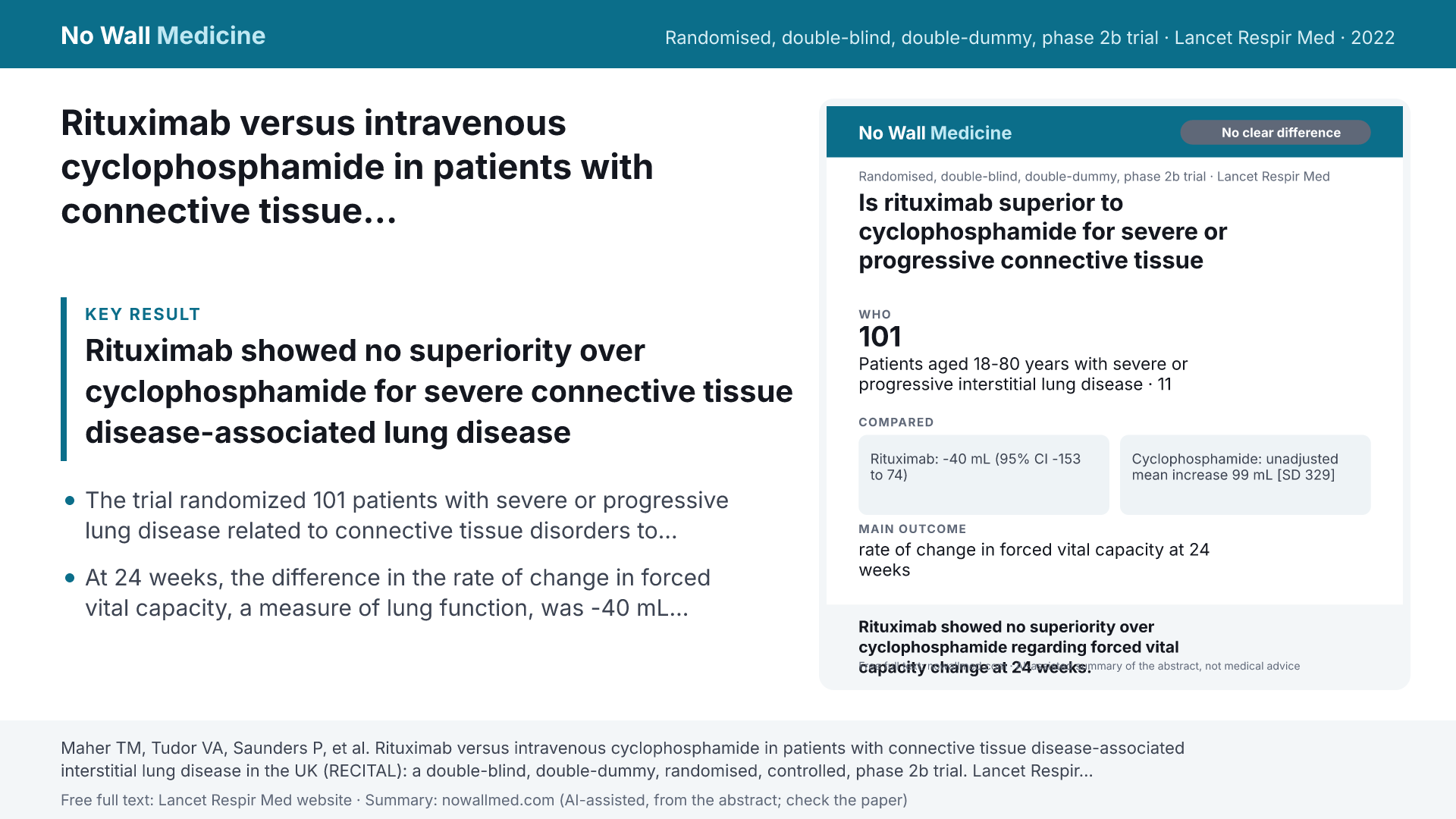
Rituximab showed no superiority over cyclophosphamide for severe connective tissue disease-associated lung disease
Rituximab versus intravenous cyclophosphamide in patients with connective tissue disease-associated interstitial lung disease in the UK (RECITAL): a double-blind, double-dummy, randomised, controlled, phase 2b trial
Randomised, double-blind, double-dummy, phase 2b trialNo clear difference
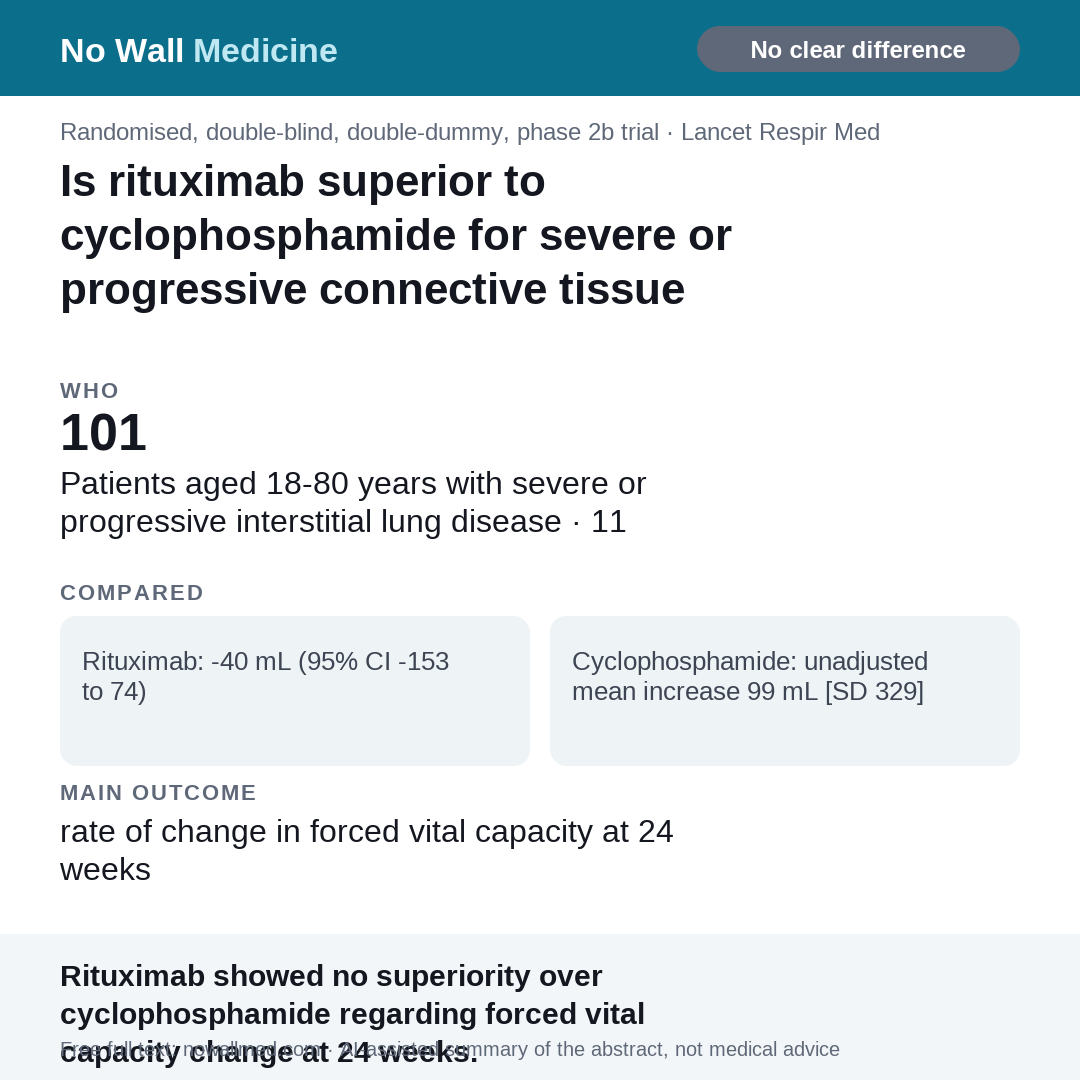
Is rituximab superior to cyclophosphamide for severe or progressive connective tissue disease-associated interstitial lung disease?
Who
101
Patients aged 18-80 years with severe or progressive interstitial lung disease · 11 specialist centres in the United Kingdom
Compared
Rituximab: -40 mL (95% CI -153 to 74)
Cyclophosphamide: unadjusted mean increase 99 mL [SD 329]
Main outcome
rate of change in forced vital capacity at 24 weeks
Result: -40 mL (95% CI -153 to 74)
Bottom line: Rituximab showed no superiority over cyclophosphamide regarding forced vital capacity change at 24 weeks.
Lancet Respir Med · 2022-11-11Download image
Clinical question: Is rituximab superior to cyclophosphamide for severe or progressive connective tissue disease-associated interstitial lung disease?
Why it matters: It was unknown whether rituximab is superior to cyclophosphamide for treating severe or progressive interstitial lung disease associated with connective tissue disease.
Key points
- The trial randomized 101 patients with severe or progressive lung disease related to connective tissue disorders to receive either rituximab or cyclophosphamide.
- At 24 weeks, the difference in the rate of change in forced vital capacity, a measure of lung function, was -40 mL between the rituximab and cyclophosphamide groups (p=0.49).
- While both groups showed improvements in lung function, no significant differences were found in secondary endpoints except for physician-assessed global disease activity at 48 weeks.
Headline and key points written with AI from the paper’s abstract, with every number checked against it. Read the paper before relying on them.
Was this summary helpful?
Abstract
Background
Rituximab is often used as rescue therapy in interstitial lung disease (ILD) associated with connective tissue disease (CTD), but has not been studied in clinical trials. This study aimed to assess whether rituximab is superior to cyclophosphamide as a treatment for severe or progressive CTD associated ILD. Methods
We conducted a randomised, double-blind, double-dummy, phase 2b trial to assess the superiority of rituximab compared with cyclophosphamide. Patients aged 18-80 years with severe or progressive ILD related to scleroderma, idiopathic inflammatory myositis, or mixed CTD, recruited across 11 specialist ILD or rheumatology centres in the UK, were randomly assigned (1:1) to receive rituximab (1000 mg at weeks 0 and 2 intravenously) or cyclophosphamide (600 mg/m2 body surface area every 4 weeks intravenously for six doses). The primary endpoint was rate of change in forced vital capacity (FVC) at 24 weeks compared with baseline, analysed using a mixed-effects model with random intercepts, adjusted for baseline FVC and CTD type. Prespecified secondary endpoints reported in this Article were change in FVC at 48 weeks versus baseline; changes from baseline in 6 min walk distance, diffusing capacity of the lung for carbon monoxide (DLCO), physician-assessed global disease activity (GDA) score, and quality-of-life scores on the St George's Respiratory Questionnaire (SGRQ), King's Brief Interstitial Lung Disease (KBILD) questionnaire, and European Quality of Life Five-Dimension (EQ-5D) questionnaire at 24 and 48 weeks; overall survival, progression-free survival, and time to treatment failure; and corticosteroid use. All endpoints were analysed in the modified intention-to-treat population, which comprised all patients who received at least one dose of study drug. This trial is registered with ClinicalTrials.gov (NCT01862926). Findings
Between Dec 1, 2014, and March 31, 2020, we screened 145 participants, of whom 101 participants were randomly allocated: 50 (50%) to receive cyclophosphamide and 51 (50%) to receive rituximab. 48 (96%) participants in the cyclophosphamide group and 49 (96%) in the rituximab group received at least one dose of treatment and were included in analyses; 43 (86%) participants in the cyclophosphamide group and 42 (82%) participants in the rituximab group completed 24 weeks of treatment and follow-up. At 24 weeks, FVC was improved from baseline in both the cyclophosphamide group (unadjusted mean increase 99 mL [SD 329]) and the rituximab group (97 mL [234]); in the adjusted mixed-effects model, the difference in the primary endpoint at 24 weeks was -40 mL (95% CI -153 to 74; p=0·49) between the rituximab group and the cyclophosphamide group. KBILD quality-of-life scores were improved at 24 weeks by a mean 9·4 points (SD 20·8) in the cyclophosphamide group and 8·8 points (17·0) in the rituximab group. No significant differences in secondary endpoints were identified between the treatment groups, with the exception of change in GDA score at week 48, which favoured cyclophosphamide (difference 0·90 [95% CI 0·11 to 1·68]). Improvements in lung function and respiratory-related quality-of-life measures were observed in both treatment groups. Lower corticosteroid exposure over 48 weeks of follow-up was recorded in the rituximab group. Two (4%) of 48 participants who received cyclophosphamide and three (6%) of 49 who received rituximab died during the study, all due to complications of CTD or ILD. Overall survival, progression-free survival, and time to treatment failure did not significantly differ between the two groups. All participants reported at least one adverse event during the study. Numerically fewer adverse events were reported by participants receiving rituximab (445 events) than those receiving cyclophosphamide (646 events). Gastrointestinal and respiratory disorders were the most commonly reported adverse events in both groups. There were 62 serious adverse events of which 33 occurred in the cyclophosphamide group and 29 in the rituximab group. Interpretation
Rituximab was not superior to cyclophosphamide to treat patients with CTD-ILD, although participants in both treatment groups had increased FVC at 24 weeks, in addition to clinically important improvements in patient-reported quality of life. Rituximab was associated with fewer adverse events. Rituximab should be considered as a therapeutic alternative to cyclophosphamide in individuals with CTD-ILD requiring intravenous therapy. Funding
Efficacy and Mechanism Evaluation Programme (Medical Research Council and National Institute for Health Research, UK).
Abstract reproduced under the article’s CC BY licence.
Subject terms
Cite this article
Maher TM, Tudor VA, Saunders P, Gibbons MA, Fletcher SV, Denton CP. Rituximab versus intravenous cyclophosphamide in patients with connective tissue disease-associated interstitial lung disease in the UK (RECITAL): a double-blind, double-dummy, randomised, controlled, phase 2b trial. Lancet Respir Med. 2022. doi:10.1016/S2213-2600(22)00359-9
Spotted a mistake? Suggest a correction
Top studies every Monday
The week’s key trials and guidelines in your specialties, plus any topics you follow. By email, free.
Get the weekly digest