Rivaroxaban compared with low-dose aspirin in individuals with type 2 diabetes and high cardiovascular risk: a randomised trial to assess effects on endothelial function, platelet activation and vascular biomarkers
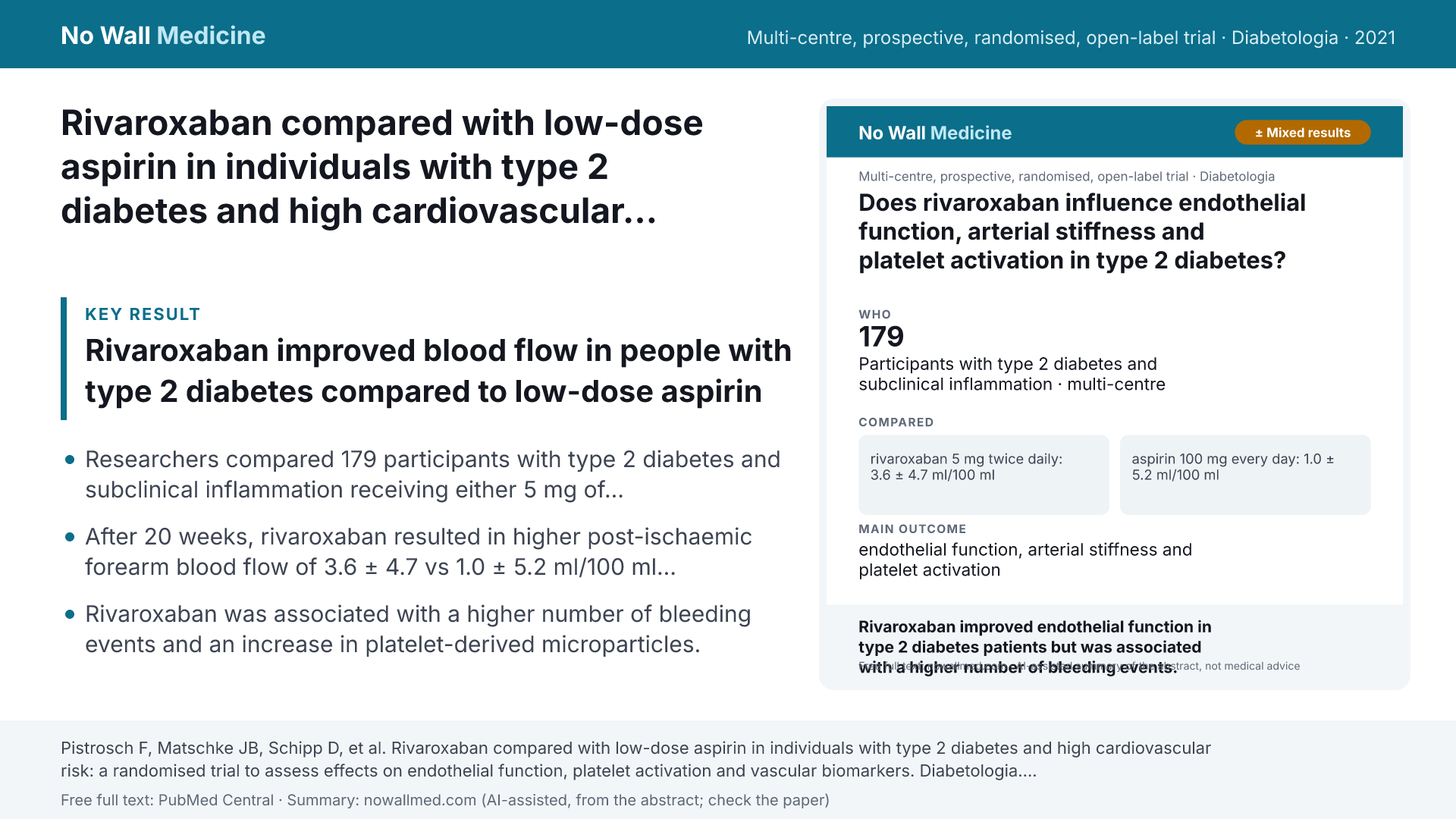
Key result: Rivaroxaban improved blood flow in people with type 2 diabetes compared to low-dose aspirin
Multi-centre, prospective, randomised, open-label trialMixed results
Does rivaroxaban influence endothelial function, arterial stiffness and platelet activation in type 2 diabetes?
Who
179
Participants with type 2 diabetes and subclinical inflammation · multi-centre
Compared
rivaroxaban 5 mg twice daily: 3.6 ± 4.7 ml/100 ml
aspirin 100 mg every day: 1.0 ± 5.2 ml/100 ml
Main outcome
endothelial function, arterial stiffness and platelet activation
Bottom line: Rivaroxaban improved endothelial function in type 2 diabetes patients but was associated with a higher number of bleeding events.
Diabetologia · 2021-09-08 · Funded by Bayer Vital AG, Germany
Key points
- Researchers compared 179 participants with type 2 diabetes and subclinical inflammation receiving either 5 mg of rivaroxaban twice daily or 100 mg of aspirin daily.
- After 20 weeks, rivaroxaban resulted in higher post-ischaemic forearm blood flow of 3.6 ± 4.7 vs 1.0 ± 5.2 ml/100 ml compared to aspirin.
- Rivaroxaban was associated with a higher number of bleeding events and an increase in platelet-derived microparticles.
Discussion prompts
- Would these patients look like yours? Who was left out?
- Is the main outcome one that matters to patients?
- Is the difference large enough to change what you do?
Cite: Pistrosch F, Matschke JB, Schipp D, et al. Rivaroxaban compared with low-dose aspirin in individuals with type 2 diabetes and high cardiovascular risk: a randomised trial to assess effects on endothelial function, platelet activation and vascular biomarkers. Diabetologia. 2021;64(12):2701-2712. doi:10.1007/s00125-021-05562-9
Free full text: PubMed Central · Summary and visual abstract: nowallmed.com/a/rivaroxaban-compared-with-low-dose-aspirin-in-individuals-with-type-2-7q6z17/ (AI-assisted from the abstract; check the paper before relying on it).