Rivaroxaban was associated with fewer severe ischemic events after lower extremity revascularization procedures
Rivaroxaban in Peripheral Artery Disease After Revascularization: Worst Events and Net Outcomes in VOYAGER PAD
Randomized trialBenefit found
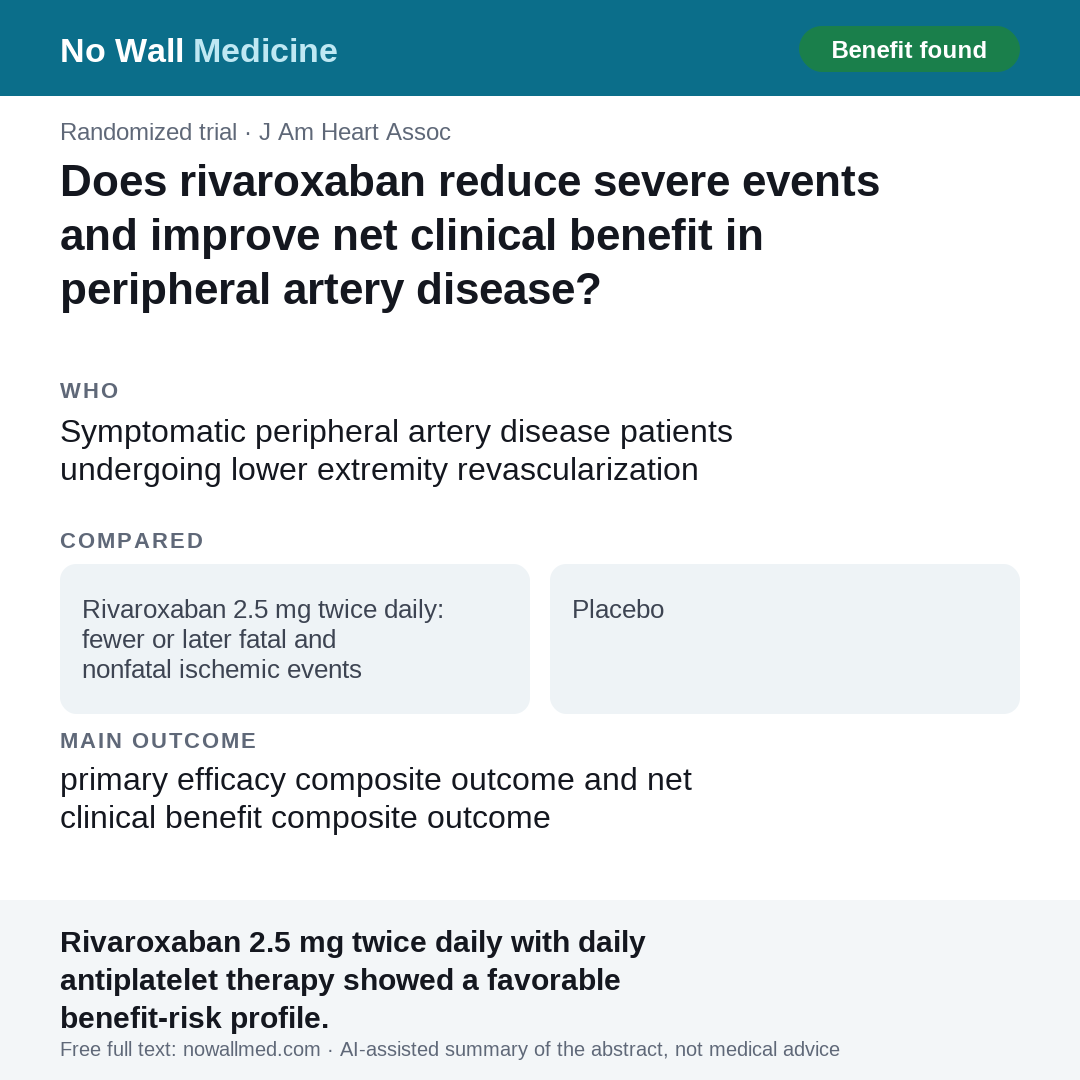
Does rivaroxaban reduce severe events and improve net clinical benefit in peripheral artery disease?
Who
Symptomatic peripheral artery disease patients undergoing lower extremity revascularization procedures
Compared
Rivaroxaban 2.5 mg twice daily: fewer or later fatal and nonfatal ischemic events
Placebo
Main outcome
primary efficacy composite outcome and net clinical benefit composite outcome
Result: win ratio 1.16 (95% CI 1.03-1.30)
Bottom line: Rivaroxaban 2.5 mg twice daily with daily antiplatelet therapy showed a favorable benefit-risk profile.
J Am Heart Assoc · 2025-10-23Download image
Clinical question: Does rivaroxaban reduce severe events and improve net clinical benefit in peripheral artery disease?
Why it matters: Researchers wanted to determine if rivaroxaban decreased the most severe ischemic events and to compare the balance of harm and benefit.
Key points
- Researchers analyzed patients with symptomatic peripheral artery disease, a condition of narrowed arteries, who underwent procedures to restore blood flow to the legs.
- The win ratio method showed fewer or later fatal and nonfatal ischemic events, which are events caused by reduced blood flow, in the rivaroxaban group (win ratio, 1.16 [95% CI, 1.03-1.30]; P=0.0167).
- A net clinical benefit analysis, which combines both efficacy and safety outcomes, showed an overall beneficial effect for rivaroxaban (P<0.001).
Headline and key points written with AI from the paper’s abstract, with every number checked against it. Read the paper before relying on them.
Was this summary helpful?
Subject terms
Cite this article
Hogan S, Szarek M, Debus ES, Nehler M, Anand SS, Patel MR. Rivaroxaban in Peripheral Artery Disease After Revascularization: Worst Events and Net Outcomes in VOYAGER PAD. J Am Heart Assoc. 2025. doi:10.1161/JAHA.124.039752
Spotted a mistake? Suggest a correction
Top studies every Monday
The week’s key trials and guidelines in your specialties, plus any topics you follow. By email, free.
Get the weekly digest