Robot-assisted simple enucleation showed similar positive surgical margins compared to standard partial nephrectomy
Robot-assisted Simple Enucleation Versus Standard Robot-assisted Partial Nephrectomy for Low- or Intermediate-complexity, Clinical T1 Renal Tumors: A Randomized Controlled Noninferiority Trial
Prospective, randomized, controlled, noninferiority trialBenefit found
Is robot-assisted simple enucleation noninferior to standard robot-assisted partial nephrectomy for T1 renal tumors?
Who
380
Patients aged 18-80 years with newly diagnosed, sporadic, unilateral clinical T1 renal tumors
Compared
2.3%robot-assisted simple enucleation
3.0%standard robot-assisted partial nephrectomy
Main outcome
positive surgical margin rate
Result: difference -0.7%, 95% CI -4.0% to 2.7%
Bottom line: Robot-assisted simple enucleation is noninferior to standard robot-assisted partial nephrectomy regarding positive surgical margin rates.
Limitation: Long-term follow-up is needed to draw conclusions regarding oncological outcomes.
Eur Urol Oncol · 2023-08-18Download image
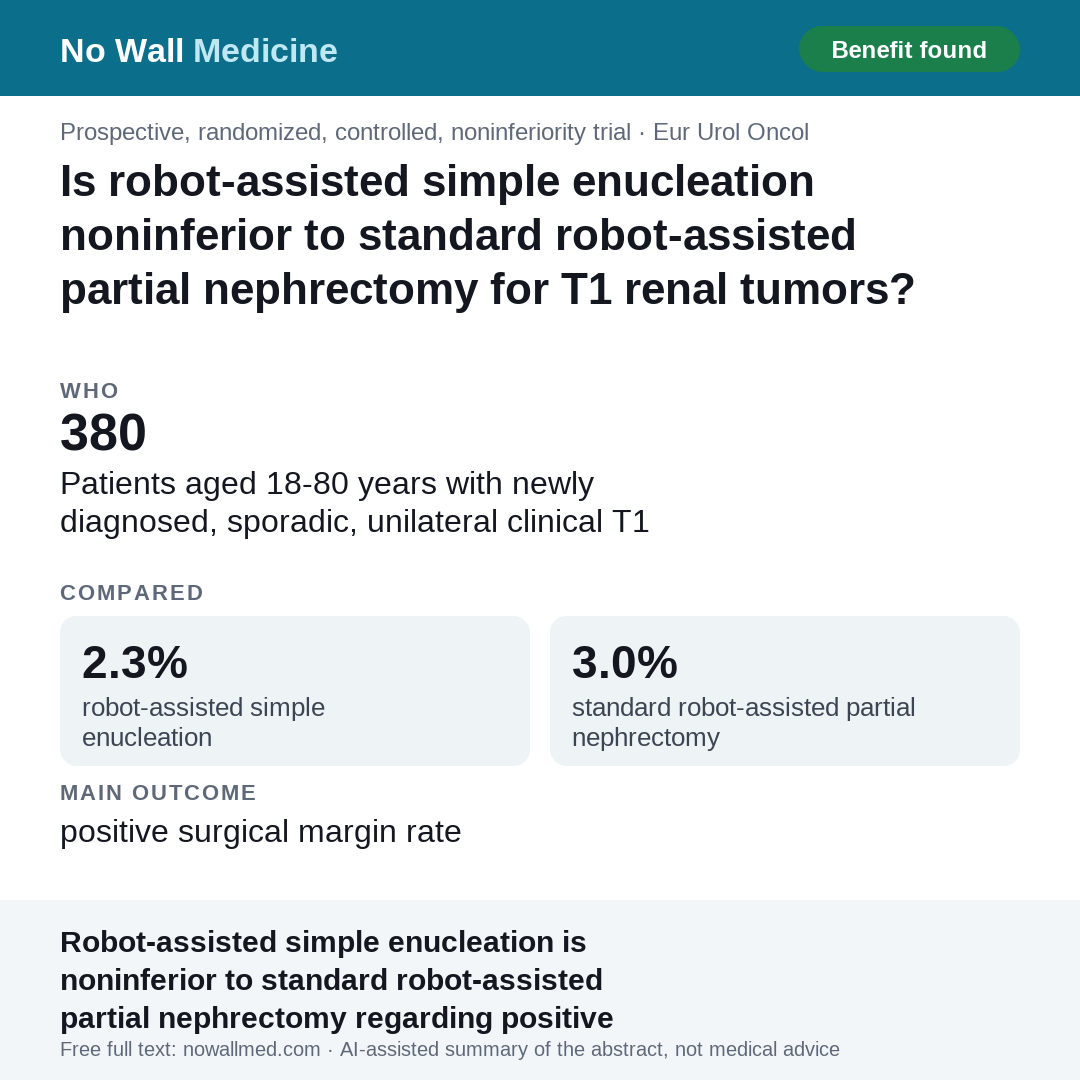
Clinical question: Is robot-assisted simple enucleation noninferior to standard robot-assisted partial nephrectomy for T1 renal tumors?
Why it matters: It was unknown whether robot-assisted simple enucleation is noninferior to standard robot-assisted partial nephrectomy regarding positive surgical margins for low- or intermediate-complexity renal tumors.
Key points
- Researchers conducted a randomized trial with 380 patients aged 18-80 years with clinical T1 renal tumors, comparing robot-assisted simple enucleation to standard robot-assisted partial nephrectomy.
- The rate of positive surgical margins was 2.3% in the simple enucleation group and 3.0% in the standard partial nephrectomy group.
- The simple enucleation group had a shorter median operative time of 145 minutes compared to 155 minutes for the standard partial nephrectomy group.
Headline and key points written with AI from the paper’s abstract, with every number checked against it. Read the paper before relying on them.
Abstract
Background
Although partial nephrectomy has become the gold standard for T1 renal tumors whenever technically feasible, simple enucleation has shown superior results. To the best of our knowledge, no randomized controlled trials comparing these two surgical approaches have been published.Objective
To compare the surgical margin status for robot-assisted simple enucleation (RASE) and standard robot-assisted partial nephrectomy (sRAPN) for clinical T1 renal tumors.Design, setting, and participants
This is a prospective, randomized, controlled, noninferiority trial. A total of 380 patients aged 18-80 yr with newly diagnosed, sporadic, unilateral clinical T1 renal tumors (RENAL score Outcome measurements and statistical analysis
We defined noninferiority for RASE versus standard RAPN as an upper 95% confidence interval (CI) bound of Results and limitations
A cohort of 380 patients was enrolled and randomly assigned to RASE (n = 190) or sRAPN (n = 190). On intention-to-treat analysis for patients with malignant tumors, 2.3% of patients in the RASE group and 3.0% in the sRAPN group had a PSM. The RASE group showed noninferiority to the sRAPN group within a 7.5% margin (difference -0.7%, 95% CI -4.0% to 2.7%). Per-protocol analysis also demonstrated noninferiority of RASE. The RASE group had a shorter median operative time (145 vs 155 min; p = 0.018) and a lower rate of tumor bed suturing (8.9% vs 43%; p 0.9).Conclusions
RASE for the management of low- to intermediate-complexity tumors is noninferior to sRAPN in terms of the PSM rate. Long-term follow-up is needed to draw conclusions regarding oncological outcomes.Patient summary
We carried out a trial to compare simple tumor enucleation versus partial nephrectomy for renal tumors. The outcome we assessed was the proportion of patients with a positive surgical margin. Our results show that simple tumor enucleation is not inferior to partial nephrectomy for this outcome. Longer follow-up is needed to assess other cancer control outcomes.
Abstract reproduced under the article’s CC BY-NC-ND licence.
Topics
Cite this article
Lu Q, Zhao X, Zhang S, Wang G, Ji C, Liu G. Robot-assisted Simple Enucleation Versus Standard Robot-assisted Partial Nephrectomy for Low- or Intermediate-complexity, Clinical T1 Renal Tumors: A Randomized Controlled Noninferiority Trial. Eur Urol Oncol. 2023. doi:10.1016/j.euo.2023.07.019
Spotted a mistake? Suggest a correction
Top studies every Monday
The week’s key trials and guidelines in your specialties, plus any topics you follow. By email, free.
Get the weekly digest