Robot-assisted therapy improved outcomes at 36 weeks for stroke patients
Robot-assisted therapy for long-term upper-limb impairment after stroke
Why it matters: In long-standing arm weakness after stroke, robot-assisted therapy was not significantly better than usual care at 12 weeks, though modest gains appeared later compared with usual care.
Related landmark trials: LEAPS (stroke walking)
Context written by the No Wall Medicine team.
Randomized, controlled trialNo clear difference
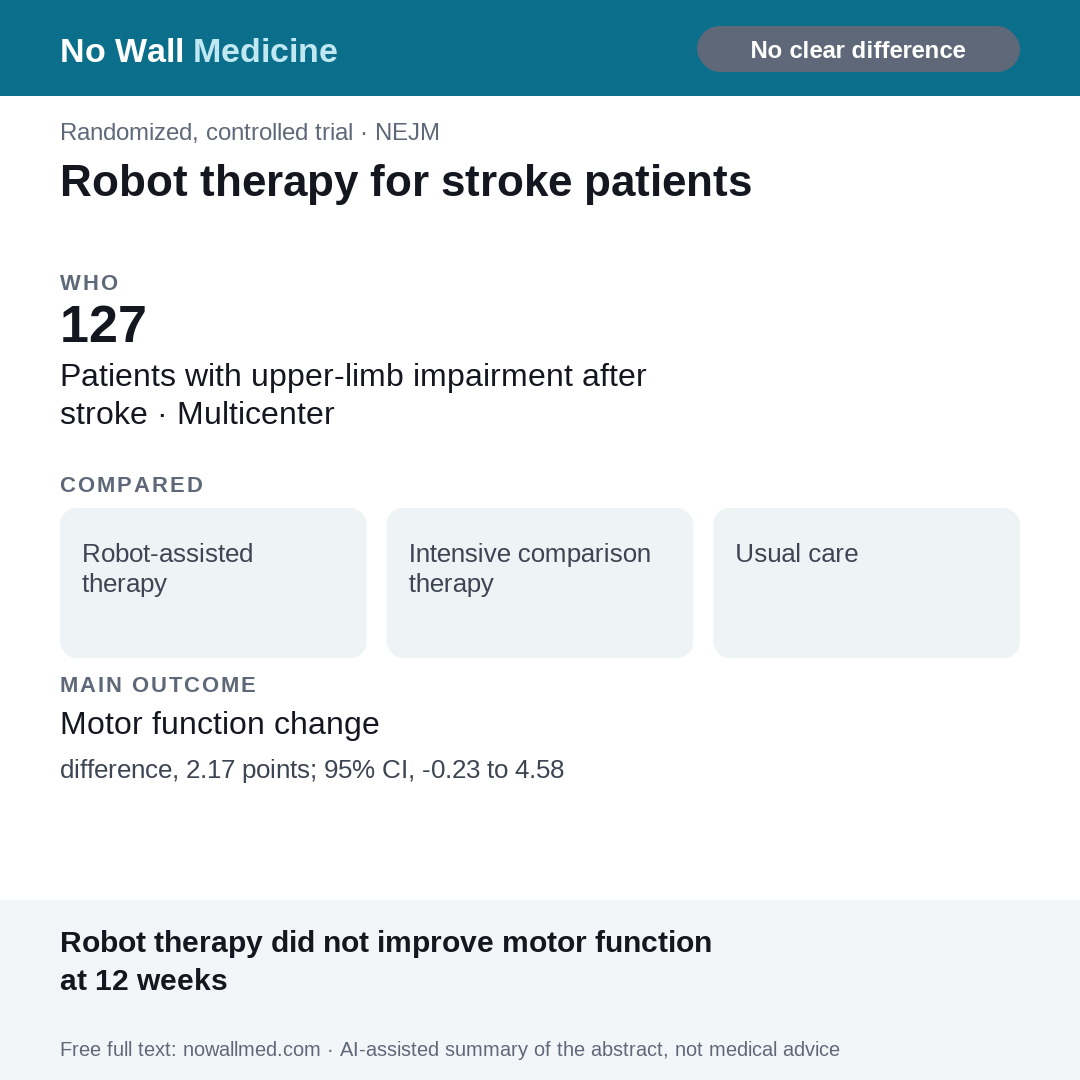
Robot therapy for stroke patients
Who
127
Patients with upper-limb impairment after stroke · Multicenter
Compared
Robot-assisted therapy
Intensive comparison therapy
Usual care
Main outcome
Motor function change
Result: difference, 2.17 points; 95% CI, -0.23 to 4.58
Bottom line: Robot therapy did not improve motor function at 12 weeks
NEJM · 2010-04-16Download image
Key points
- 127 patients with upper-limb impairment after stroke were studied in a randomized trial.
- Robot-assisted therapy improved Fugl-Meyer score by 2.88 points at 36 weeks compared to usual care.
- No serious adverse events were reported in the study.
Headline and key points written with AI from the paper’s abstract, with every number checked against it. Read the paper before relying on them.
Topics
Cite this article
Lo AC, Guarino PD, Richards LG, Haselkorn JK, Wittenberg GF, Federman DG. Robot-assisted therapy for long-term upper-limb impairment after stroke. NEJM. 2010. doi:10.1056/NEJMoa0911341
Spotted a mistake? Suggest a correction