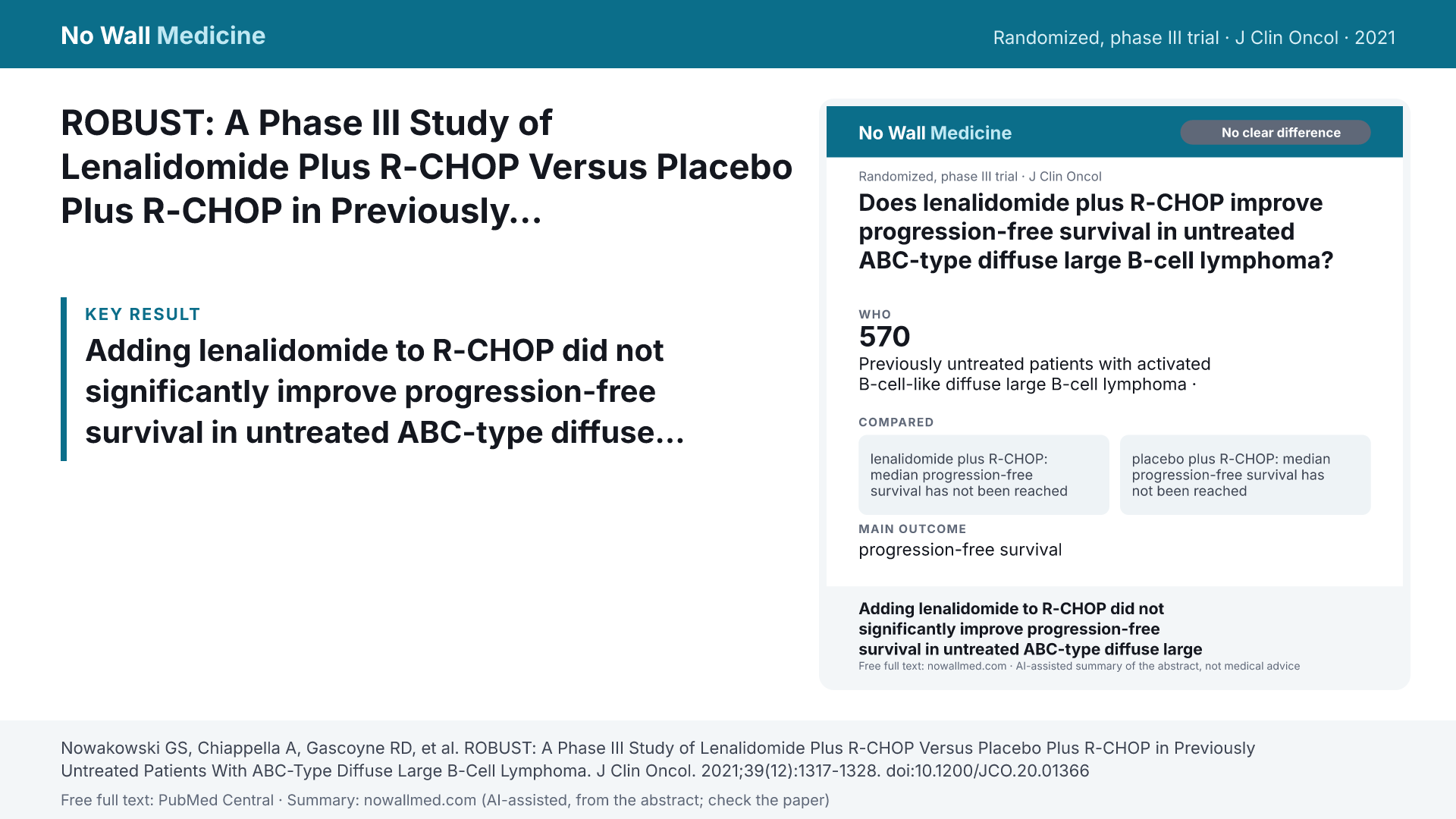
ROBUST: A Phase III Study of Lenalidomide Plus R-CHOP Versus Placebo Plus R-CHOP in Previously Untreated Patients With ABC-Type Diffuse Large B-Cell Lymphoma
Randomized, phase III trialNo clear difference
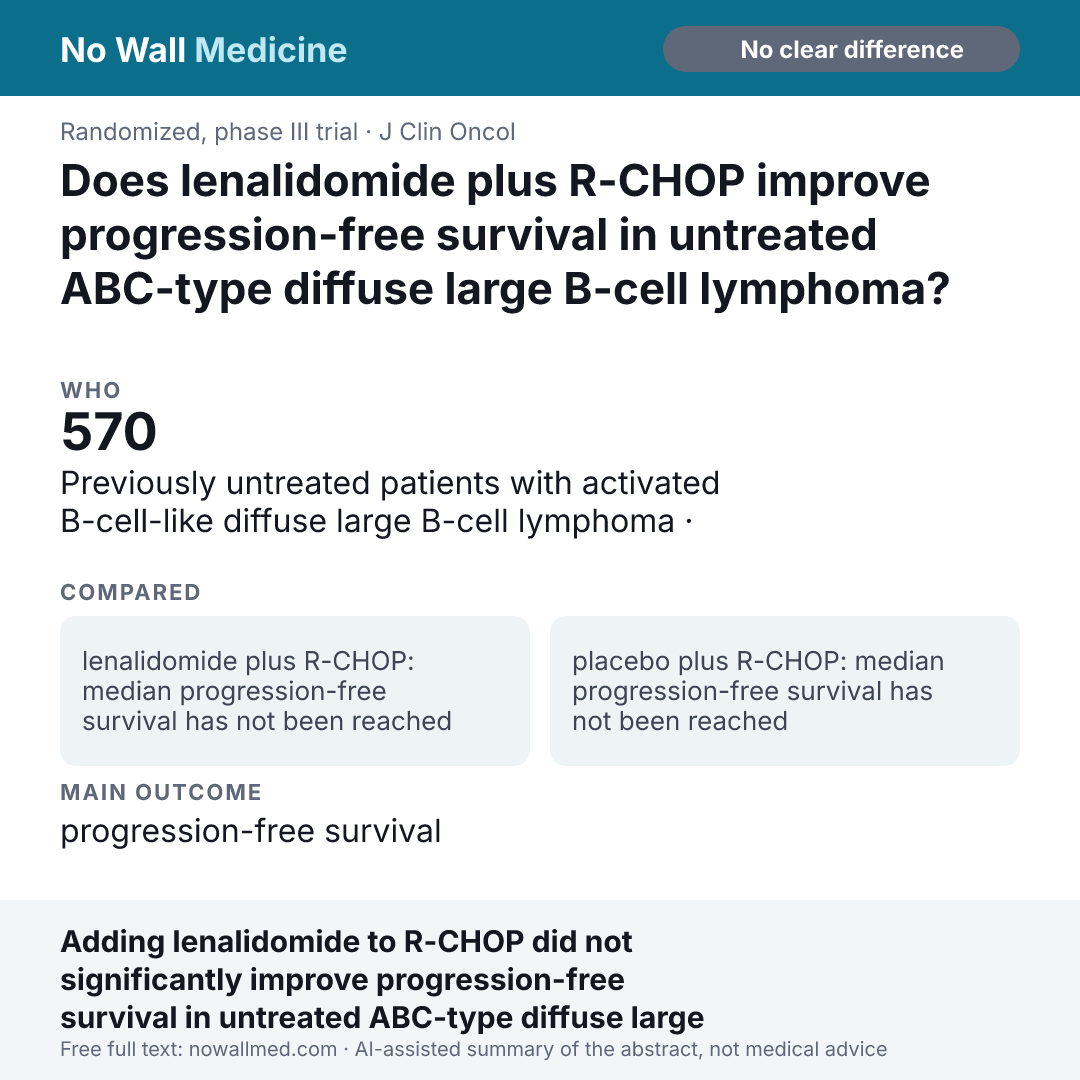
Does lenalidomide plus R-CHOP improve progression-free survival in untreated ABC-type diffuse large B-cell lymphoma?
Who
570
Previously untreated patients with activated B-cell-like diffuse large B-cell lymphoma · Global
Compared
lenalidomide plus R-CHOP: median progression-free survival has not been reached
placebo plus R-CHOP: median progression-free survival has not been reached
Main outcome
progression-free survival
Result: hazard ratio 0.85 (95% CI 0.63 to 1.14)
Bottom line: Adding lenalidomide to R-CHOP did not significantly improve progression-free survival in untreated ABC-type diffuse large B-cell lymphoma.
J Clin Oncol · 2021-02-23 · Save PNG
Clinical question: Does lenalidomide plus R-CHOP improve progression-free survival in untreated ABC-type diffuse large B-cell lymphoma?
Abstract
Purpose
Patients with the activated B-cell-like (ABC) subtype of diffuse large B-cell lymphoma (DLBCL) historically showed inferior survival with standard rituximab plus cyclophosphamide, doxorubicin, vincristine, and prednisone (R-CHOP). Phase II studies demonstrated that adding the immunomodulatory agent lenalidomide to R-CHOP improved outcomes in ABC-type DLBCL. The goal of the global, phase III ROBUST study was to compare lenalidomide plus R-CHOP (R2-CHOP) with placebo/R-CHOP in previously untreated, ABC-type DLBCL. Methods
Histology and cell-of-origin type were prospectively analyzed by central pathology prior to random assignment and study treatment. Patients with ABC-DLBCL received lenalidomide oral 15 mg/d, days 1-14/21 plus standard R-CHOP21 versus placebo/R-CHOP21 for six cycles. The primary end point was progression-free survival (PFS) per independent central radiology review. Results
A total of 570 patients with ABC-DLBCL (n = 285 per arm) were stratified by International Prognostic Index score, age, and bulky disease, and randomly assigned to R2-CHOP or placebo/R-CHOP. Baseline demographics were similar between arms. Most patients completed six cycles of treatment: 74% R2-CHOP and 84% placebo/R-CHOP. The most common grade 3/4 adverse events for R2-CHOP versus placebo/R-CHOP were neutropenia (60% v 48%), anemia (22% v 14%), thrombocytopenia (17% v 11%), and leukopenia (14% v 15%). The primary end point of PFS was not met, with a hazard ratio of 0.85 (95% CI, 0.63 to 1.14) and P = .29; median PFS has not been reached for either arm. PFS trends favoring R2-CHOP over placebo/R-CHOP were seen in patients with higher-risk disease. Conclusion
ROBUST is the first DLBCL phase III study to integrate biomarker-driven identification of eligible ABC patients. Although the ROBUST trial did not meet the primary end point of PFS in all patients, the safety profile of R2-CHOP was consistent with individual treatments with no new safety signals.
Subject terms
Headline, design, result, key points, caveat and citation as plain text.
Cite this article
Nowakowski GS, Chiappella A, Gascoyne RD, et al. ROBUST: A Phase III Study of Lenalidomide Plus R-CHOP Versus Placebo Plus R-CHOP in Previously Untreated Patients With ABC-Type Diffuse Large B-Cell Lymphoma. J Clin Oncol. 2021;39(12):1317-1328. doi:10.1200/JCO.20.01366
Spotted a mistake? Suggest a correction