Systematic review identifies various artificial intelligence applications currently implemented in real-world clinical settings
Role of Artificial Intelligence Applications in Real-Life Clinical Practice: Systematic Review
Systematic reviewUnclear result
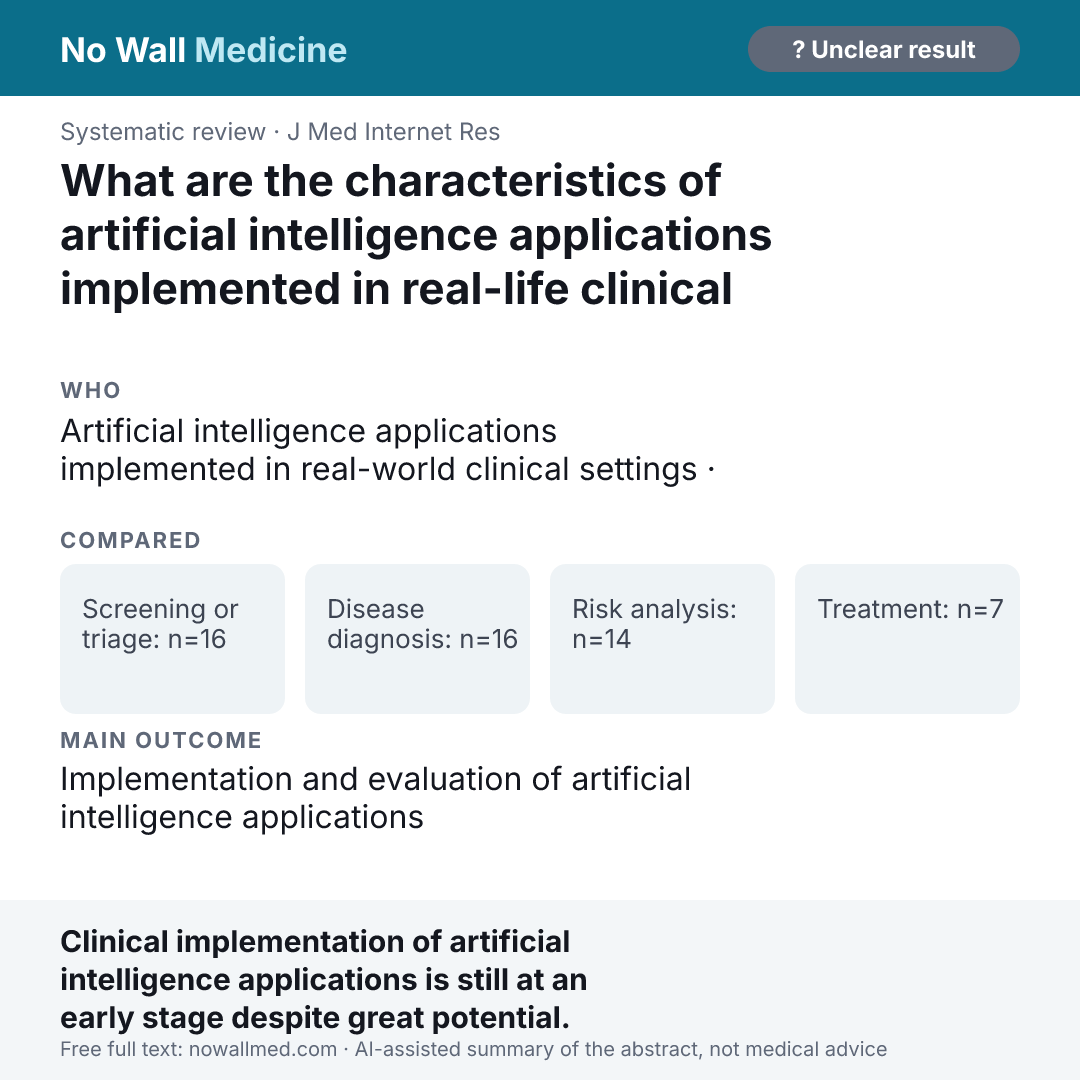
What are the characteristics of artificial intelligence applications implemented in real-life clinical practice?
Who
Artificial intelligence applications implemented in real-world clinical settings · Real-world clinical settings
Compared
Screening or triage: n=16
Disease diagnosis: n=16
Risk analysis: n=14
Treatment: n=7
Main outcome
Implementation and evaluation of artificial intelligence applications
Bottom line: Clinical implementation of artificial intelligence applications is still at an early stage despite great potential.
J Med Internet Res · 2021-04-22 · Save PNG
Clinical question: What are the characteristics of artificial intelligence applications implemented in real-life clinical practice?
Key points
- Researchers reviewed 51 studies published between January 2010 and May 2020 that reported the implementation and evaluation of artificial intelligence in clinical practice.
- The applications targeted tasks such as screening or triage (n=16), disease diagnosis (n=16), risk analysis (n=14), and treatment (n=7).
- Evaluations included the performance of artificial intelligence (n=26), effects on clinician outcomes (n=33), and effects on patient outcomes (n=14).
Headline and key points written with AI from the paper’s abstract, with every number checked against it. Read the paper before relying on them.
Was this summary helpful?
Subject terms
Headline, design, result, key points, caveat and citation as plain text.
Cite this article
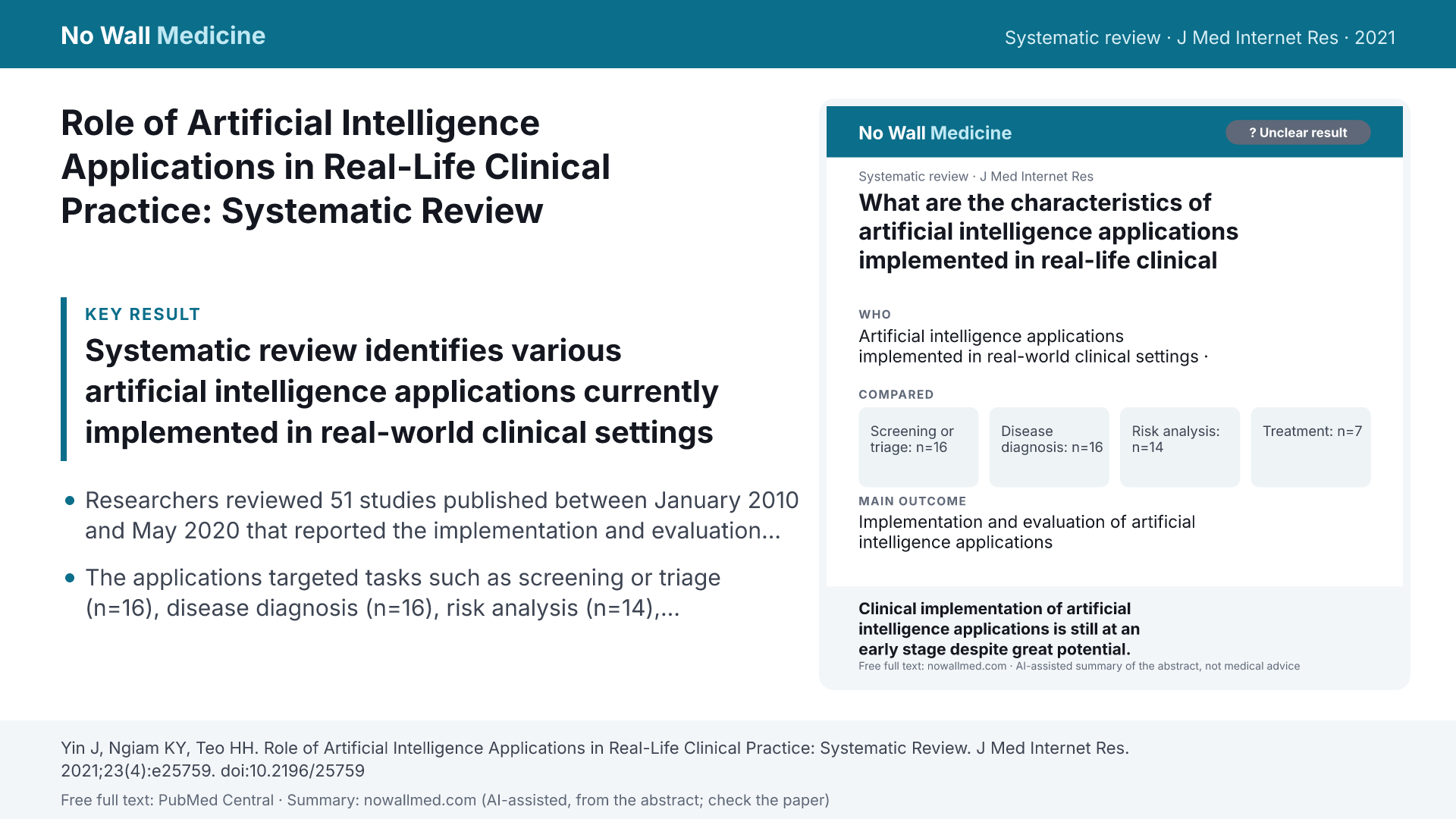
Yin J, Ngiam KY, Teo HH. Role of Artificial Intelligence Applications in Real-Life Clinical Practice: Systematic Review. J Med Internet Res. 2021;23(4):e25759. doi:10.2196/25759
Spotted a mistake? Suggest a correction