Role of video self-assessment in laparoscopic simulation training: a randomized pilot trial
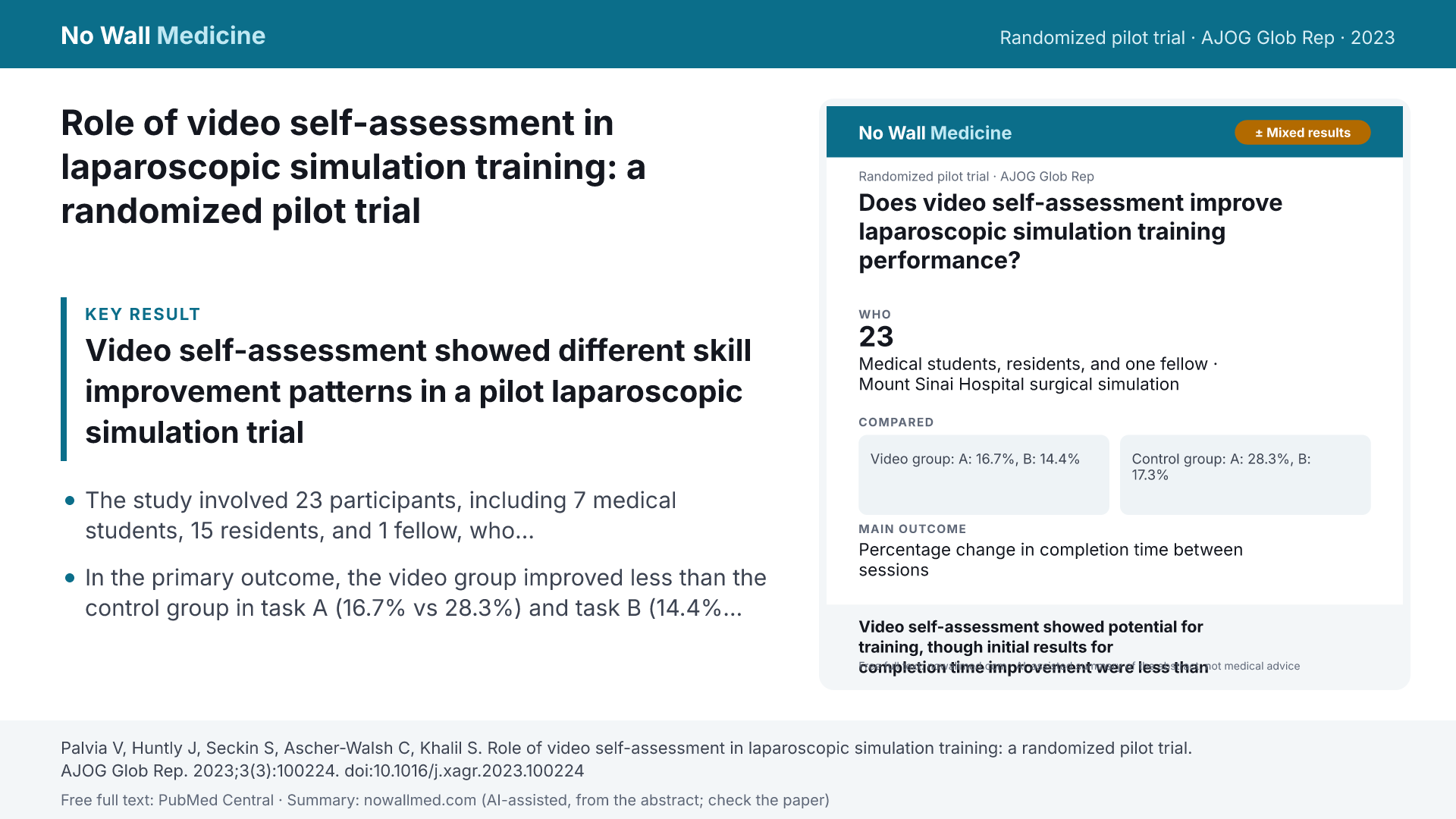
Key result: Video self-assessment showed different skill improvement patterns in a pilot laparoscopic simulation trial
Randomized pilot trialMixed results
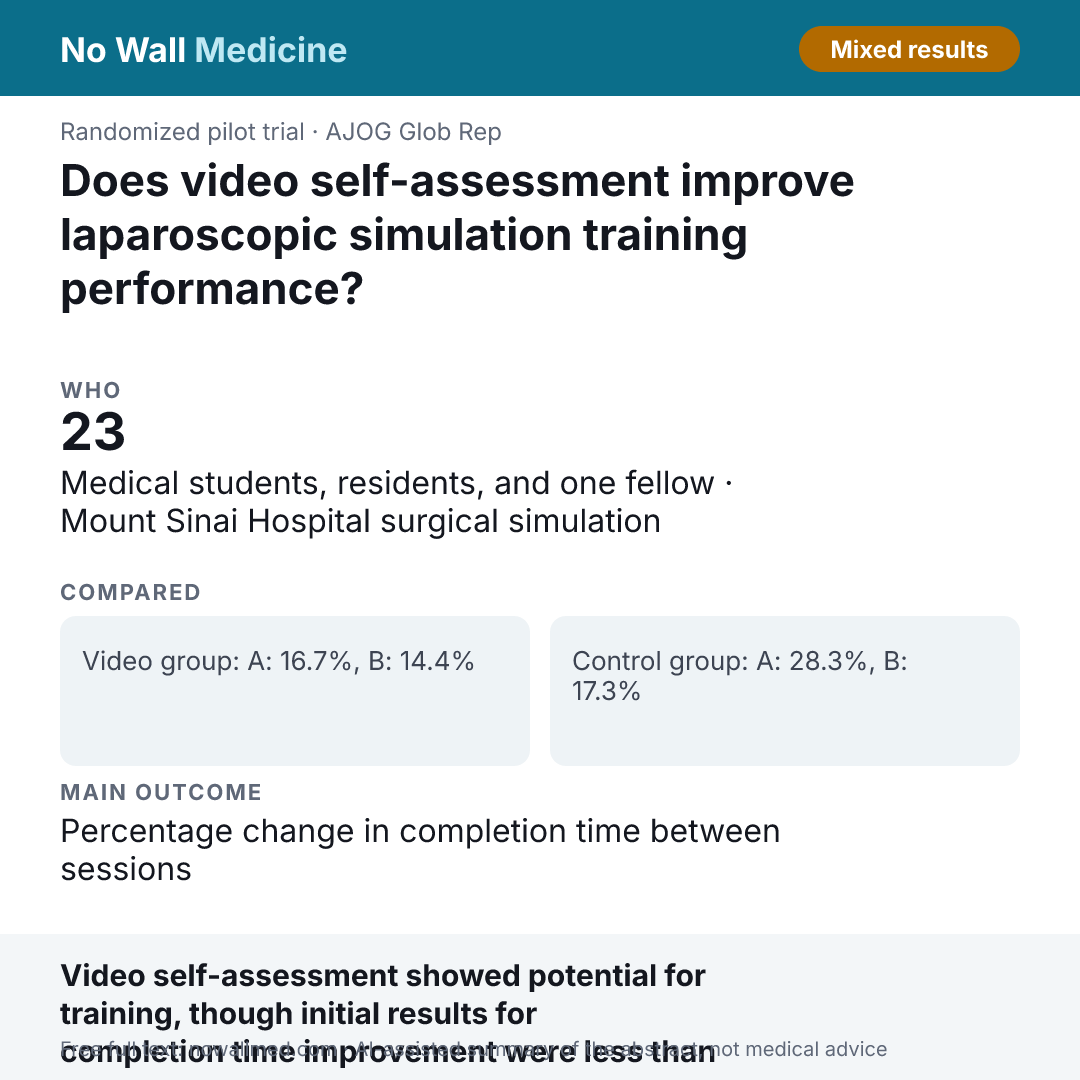
Does video self-assessment improve laparoscopic simulation training performance?
Who
23
Medical students, residents, and one fellow · Mount Sinai Hospital surgical simulation training room
Compared
Video group: A: 16.7%, B: 14.4%
Control group: A: 28.3%, B: 17.3%
Main outcome
Percentage change in completion time between sessions
Bottom line: Video self-assessment showed potential for training, though initial results for completion time improvement were less than the control group.
Limitation: This was a prospective pilot study with a small sample size.
AJOG Glob Rep · 2023-05-26 · Save PNG
Key points
- The study involved 23 participants, including 7 medical students, 15 residents, and 1 fellow, who performed laparoscopic tasks with or without video recording.
- In the primary outcome, the video group improved less than the control group in task A (16.7% vs 28.3%) and task B (14.4% vs 17.3%).
- When controlling for training level in residents only, the video group improved more in task A (17% vs 7.4%) and task B (20.9% vs 16.5%).
Limitation the authors note: The study was a prospective pilot study with a small sample size of 23 subjects.
Discussion prompts
- Would these patients look like yours? Who was left out?
- Is the main outcome one that matters to patients?
- Is the difference large enough to change what you do?
Cite: Palvia V, Huntly J, Seckin S, Ascher-Walsh C, Khalil S. Role of video self-assessment in laparoscopic simulation training: a randomized pilot trial. AJOG Glob Rep. 2023;3(3):100224. doi:10.1016/j.xagr.2023.100224
Free full text: PubMed Central · Summary and visual abstract: nowallmed.com/a/role-of-video-self-assessment-in-laparoscopic-simulation-training-a-3jynn1/ (AI-assisted from the abstract; check the paper before relying on it).