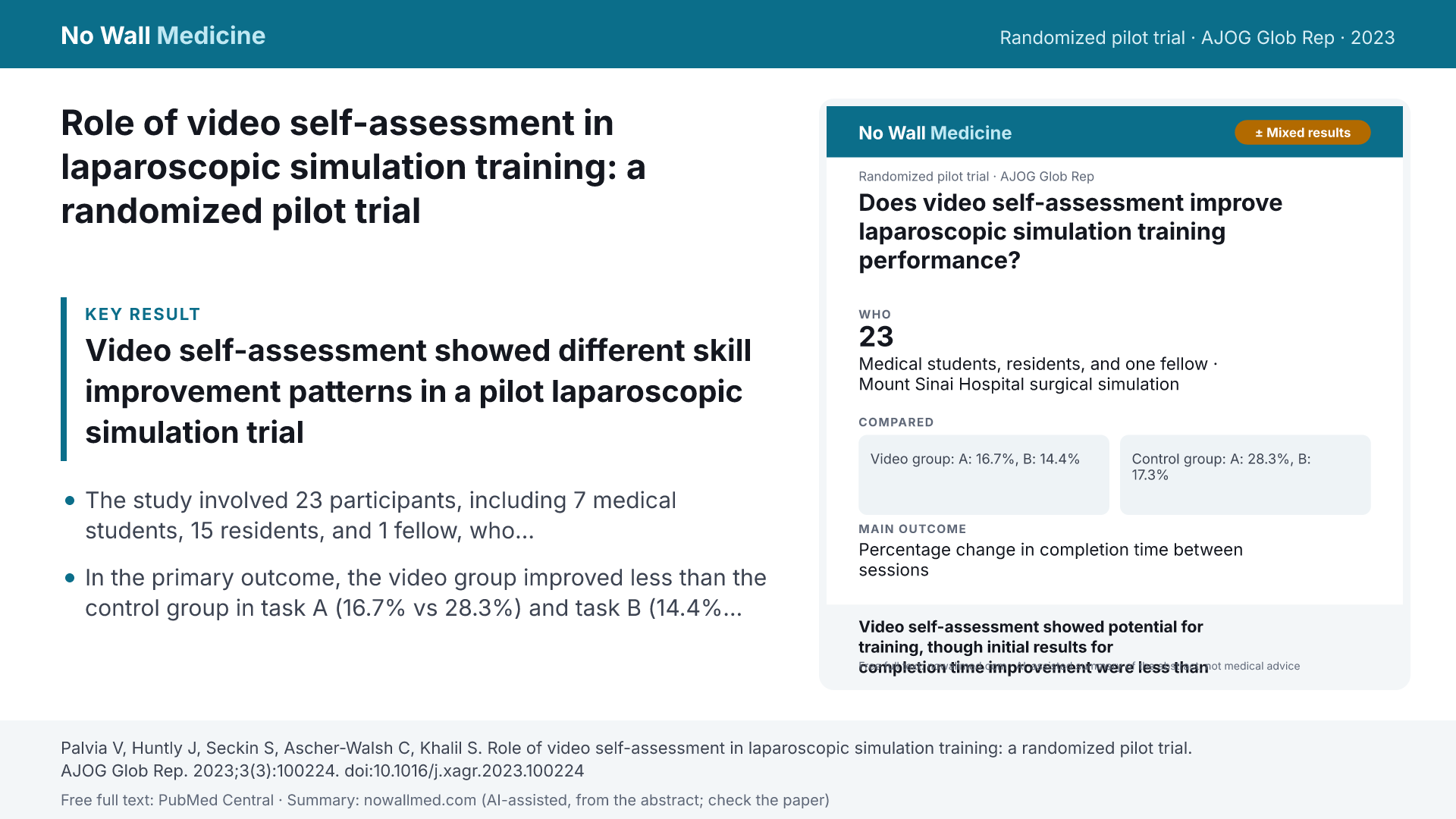
Video self-assessment showed different skill improvement patterns in a pilot laparoscopic simulation trial
Role of video self-assessment in laparoscopic simulation training: a randomized pilot trial
Randomized pilot trialMixed results
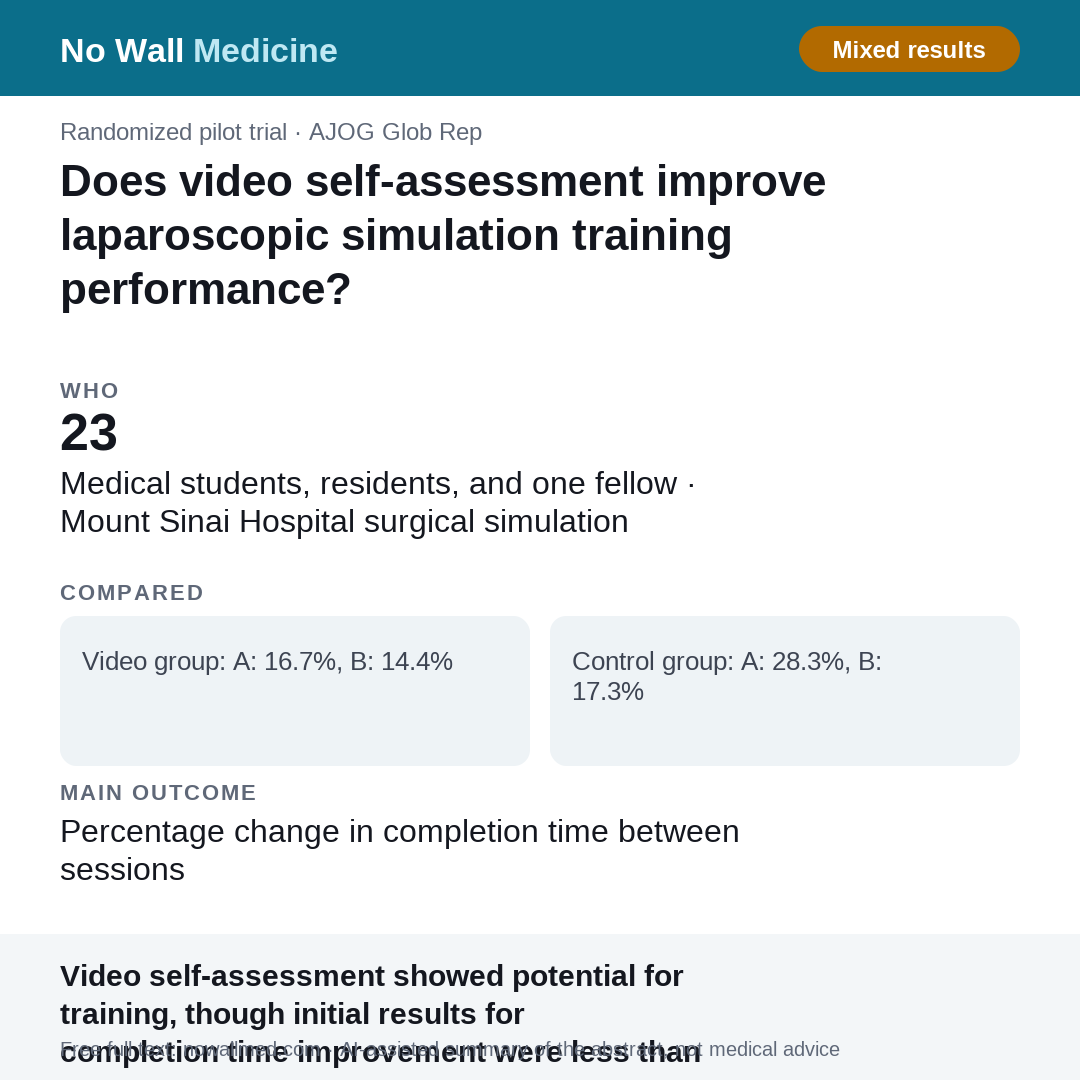
Does video self-assessment improve laparoscopic simulation training performance?
Who
23
Medical students, residents, and one fellow · Mount Sinai Hospital surgical simulation training room
Compared
Video group: A: 16.7%, B: 14.4%
Control group: A: 28.3%, B: 17.3%
Main outcome
Percentage change in completion time between sessions
Bottom line: Video self-assessment showed potential for training, though initial results for completion time improvement were less than the control group.
Limitation: This was a prospective pilot study with a small sample size.
AJOG Glob Rep · 2023-05-26Download image
Clinical question: Does video self-assessment improve laparoscopic simulation training performance?
Why it matters: Data is limited on whether using video recording for self-assessment is useful for laparoscopic training in obstetrics and gynecology residency programs.
Key points
- The study involved 23 participants, including 7 medical students, 15 residents, and 1 fellow, who performed laparoscopic tasks with or without video recording.
- In the primary outcome, the video group improved less than the control group in task A (16.7% vs 28.3%) and task B (14.4% vs 17.3%).
- When controlling for training level in residents only, the video group improved more in task A (17% vs 7.4%) and task B (20.9% vs 16.5%).
Limitation the authors note: The study was a prospective pilot study with a small sample size of 23 subjects.
Headline and key points written with AI from the paper’s abstract, with every number checked against it. Read the paper before relying on them.
Was this summary helpful?
Cite this article
Palvia V, Huntly J, Seckin S, Ascher-Walsh C, Khalil S. Role of video self-assessment in laparoscopic simulation training: a randomized pilot trial. AJOG Glob Rep. 2023. doi:10.1016/j.xagr.2023.100224
Spotted a mistake? Suggest a correction
Top studies every Monday
The week’s key trials and guidelines in your specialties, plus any topics you follow. By email, free.
Get the weekly digest