Routine stress testing after high-risk heart procedures showed no benefit for patients with or without acute coronary syndrome
Routine Stress Testing After PCI in Patients With and Without Acute Coronary Syndrome: A Secondary Analysis of the POST-PCI Randomized Clinical Trial
Randomized clinical trialNo clear difference
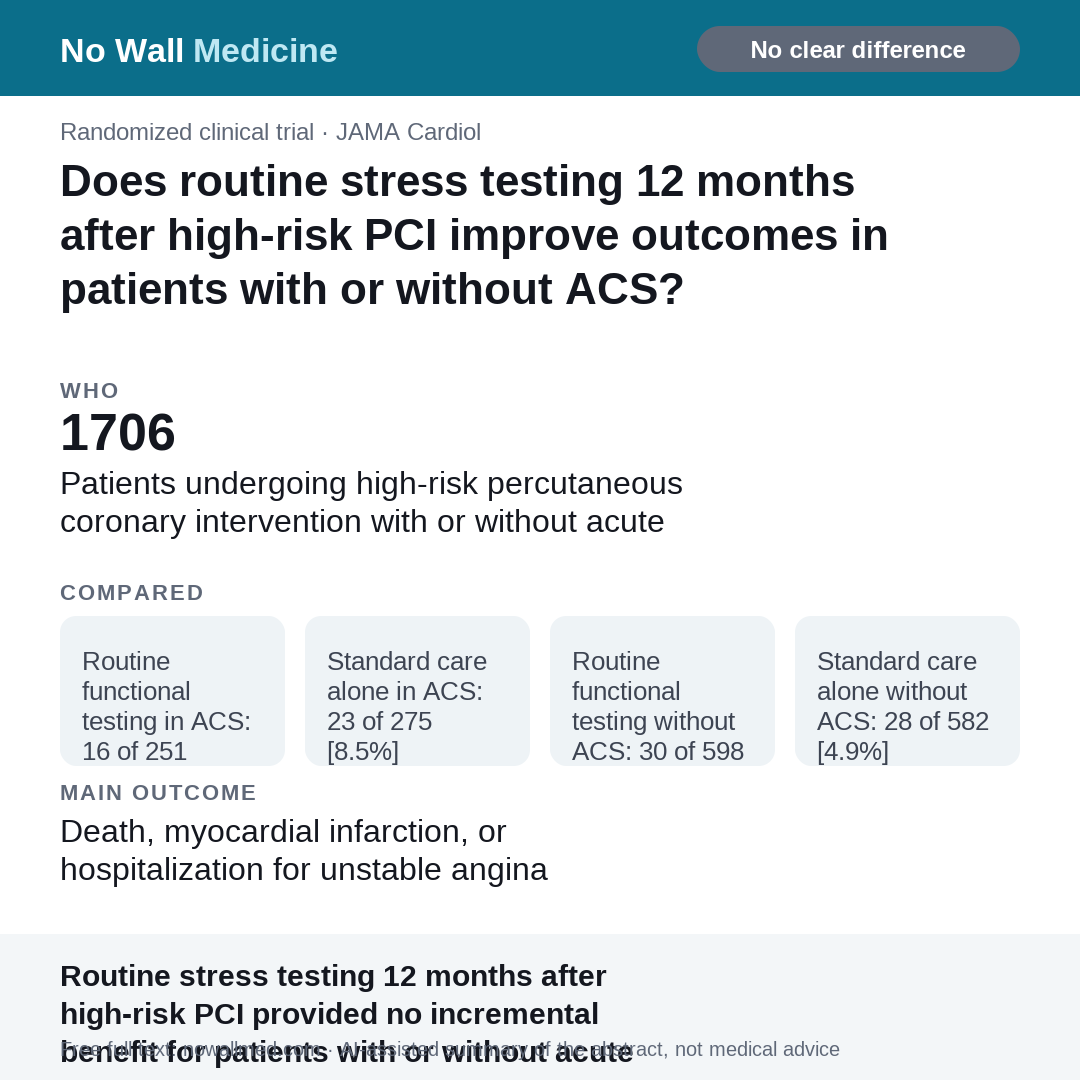
Does routine stress testing 12 months after high-risk PCI improve outcomes in patients with or without ACS?
Who
1706
Patients undergoing high-risk percutaneous coronary intervention with or without acute coronary syndrome · 11 sites in South Korea
Compared
Routine functional testing in ACS: 16 of 251 [6.6%]
Standard care alone in ACS: 23 of 275 [8.5%]
Routine functional testing without ACS: 30 of 598 [5.1%]
Standard care alone without ACS: 28 of 582 [4.9%]
Main outcome
Death, myocardial infarction, or hospitalization for unstable angina
Result: HR, 0.76 (95% CI, 0.40-1.44) in ACS; HR, 1.04 (95% CI, 0.62-1.74) without ACS
Bottom line: Routine stress testing 12 months after high-risk PCI provided no incremental benefit for patients with or without acute coronary syndrome.
JAMA Cardiol · 2024-06-26Download image
Clinical question: Does routine stress testing 12 months after high-risk PCI improve outcomes in patients with or without ACS?
Why it matters: The appropriate follow-up surveillance strategy for patients with acute coronary syndrome who have undergone percutaneous coronary intervention remains unknown.
Key points
- The randomized trial included 1706 patients, including 350 females and 526 patients with acute coronary syndrome, who received either routine functional testing or standard care 12 months after percutaneous coronary intervention.
- The 2-year incidence of death, heart attack, or hospitalization for unstable angina was 6.6% for functional testing and 8.5% for standard care in patients with acute coronary syndrome.
- The 2-year incidence of the primary outcome was 5.1% for functional testing and 4.9% for standard care in patients without acute coronary syndrome.
Headline and key points written with AI from the paper’s abstract, with every number checked against it. Read the paper before relying on them.
Was this summary helpful?
Subject terms
Cite this article
Lee J, Kang DY, Kim H, Choi Y, Jo S, Ahn JM. Routine Stress Testing After PCI in Patients With and Without Acute Coronary Syndrome: A Secondary Analysis of the POST-PCI Randomized Clinical Trial. JAMA Cardiol. 2024. doi:10.1001/jamacardio.2024.1556
Spotted a mistake? Suggest a correction
Top studies every Monday
The week’s key trials and guidelines in your specialties, plus any topics you follow. By email, free.
Get the weekly digest