Safety and effectiveness of non-invasive brain stimulation on mobility and balance function in children with cerebral palsy: a systematic review and meta-analysis
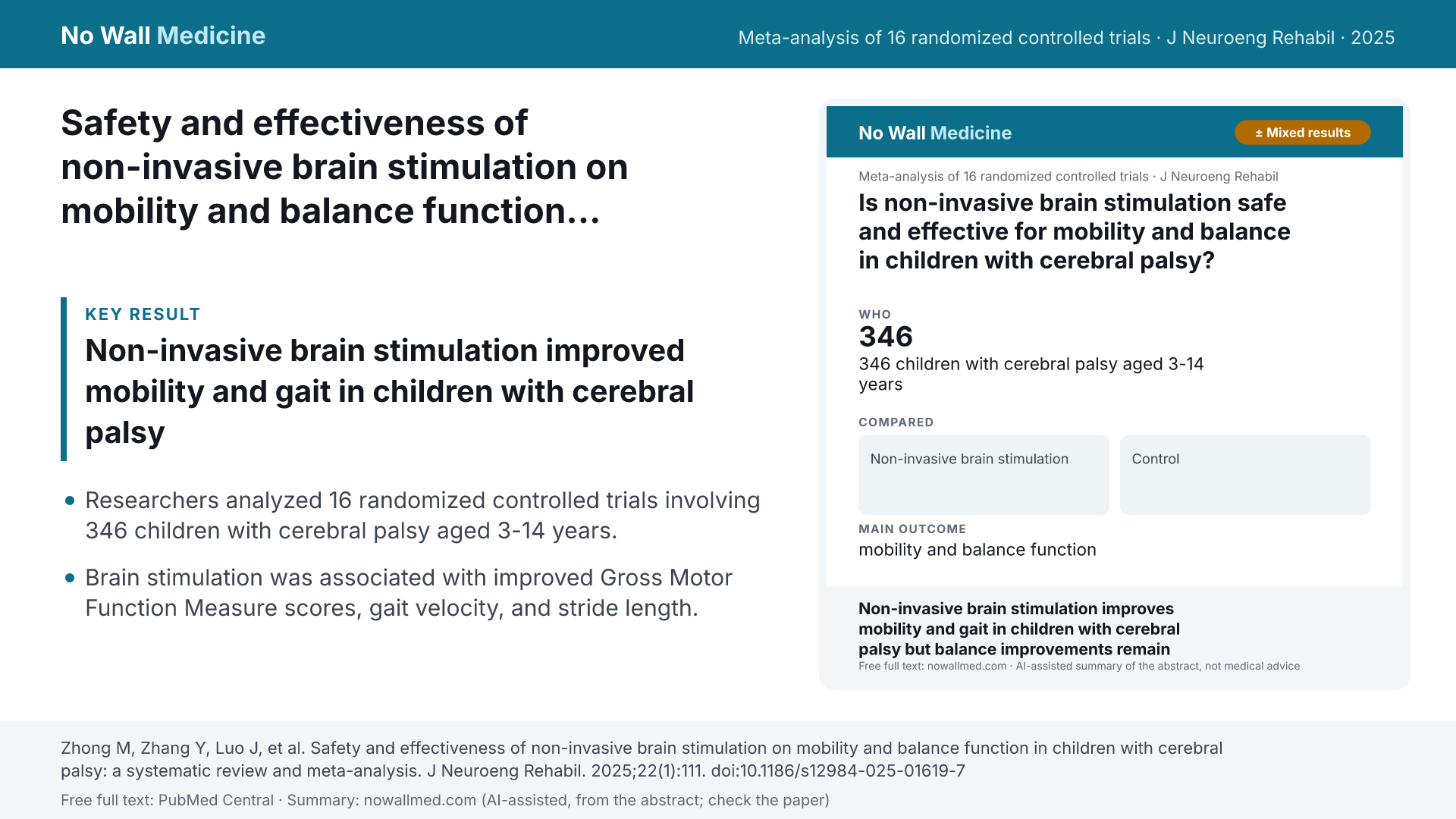
Key result: Non-invasive brain stimulation improved mobility and gait in children with cerebral palsy
Meta-analysis of 16 randomized controlled trialsMixed results
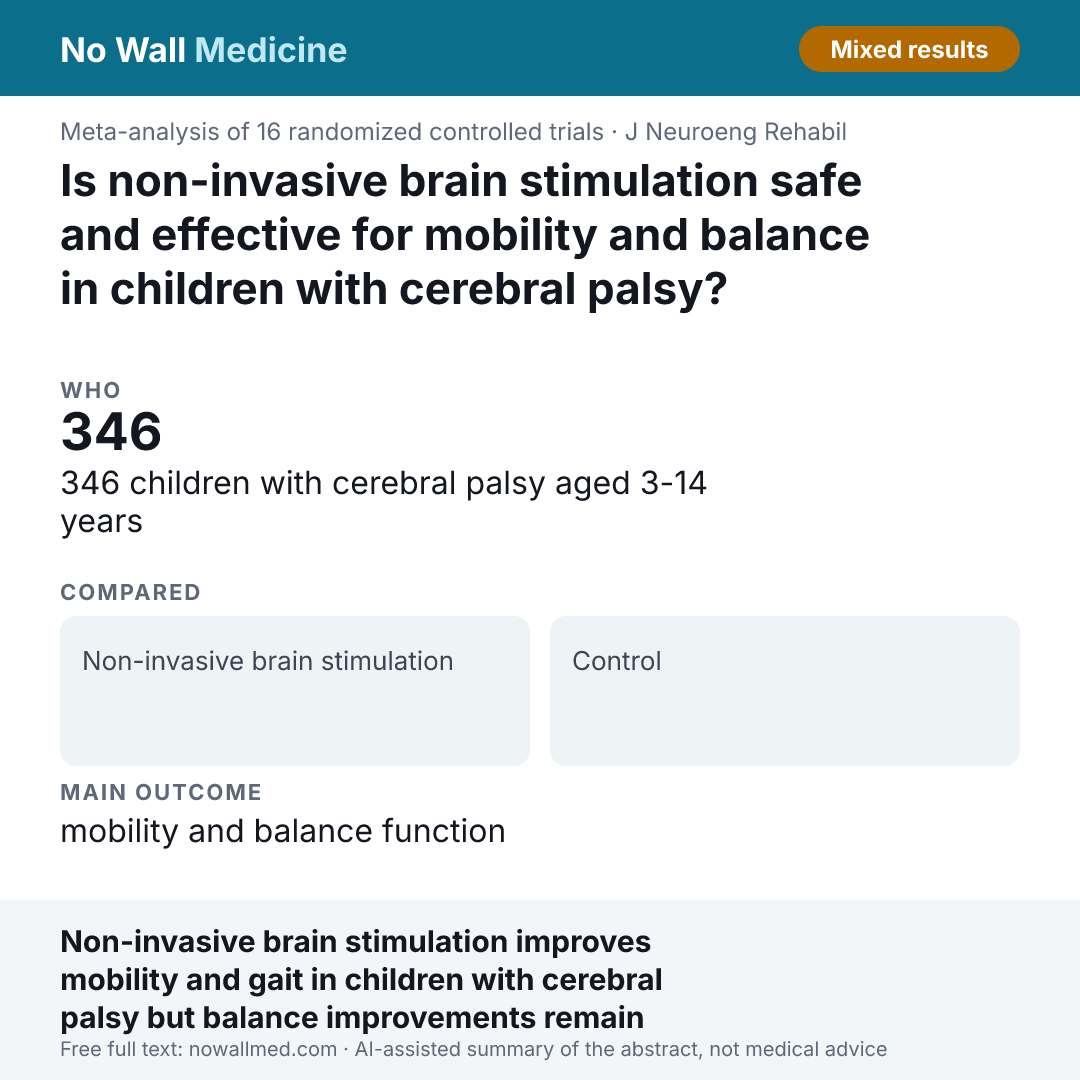
Is non-invasive brain stimulation safe and effective for mobility and balance in children with cerebral palsy?
Who
346
346 children with cerebral palsy aged 3-14 years
Compared
Non-invasive brain stimulation
Control
Main outcome
mobility and balance function
Result: standard mean difference 0.47 to 0.63 for Gross Motor Function Measure
Bottom line: Non-invasive brain stimulation improves mobility and gait in children with cerebral palsy but balance improvements remain inconclusive.
Limitation: Future research should focus on extending follow-up periods and increasing sample sizes.
J Neuroeng Rehabil · 2025-05-18 · Save PNG
Key points
- Researchers analyzed 16 randomized controlled trials involving 346 children with cerebral palsy aged 3-14 years.
- Brain stimulation was associated with improved Gross Motor Function Measure scores, gait velocity, and stride length.
- The intervention was associated with a low incidence of adverse events and no significant improvements in balance.
Discussion prompts
- Would these patients look like yours? Who was left out?
- Is the main outcome one that matters to patients?
- Is the difference large enough to change what you do?
Cite: Zhong M, Zhang Y, Luo J, et al. Safety and effectiveness of non-invasive brain stimulation on mobility and balance function in children with cerebral palsy: a systematic review and meta-analysis. J Neuroeng Rehabil. 2025;22(1):111. doi:10.1186/s12984-025-01619-7
Free full text: PubMed Central · Summary and visual abstract: nowallmed.com/a/safety-and-effectiveness-of-non-invasive-brain-stimulation-on-jof1i2/ (AI-assisted from the abstract; check the paper before relying on it).