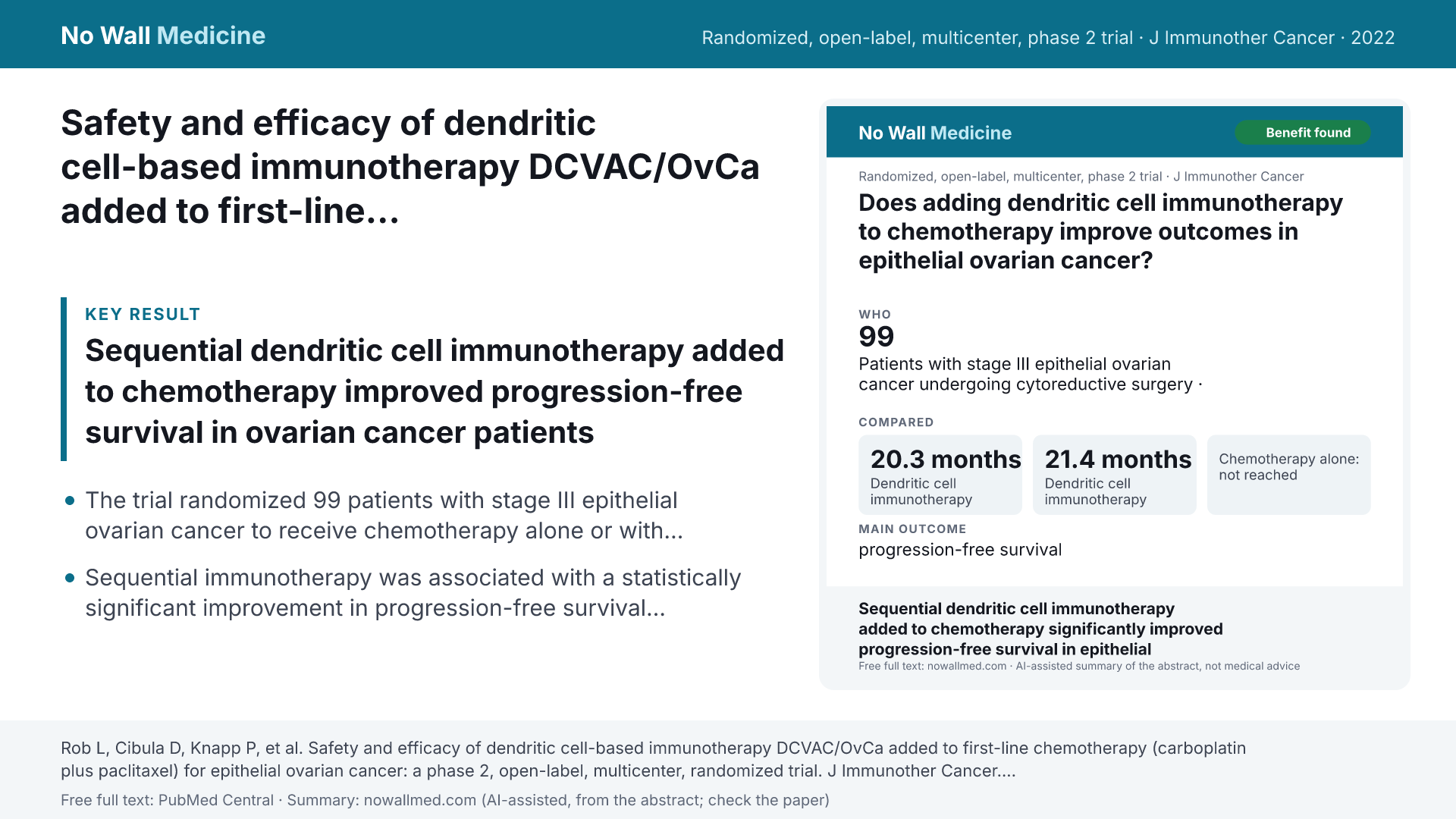
Sequential dendritic cell immunotherapy added to chemotherapy improved progression-free survival in ovarian cancer patients
Safety and efficacy of dendritic cell-based immunotherapy DCVAC/OvCa added to first-line chemotherapy (carboplatin plus paclitaxel) for epithelial ovarian cancer: a phase 2, open-label, multicenter, randomized trial
Randomized, open-label, multicenter, phase 2 trialBenefit found
Does adding dendritic cell immunotherapy to chemotherapy improve outcomes in epithelial ovarian cancer?
Who
99
Patients with stage III epithelial ovarian cancer undergoing cytoreductive surgery · multicenter
Compared
20.3 monthsDendritic cell immunotherapy parallel to chemotherapy
21.4 monthsDendritic cell immunotherapy sequential to chemotherapy
Chemotherapy alone: not reached
Main outcome
progression-free survival
Result: hazard ratio 0.39 (95% CI 0.16 to 0.96)
Bottom line: Sequential dendritic cell immunotherapy added to chemotherapy significantly improved progression-free survival in epithelial ovarian cancer patients.
J Immunother Cancer · 2022-01-07 · Save PNG
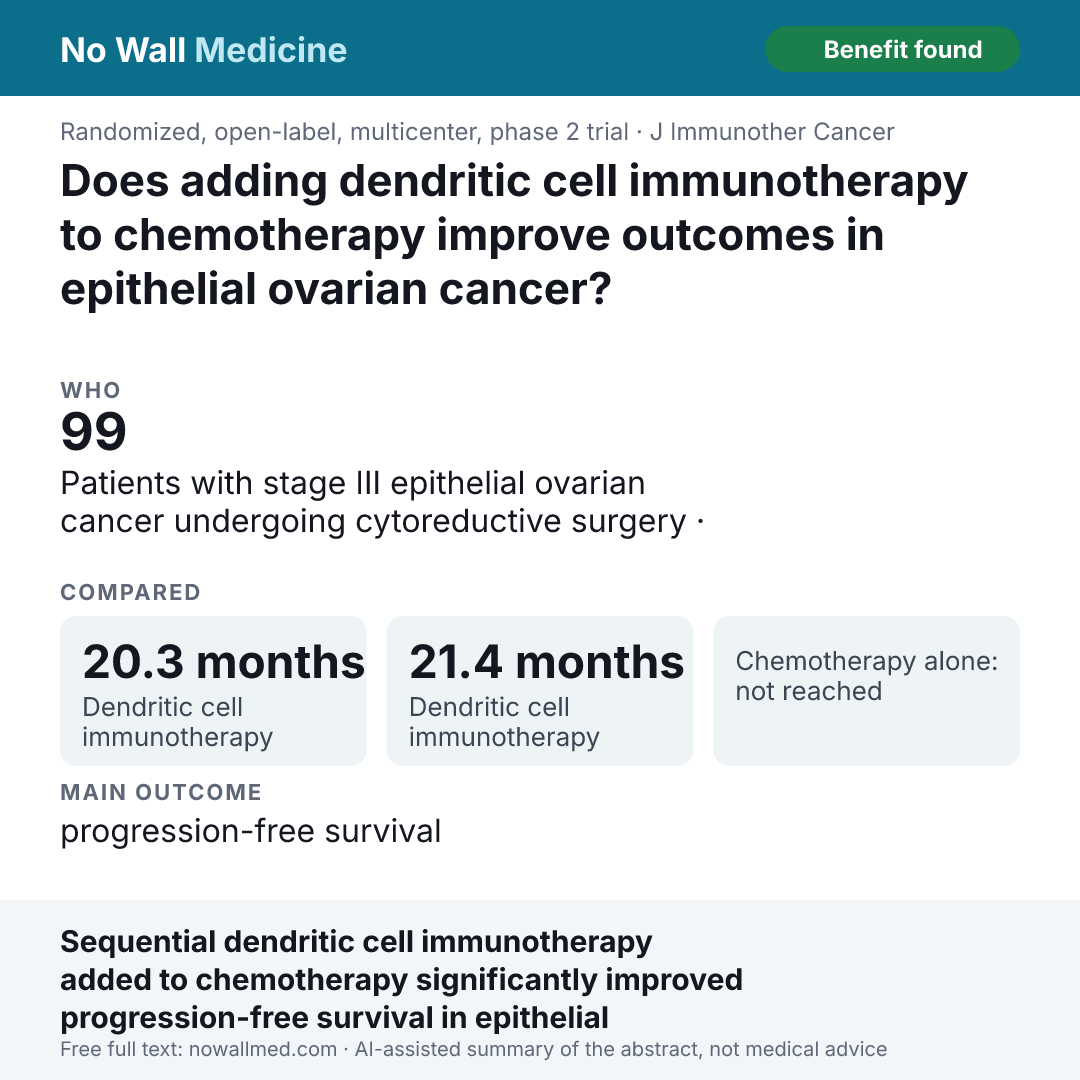
Clinical question: Does adding dendritic cell immunotherapy to chemotherapy improve outcomes in epithelial ovarian cancer?
Why it matters: Most patients with epithelial ovarian cancer relapse after surgery and chemotherapy, and it is unknown if adding dendritic cell immunotherapy can improve clinical outcomes.
Key points
- The trial randomized 99 patients with stage III epithelial ovarian cancer to receive chemotherapy alone or with dendritic cell immunotherapy administered either parallel or sequential to chemotherapy.
- Sequential immunotherapy was associated with a statistically significant improvement in progression-free survival compared to chemotherapy alone, with a hazard ratio of 0.39 (95% CI, 0.16 to 0.96; p=0.0336).
- Treatment-emergent adverse events related to the immunotherapy occurred in 5.9% of the parallel group and 3.8% of the sequential group.
Headline and key points written with AI from the paper’s abstract, with every number checked against it. Read the paper before relying on them.
Was this summary helpful?
Abstract
Background
Most patients with epithelial ovarian cancer (EOC) relapse despite primary debulking surgery and chemotherapy (CT). Autologous dendritic cell immunotherapy (DCVAC) can present tumor antigens to elicit a durable immune response. We hypothesized that adding parallel or sequential DCVAC to CT stimulates antitumor immunity and improves clinical outcomes in patients with EOC. Based on the interim results of sequential DCVAC/OvCa administration and to accommodate the increased interest in maintenance treatment in EOC, the trial was amended by adding Part 2. Methods
Patients with International Federation of Gynecology and Obstetrics stage III EOC (serous, endometrioid, or mucinous), who underwent cytoreductive surgery up to 3 weeks prior to randomization and were scheduled for first-line platinum-based CT were eligible. Patients, stratified by tumor residuum (0 or <1 cm), were randomized (1:1:1) to DCVAC/OvCa parallel to CT (Group A), DCVAC/OvCa sequential to CT (Group B), or CT alone (Group C) in Part 1, and to Groups B and C in Part 2. Autologous dendritic cells for DCVAC were differentiated from patients' CD14+ monocytes, pulsed with two allogenic OvCa cell lines (SK-OV-3, OV-90), and matured in the presence of polyinosinic:polycytidylic acid. We report the safety outcomes (safety analysis set, Parts 1 and 2 combined) along with the primary (progression-free survival (PFS)) and secondary (overall survival (OS)) efficacy endpoints. Efficacy endpoints were assessed in the modified intention-to-treat (mITT) analysis set in Part 1. Results
Between November 2013 and March 2016, 99 patients were randomized. The mITT (Part 1) comprised 31, 29, and 30 patients in Groups A, B, and C, respectively. Baseline characteristics and DCVAC/OvCa exposure were comparable across the treatment arms. DCVAC/OvCa showed a good safety profile with treatment-emergent adverse events related to DCVAC/OvCa in 2 of 34 patients (5.9%) in Group A and 2 of 53 patients (3.8%) in Group B. Median PFS was 20.3, not reached, and 21.4 months in Groups A, B, and C, respectively. The HR (95% CI) for Group A versus Group C was 0.98 (0.48 to 2.00; p=0.9483) and the HR for Group B versus Group C was 0.39 (0.16 to 0.96; p=0.0336). This was accompanied by a non-significant trend of improved OS in Groups A and B. Median OS was not reached in any group after a median follow-up of 66 months (34% of events). Conclusions
DCVAC/OvCa and leukapheresis was not associated with significant safety concerns in this trial. DCVAC/OvCa sequential to CT was associated with a statistically significant improvement in PFS in patients undergoing first-line treatment of EOC. Trial registration number
NCT02107937, EudraCT2010-021462-30.
Abstract reproduced under the article’s CC BY licence.
Subject terms
Headline, design, result, key points, caveat and citation as plain text.
Cite this article
Rob L, Cibula D, Knapp P, et al. Safety and efficacy of dendritic cell-based immunotherapy DCVAC/OvCa added to first-line chemotherapy (carboplatin plus paclitaxel) for epithelial ovarian cancer: a phase 2, open-label, multicenter, randomized trial. J Immunother Cancer. 2022;10(1). doi:10.1136/jitc-2021-003190
Spotted a mistake? Suggest a correction