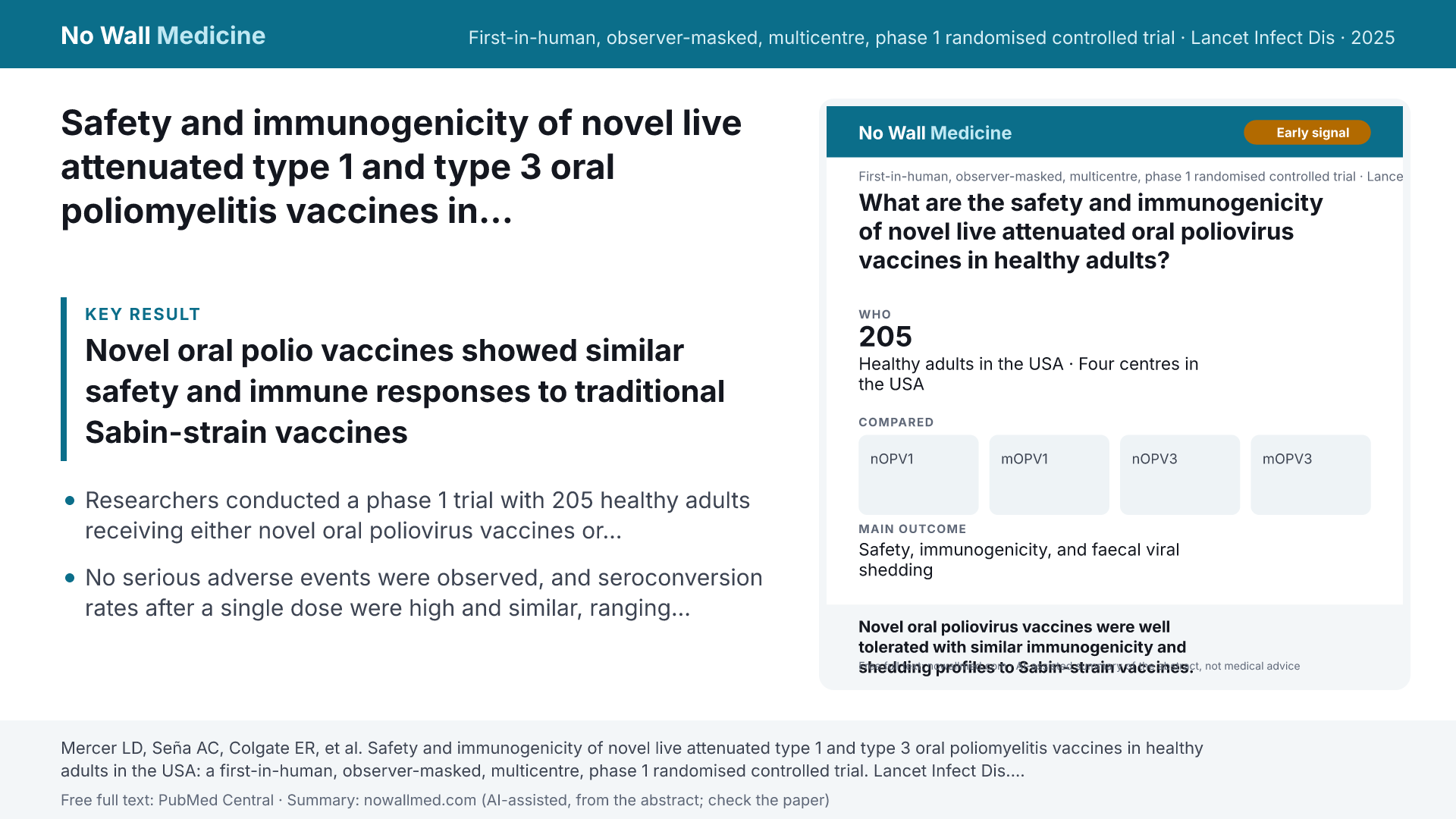
Novel oral polio vaccines showed similar safety and immune responses to traditional Sabin-strain vaccines
Safety and immunogenicity of novel live attenuated type 1 and type 3 oral poliomyelitis vaccines in healthy adults in the USA: a first-in-human, observer-masked, multicentre, phase 1 randomised controlled trial
First-in-human, observer-masked, multicentre, phase 1 randomised controlled trialBenefit found
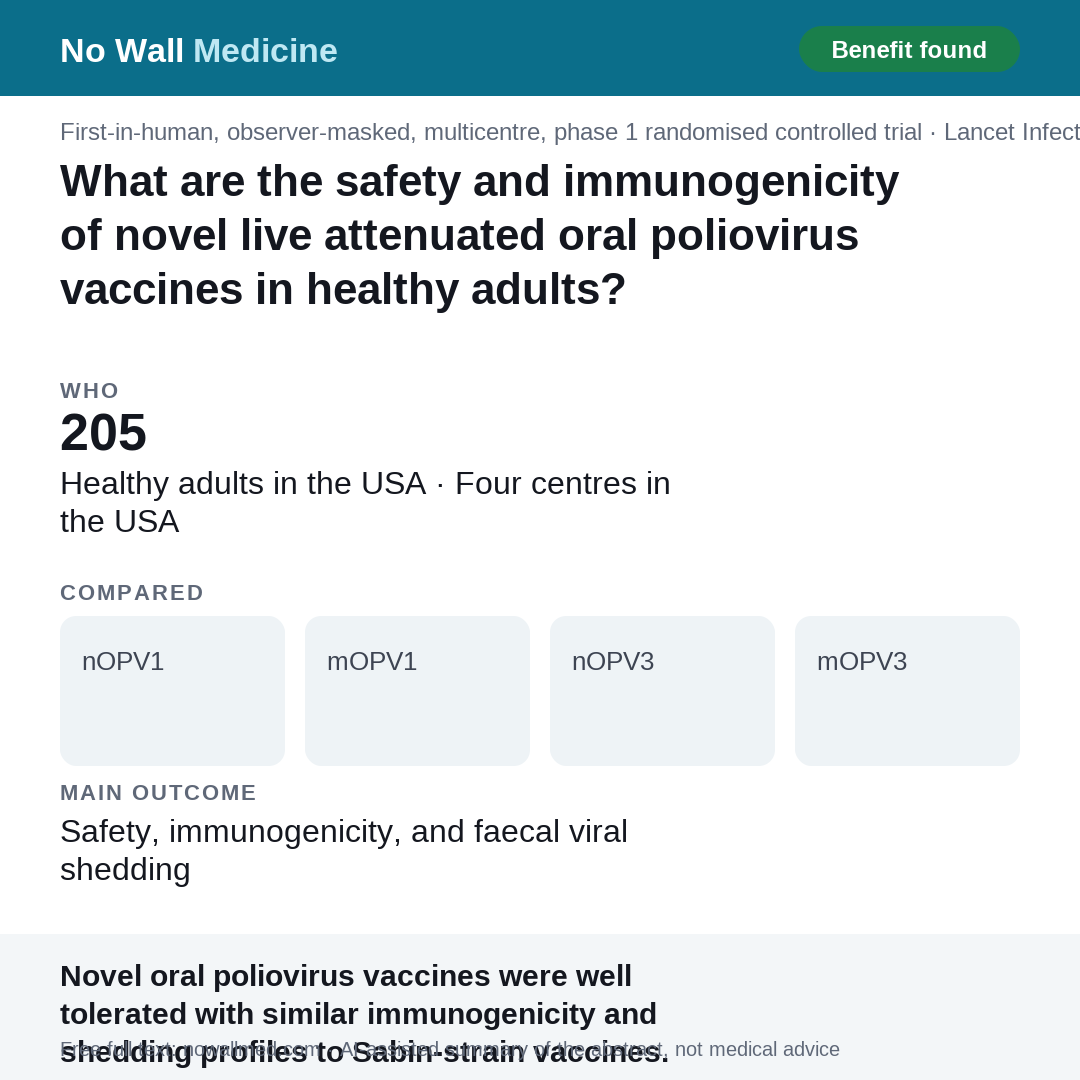
What are the safety and immunogenicity of novel live attenuated oral poliovirus vaccines in healthy adults?
Who
205
Healthy adults in the USA · Four centres in the USA
Compared
nOPV1
mOPV1
nOPV3
mOPV3
Main outcome
Safety, immunogenicity, and faecal viral shedding
Bottom line: Novel oral poliovirus vaccines were well tolerated with similar immunogenicity and shedding profiles to Sabin-strain vaccines.
Funded by: Bill & Melinda Gates Foundation
Lancet Infect Dis · 2025-08-13Download image
Clinical question: What are the safety and immunogenicity of novel live attenuated oral poliovirus vaccines in healthy adults?
Why it matters: New oral poliovirus vaccines were developed to improve genetic stability and reduce the risk of vaccine-derived polioviruses compared to existing Sabin-strain vaccines.
Key points
- Researchers conducted a phase 1 trial with 205 healthy adults receiving either novel oral poliovirus vaccines or traditional Sabin-strain monovalent oral poliovirus vaccines.
- No serious adverse events were observed, and seroconversion rates after a single dose were high and similar, ranging from 86% to 100% for the novel vaccines and 86% to 93% for the traditional vaccines.
- Viral shedding rates were similar between the novel and traditional vaccine groups, with peak viral shedding detected via PCR in 100% of inactivated poliovirus vaccine participants on day 8.
Headline and key points written with AI from the paper’s abstract, with every number checked against it. Read the paper before relying on them.
Was this summary helpful?
Abstract
Background
Reducing the risks of vaccine-derived polioviruses and vaccine-associated paralytic poliomyelitis motivated the development of novel types 1 and 3 oral poliovirus vaccines (nOPV1 and nOPV3, respectively), designed to have similar safety and immunogenicity and improved genetic stability (to reduce risk of reversion to neurovirulence) relative to types 1 or 3 Sabin-strain OPVs. We aimed to assess the safety and immunogenicity of nOPV1 and nOPV3 in healthy adults. Methods
We did a first-in-human, observer-masked, multicentre, phase 1 randomised controlled trial in healthy adults at four centres in the USA. Participants were block randomised, stratified by site and according to polio vaccination history (inactivated poliovirus vaccine [IPV] only [hereafter IPV participants] or regimens including OPV [hereafter OPV participants]), and randomly assigned to receive either nOPV or homotypic Sabin-strain monovalent OPV (mOPV). IPV participants received a single dose of nOPV1 or mOPV1 (cohort 1) or nOPV3 or mOPV3 (cohort 3) and OPV participants received two doses 28 days apart of nOPV1 or mOPV1 (cohort 2) or nOPV3 or mOPV3 (cohort 4). The primary outcome was safety among vaccinated participants. Secondary outcomes included homotypic serum neutralising antibody responses measured before and 28 days after each dose in a per-protocol population, and faecal viral shedding mainly in IPV participants assessed up to 56 days following each dose among vaccinated participants. This study was registered with ClinicalTrials.gov (NCT04529538) and is complete. Findings
Between May 6, 2021 and Feb 17, 2023, 377 individuals were assessed for eligibility, 226 were randomly assigned, and 205 receive at least one dose of nOPV1 (n=70), mOPV1 (n=45), nOPV3 (n=54), or mOPV3 (n=36). No serious adverse events were observed. Most adverse events were mild, severe events were rare, and solicited events were balanced across groups. Severe solicited events were predominantly fatigue, occurring in 1-4% of participants across all groups except for mOPV1 recipients in whom no such events were reported, and one case of nausea and vomiting in an mOPV1 recipient, and one case of abdominal pain in an nOPV1 recipient. Two (3%) participants in the nOPV1 groups (one reporting severe fatigue, headache, and myalgia, and one reporting abdominal pain) and one (2%) participant in the mOPV1 groups (kidney infection) reported a severe unsolicited adverse event within 28 days. Homotypic seroprotection was nearly 100% at baseline and was 100% 28 days after the first dose. Homotypic seroconversion rates after a single dose were high and similar for nOPV and mOPV (ranging from 86% to 100% for nOPV and from 86% to 93% for mOPV). Similar rates of viral shedding were observed among participants receiving nOPV or mOPV. Peak viral shedding rate detected via PCR among IPV participants was 100% on day 8 after a dose, across groups. Interpretation
nOPV1 and nOPV3 were well tolerated and showed similar immunogenicity and shedding profiles to mOPV1 and mOPV3, respectively, supporting progression of these vaccine candidates to phase 2 studies. Funding
Bill & Melinda Gates Foundation.
Abstract reproduced under the article’s CC BY licence.
Subject terms
Cite this article
Mercer LD, Seña AC, Colgate ER, Crothers JW, Wright PF, Al-Ibrahim M. Safety and immunogenicity of novel live attenuated type 1 and type 3 oral poliomyelitis vaccines in healthy adults in the USA: a first-in-human, observer-masked, multicentre, phase 1 randomised controlled trial. Lancet Infect Dis. 2025. doi:10.1016/S1473-3099(25)00285-3
Spotted a mistake? Suggest a correction
Top studies every Monday
The week’s key trials and guidelines in your specialties, plus any topics you follow. By email, free.
Get the weekly digest