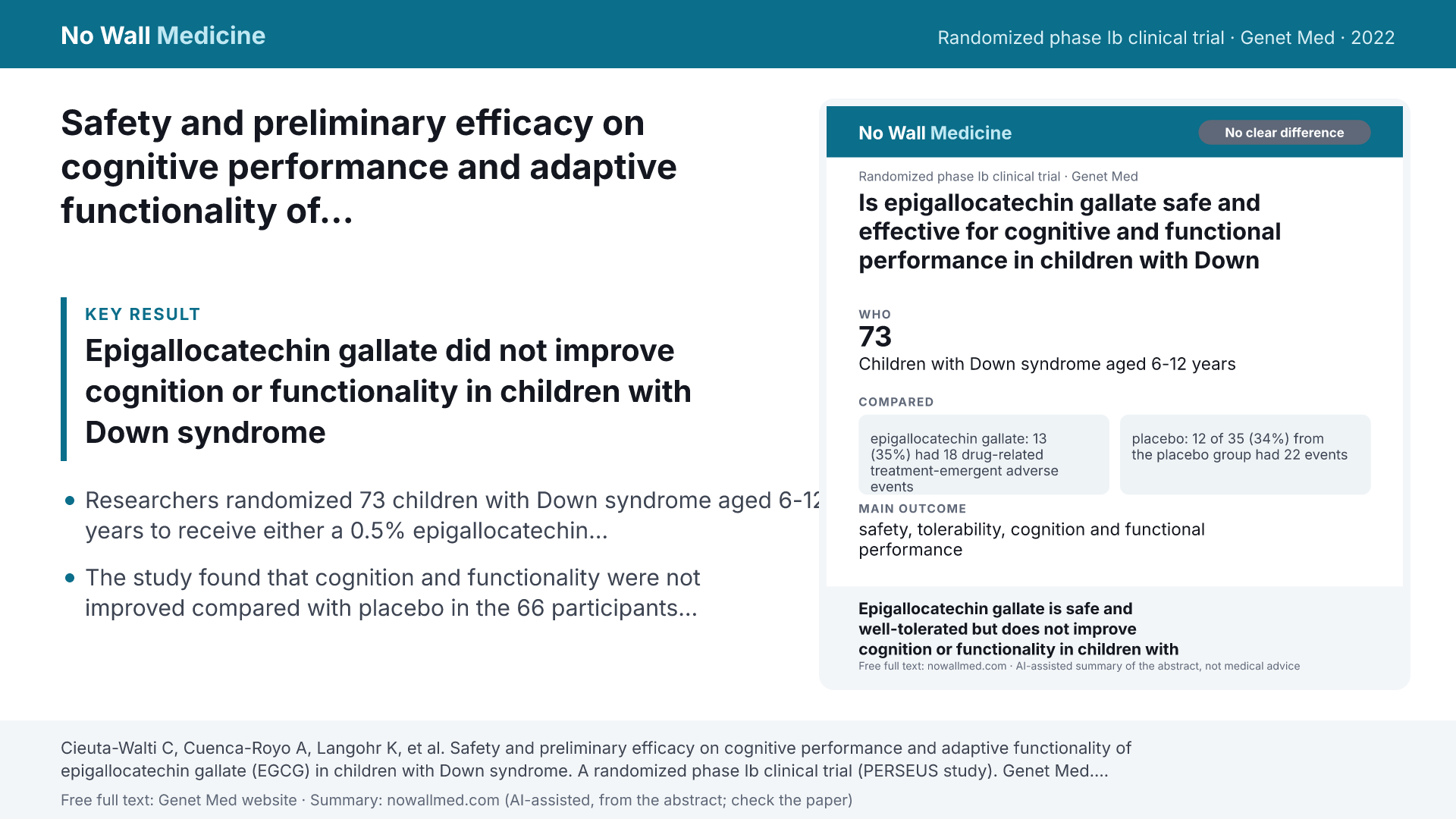
Epigallocatechin gallate did not improve cognition or functionality in children with Down syndrome
Safety and preliminary efficacy on cognitive performance and adaptive functionality of epigallocatechin gallate (EGCG) in children with Down syndrome. A randomized phase Ib clinical trial (PERSEUS study)
Randomized phase Ib clinical trialNo clear difference
Is epigallocatechin gallate safe and effective for cognitive and functional performance in children with Down syndrome?
Who
73
Children with Down syndrome aged 6-12 years
Compared
epigallocatechin gallate: 13 (35%) had 18 drug-related treatment-emergent adverse events
placebo: 12 of 35 (34%) from the placebo group had 22 events
Main outcome
safety, tolerability, cognition and functional performance
Bottom line: Epigallocatechin gallate is safe and well-tolerated but does not improve cognition or functionality in children with Down syndrome.
Genet Med · 2022-08-11Download image
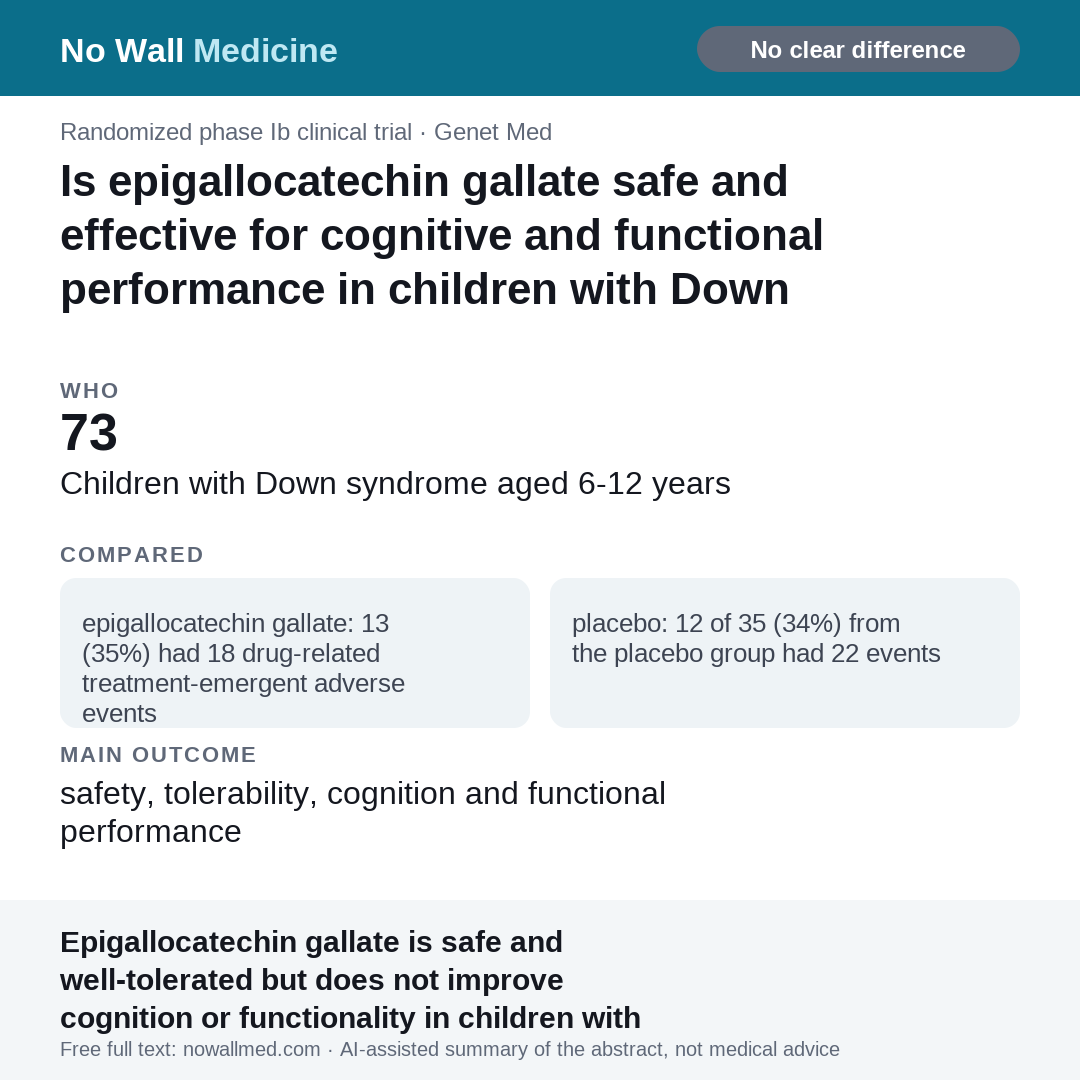
Clinical question: Is epigallocatechin gallate safe and effective for cognitive and functional performance in children with Down syndrome?
Why it matters: It was unknown if epigallocatechin gallate is safe and effective for improving cognitive and functional performance in the pediatric Down syndrome population.
Key points
- Researchers randomized 73 children with Down syndrome aged 6-12 years to receive either a 0.5% epigallocatechin gallate supplement or a placebo for 6 months.
- The study found that cognition and functionality were not improved compared with placebo in the 66 participants who completed the trial.
- Of the 72 treated participants, 62 (86%) experienced treatment-emergent adverse events, though no severe adverse events occurred in the epigallocatechin gallate group.
Headline and key points written with AI from the paper’s abstract, with every number checked against it. Read the paper before relying on them.
Was this summary helpful?
Subject terms
Cite this article
Cieuta-Walti C, Cuenca-Royo A, Langohr K, Rakic C, López-Vílchez MÁ, Lirio J. Safety and preliminary efficacy on cognitive performance and adaptive functionality of epigallocatechin gallate (EGCG) in children with Down syndrome. A randomized phase Ib clinical trial (PERSEUS study). Genet Med. 2022. doi:10.1016/j.gim.2022.06.011
Spotted a mistake? Suggest a correction