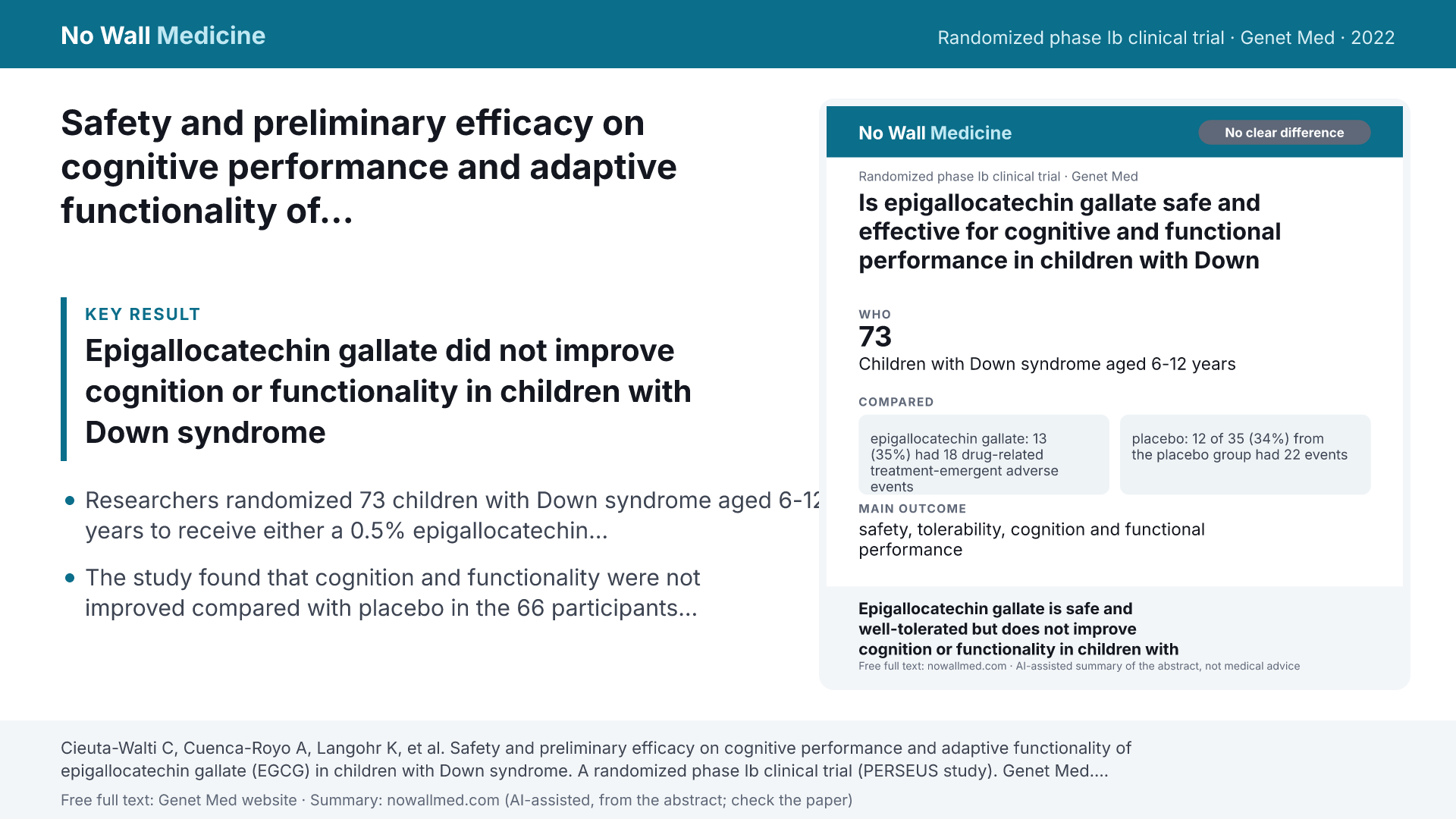
Safety and preliminary efficacy on cognitive performance and adaptive functionality of epigallocatechin gallate (EGCG) in children with Down syndrome. A randomized phase Ib clinical trial (PERSEUS study)
Key result: Epigallocatechin gallate did not improve cognition or functionality in children with Down syndrome
Key points
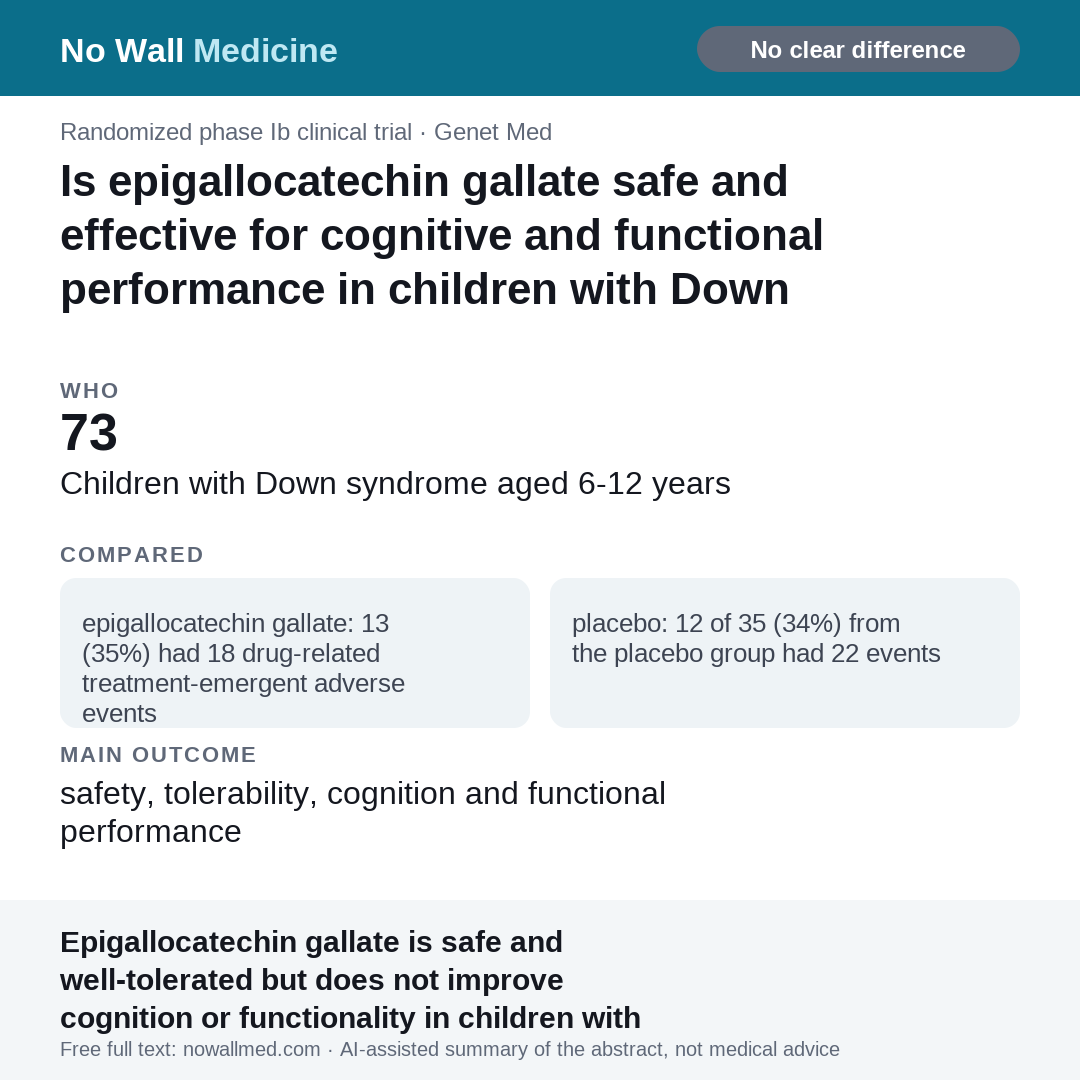
- Researchers randomized 73 children with Down syndrome aged 6-12 years to receive either a 0.5% epigallocatechin gallate supplement or a placebo for 6 months.
- The study found that cognition and functionality were not improved compared with placebo in the 66 participants who completed the trial.
- Of the 72 treated participants, 62 (86%) experienced treatment-emergent adverse events, though no severe adverse events occurred in the epigallocatechin gallate group.
Why it matters: It was unknown if epigallocatechin gallate is safe and effective for improving cognitive and functional performance in the pediatric Down syndrome population.
Discussion prompts
- Would these patients look like yours? Who was left out?
- Is the main outcome one that matters to patients?
- Is the difference large enough to change what you do?
Cite: Cieuta-Walti C, Cuenca-Royo A, Langohr K, Rakic C, López-Vílchez MÁ, Lirio J. Safety and preliminary efficacy on cognitive performance and adaptive functionality of epigallocatechin gallate (EGCG) in children with Down syndrome. A randomized phase Ib clinical trial (PERSEUS study). Genet Med. 2022. doi:10.1016/j.gim.2022.06.011
Free full text: Genet Med website · Summary and visual abstract: nowallmed.com/a/safety-and-preliminary-efficacy-on-cognitive-performance-and-adaptive-19m6uv4/ (AI-assisted from the abstract; check the paper before relying on it).