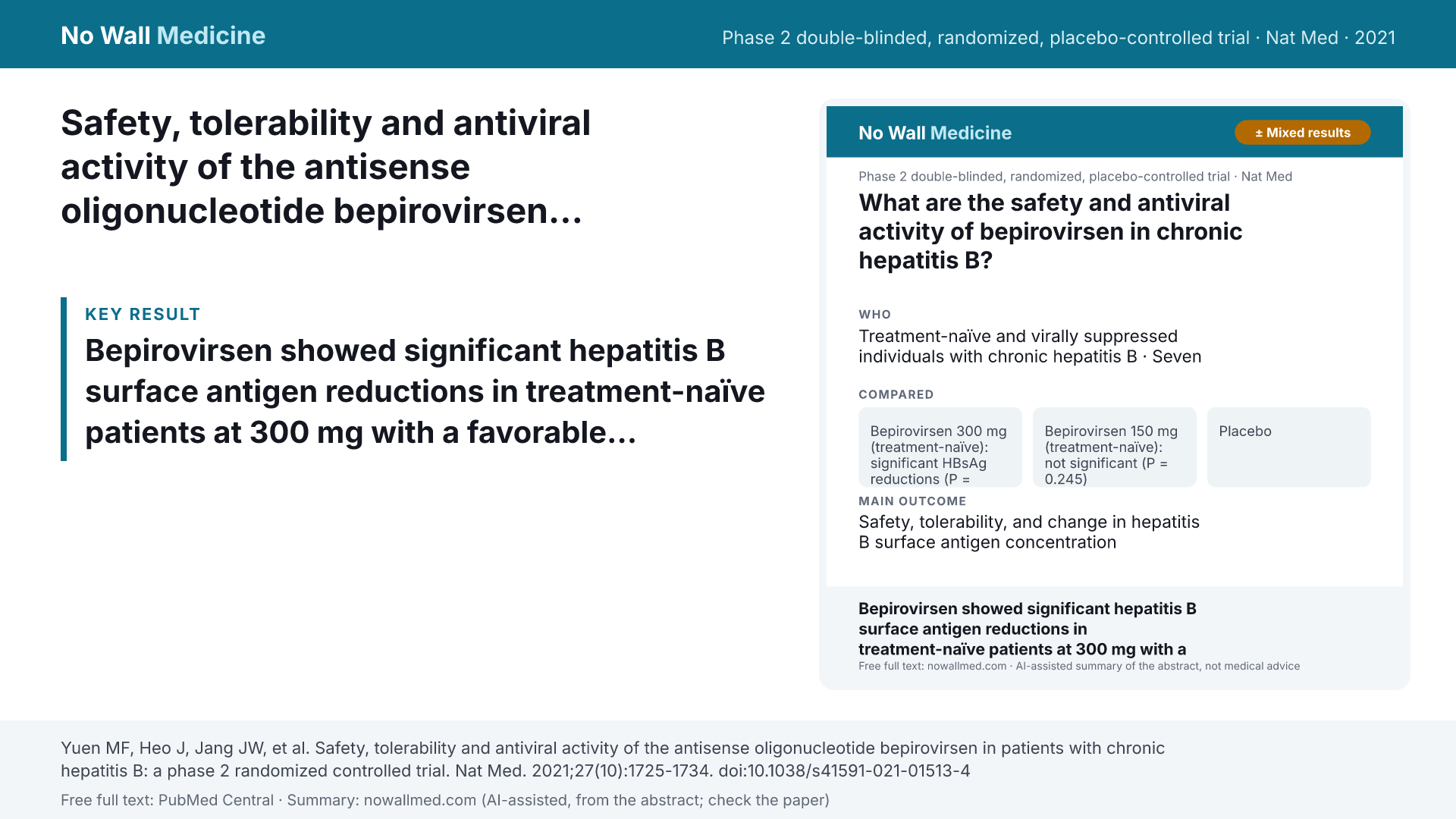
Safety, tolerability and antiviral activity of the antisense oligonucleotide bepirovirsen in patients with chronic hepatitis B: a phase 2 randomized controlled trial
Phase 2 double-blinded, randomized, placebo-controlled trialMixed results
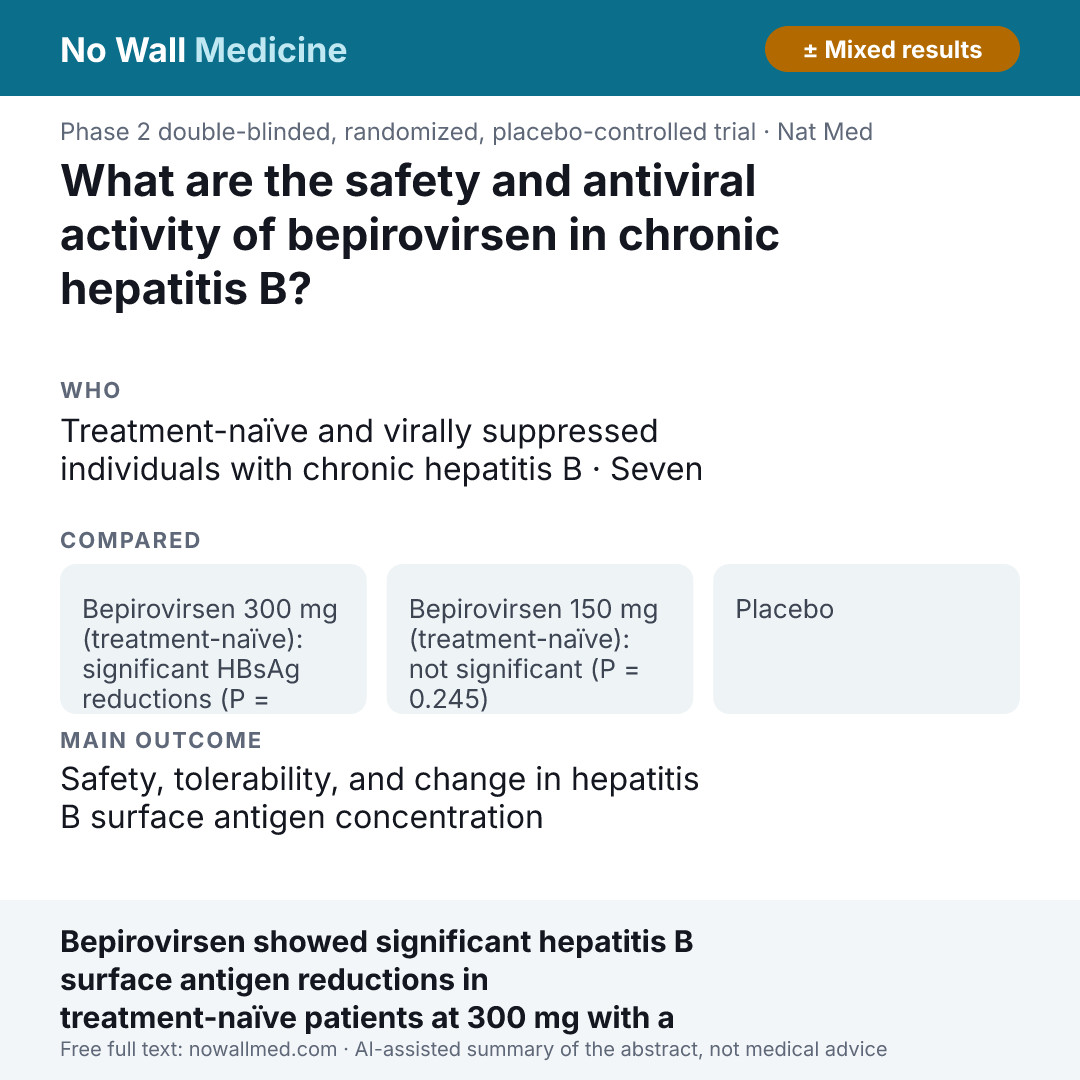
What are the safety and antiviral activity of bepirovirsen in chronic hepatitis B?
Who
Treatment-naïve and virally suppressed individuals with chronic hepatitis B · Seven centers across Hong Kong and the Republic of Korea
Compared
Bepirovirsen 300 mg (treatment-naïve): significant HBsAg reductions (P = 0.001)
Bepirovirsen 150 mg (treatment-naïve): not significant (P = 0.245)
Placebo
Main outcome
Safety, tolerability, and change in hepatitis B surface antigen concentration
Bottom line: Bepirovirsen showed significant hepatitis B surface antigen reductions in treatment-naïve patients at 300 mg with a favorable safety profile.
Nat Med · 2021-10-12 · Save PNG
Clinical question: What are the safety and antiviral activity of bepirovirsen in chronic hepatitis B?
Abstract
Chronic infection with hepatitis B virus (HBV) leads to an increased risk of death from cirrhosis and hepatocellular carcinoma. Functional cure rates are low with current treatment options (nucleos(t)ide analogs (NAs) and pegylated interferons). Bepirovirsen is an antisense oligonucleotide targeting all HBV messenger RNAs; in cell culture and animal models, bepirovirsen leads to reductions in HBV-derived RNAs, HBV DNA and viral proteins. This phase 2 double-blinded, randomized, placebo-controlled trial is the first evaluation of the safety and activity of an antisense oligonucleotide targeting HBV RNA in both treatment-naïve and virally suppressed individuals with chronic HBV infection. The primary objective was to assess the safety and tolerability of bepirovirsen in individuals with chronic hepatitis B (CHB) (NCT02981602). The secondary objective was to assess antiviral activity, including the change from baseline to day 29 in serum hepatitis B surface antigen (HBsAg) concentration. Participants with CHB infection ≥6 months and serum HBsAg ≥50 IU ml-1 were enrolled from seven centers across Hong Kong and the Republic of Korea and randomized (3:1 within each dose cohort) to receive bepirovirsen or placebo via subcutaneous injection twice weekly during weeks 1 and 2 (days 1, 4, 8 and 11) and once weekly during weeks 3 and 4 (days 15 and 22). Participants were then followed for 26 weeks. Twenty-four participants were treatment-naïve and seven were receiving stable NA therapy. Treatment-emergent adverse events were mostly mild/moderate (most commonly injection site reactions). Eleven (61.1%) and three (50.0%) treatment-naïve participants experienced one or more treatment-emergent adverse event in the bepirovirsen and placebo groups, respectively. In participants receiving NA therapy, the corresponding numbers were three (60.0%) and one (50.0%). Transient, self-resolving alanine aminotransferase flares (≥2× upper limit of normal) were observed in eight treatment-naïve participants and three participants on stable NA regimens in the bepirovirsen treatment arms. HBsAg reductions were observed and were significant versus placebo for treatment-naïve participants receiving bepirovirsen 300 mg (P = 0.001), but not for the bepirovirsen 150 mg group (P = 0.245) or participants receiving stable NA therapy (P = 0.762). Two participants in each of the 300 mg dose groups achieved HBsAg levels below the lower limit of quantitation by day 29 (n = 3) or day 36 (n = 1). Bepirovirsen had a favorable safety profile. These preliminary observations warrant further investigation of the safety and activity of bepirovirsen in a larger CHB patient population.
Subject terms
Headline, design, result, key points, caveat and citation as plain text.
Cite this article
Yuen MF, Heo J, Jang JW, et al. Safety, tolerability and antiviral activity of the antisense oligonucleotide bepirovirsen in patients with chronic hepatitis B: a phase 2 randomized controlled trial. Nat Med. 2021;27(10):1725-1734. doi:10.1038/s41591-021-01513-4
Spotted a mistake? Suggest a correction