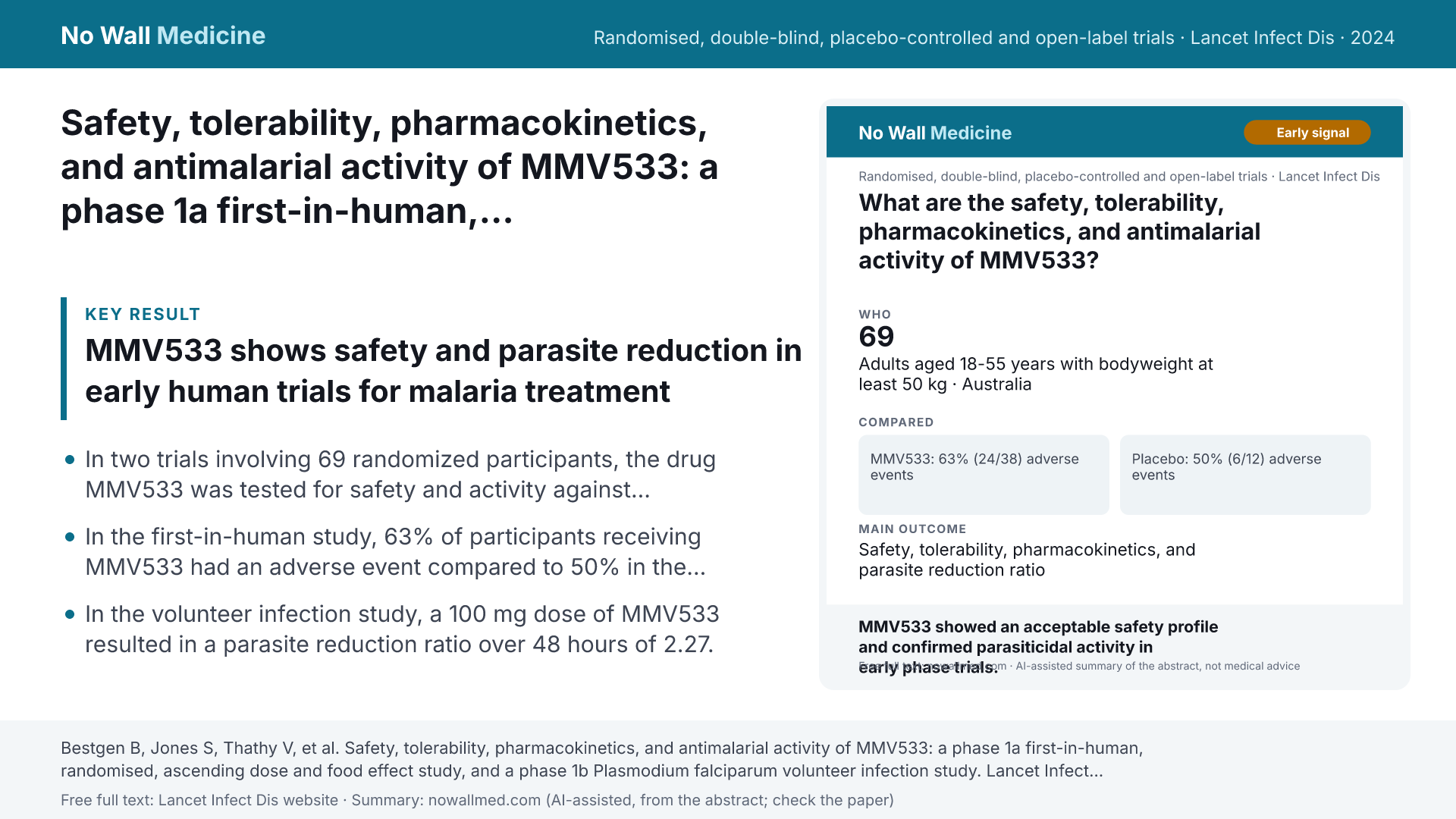
MMV533 shows safety and parasite reduction in early human trials for malaria treatment
Safety, tolerability, pharmacokinetics, and antimalarial activity of MMV533: a phase 1a first-in-human, randomised, ascending dose and food effect study, and a phase 1b Plasmodium falciparum volunteer infection study
Randomised, double-blind, placebo-controlled and open-label trialsEarly signal
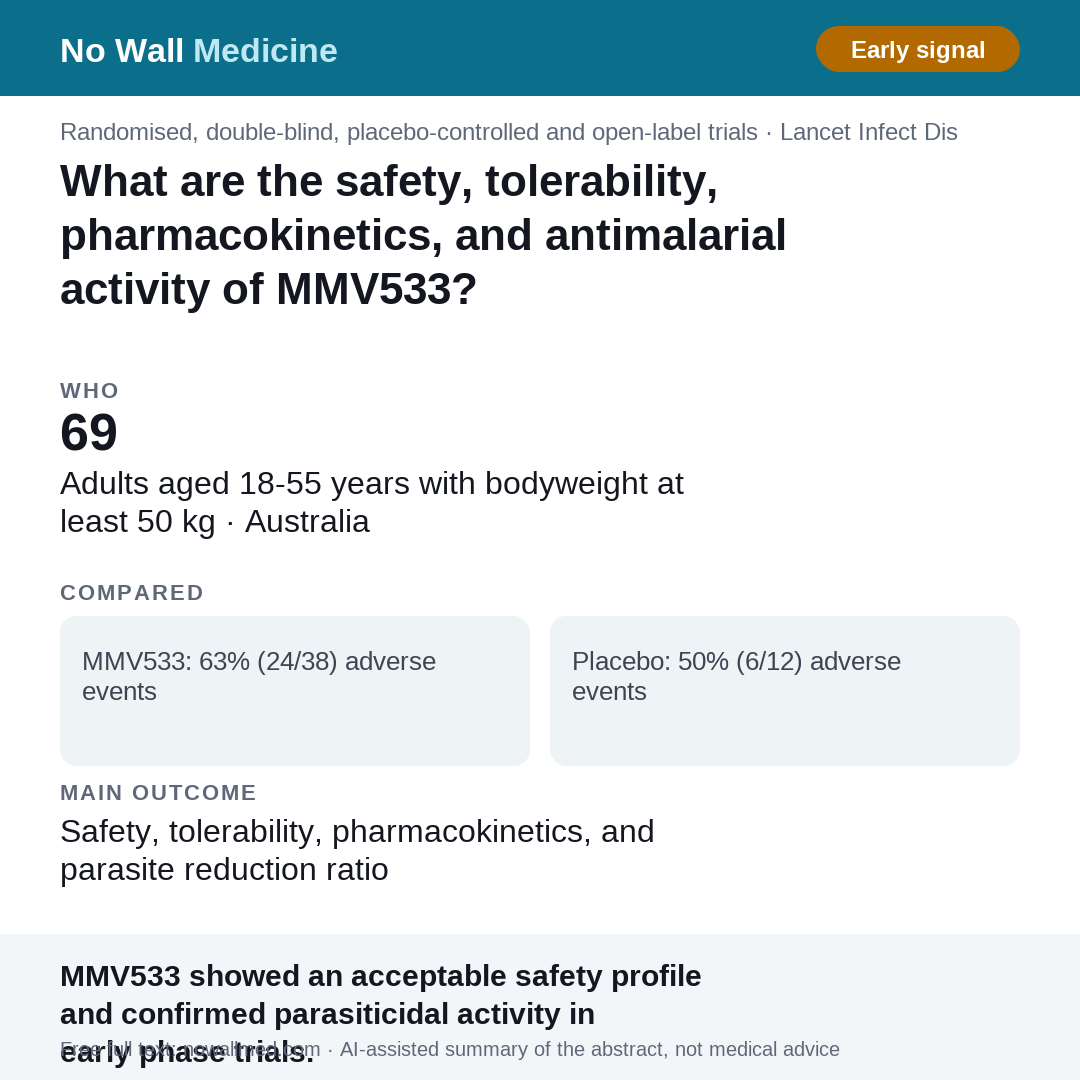
What are the safety, tolerability, pharmacokinetics, and antimalarial activity of MMV533?
Who
69
Adults aged 18-55 years with bodyweight at least 50 kg · Australia
Compared
MMV533: 63% (24/38) adverse events
Placebo: 50% (6/12) adverse events
Main outcome
Safety, tolerability, pharmacokinetics, and parasite reduction ratio
Bottom line: MMV533 showed an acceptable safety profile and confirmed parasiticidal activity in early phase trials.
Funded by: Medicines for Malaria Venture and Bill & Melinda Gates Foundation
Lancet Infect Dis · 2024-12-18Download image
Clinical question: What are the safety, tolerability, pharmacokinetics, and antimalarial activity of MMV533?
Why it matters: New antimalarial drugs are needed to address emerging resistance to artemisinin and partner drugs.
Key points
- In two trials involving 69 randomized participants, the drug MMV533 was tested for safety and activity against malaria parasites.
- In the first-in-human study, 63% of participants receiving MMV533 had an adverse event compared to 50% in the placebo group.
- In the volunteer infection study, a 100 mg dose of MMV533 resulted in a parasite reduction ratio over 48 hours of 2.27.
Headline and key points written with AI from the paper’s abstract, with every number checked against it. Read the paper before relying on them.
Was this summary helpful?
Abstract
Background
Novel antimalarials are needed to address emerging resistance to artemisinin and partner drugs. We did two trials to evaluate safety, tolerability, pharmacokinetics, and activity against blood stage Plasmodium falciparum for the drug candidate MMV533. Methods
A phase 1a first-in-human (FIH) trial was conducted at Nucleus Network (Melbourne, VIC, Australia). Part 1 was a double-blind, randomised, placebo-controlled, sequential ascending dose study and part 2 was an open-label, randomised, two-period crossover, pilot food effect study. A phase 1b, open-label, volunteer infection study (VIS) was conducted at Nucleus Network (Herston, QLD, Australia). Eligible participants were adults aged 18-55 years, with a bodyweight of at least 50 kg and BMI of 18-32 kg/m2 and participants in the VIS were malaria-naive. In part 1 of the FIH study, six cohorts of up to eight participants were randomly assigned (3:1) to a single oral MMV533 dose (5, 10, 20, 50, 100, and 160 mg) or placebo using an automated system, with study staff and participants masked to treatment allocation, and follow-up until day 28. In part 2, MMV533 30 mg was administered open-label to one cohort of nine participants assigned by simple randomisation (1:1) to the fasted-fed (n=4) or fed-fasted (n=5) groups. After a 21-day washout period, fed and fasted groups crossed over with follow-up until day 42. In the VIS, seven participants were assigned using simple randomisation (1:1:1) to three dosing groups of 20 mg (n=3), 35 mg (n=2), or 100 mg (n=2) after parasitaemia was detected, with follow-up until day 28. The primary outcomes were treatment emergent adverse events and relationship to MMV533 for the FIH study assessed in the safety population, and in the VIS primary outcomes were parasite reduction ratio over 48 h (log10PRR48), parasite clearance half-life (PCT1/2), and lag phase assessed in the pharmacodynamic population. MMV533 pharmacokinetics was a secondary outcome for both studies, evaluated in the pharmacokinetic population. The studies are registered with ClinicalTrials.gov, NCT04323306 and NCT05205941 (completed). Findings
The FIH study was conducted between July 31, 2020, and Sept 27, 2022, and the VIS between March 31 and Aug 9, 2022. 335 adults were assessed for eligibility, 71 enrolled, and 69 randomly assigned (53 in part 1 and nine in part 2 of the FIH study, and seven in the VIS). 32 (45%) of 71 participants were female and 39 (55%) were male. In part 1, 24 (63%) of 38 participants had an adverse event after MMV533 administration with no apparent relationship to dose versus six (50%) of 12 after placebo. Treatment-related adverse events were reported for four (11%) participants receiving MMV533 and one (8%) receiving placebo, with no relationship to dose. In part 2, adverse events were reported for three (38%) of eight participants when fasted and four (44%) of nine when fed, with no apparent influence of food. Time to maximum plasma concentration was 4·0-6·0 h, and apparent half-life was 103·8-127·2 h. After a high-fat meal, the geometric mean ratio (fed:fasted) of MMV533 AUC0-last was 112·0 (90% CI 89·6-140·0). In the VIS for MMV533 100 mg, log10PRR48 was 2·27 (1·99-2·56), PCT1/2 was 6·36 h (5·64-7·28), and lag phase was 2 h. Interpretation
An acceptable safety and tolerability profile, confirmed parasiticidal activity, and a long half-life support progression of MMV533 into clinical trials in patients with malaria as a component of new antimalarial combination therapies. Funding
MMV Medicines for Malaria Venture and Bill & Melinda Gates Foundation.
Abstract reproduced under the article’s CC BY licence.
Subject terms
Cite this article
Bestgen B, Jones S, Thathy V, et al. Safety, tolerability, pharmacokinetics, and antimalarial activity of MMV533: a phase 1a first-in-human, randomised, ascending dose and food effect study, and a phase 1b Plasmodium falciparum volunteer infection study. Lancet Infect Dis. 2024. doi:10.1016/S1473-3099(24)00664-9
Spotted a mistake? Suggest a correction