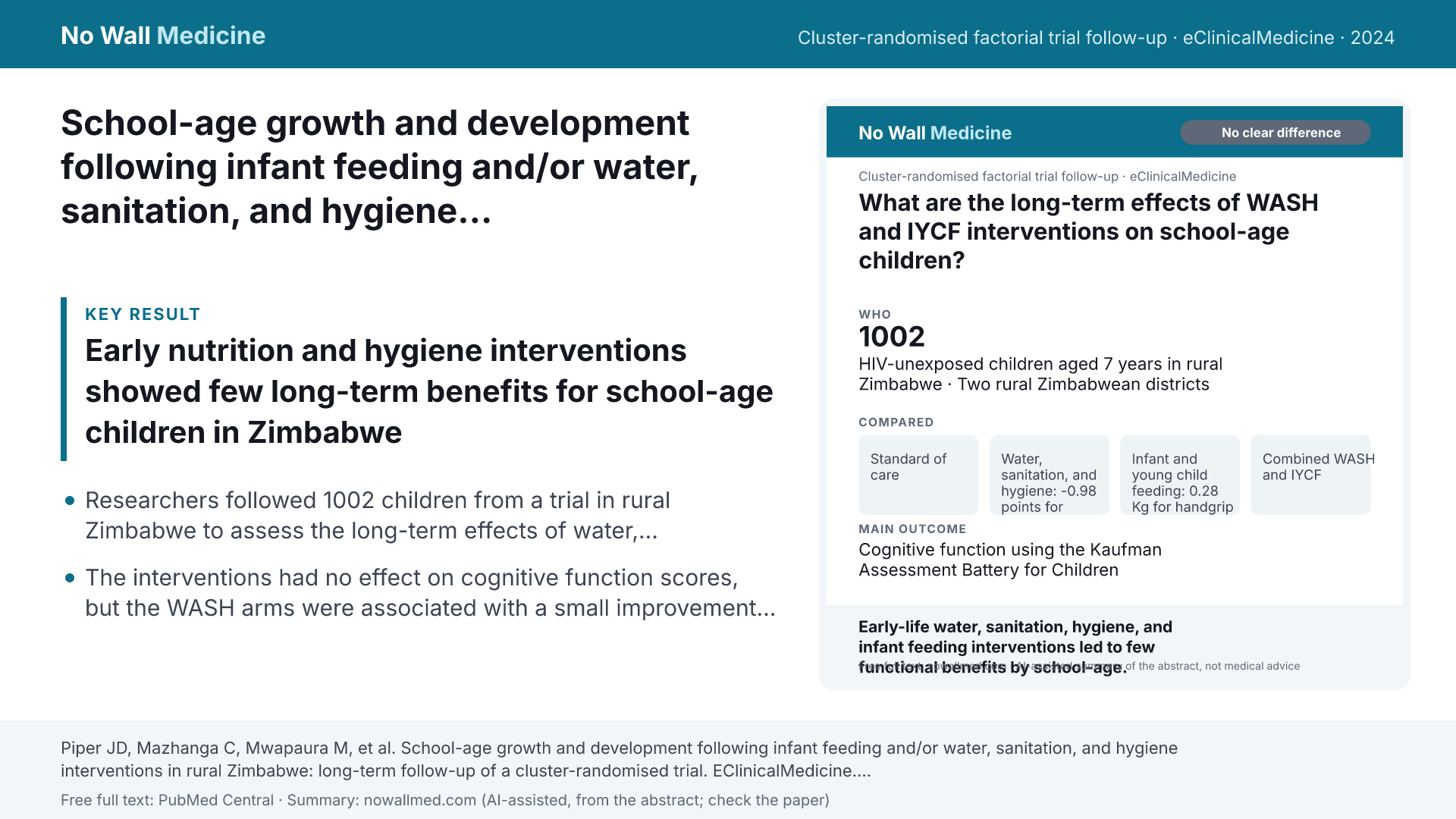
Early nutrition and hygiene interventions showed few long-term benefits for school-age children in Zimbabwe
School-age growth and development following infant feeding and/or water, sanitation, and hygiene interventions in rural Zimbabwe: long-term follow-up of a cluster-randomised trial
Cluster-randomised factorial trial follow-upNo clear difference
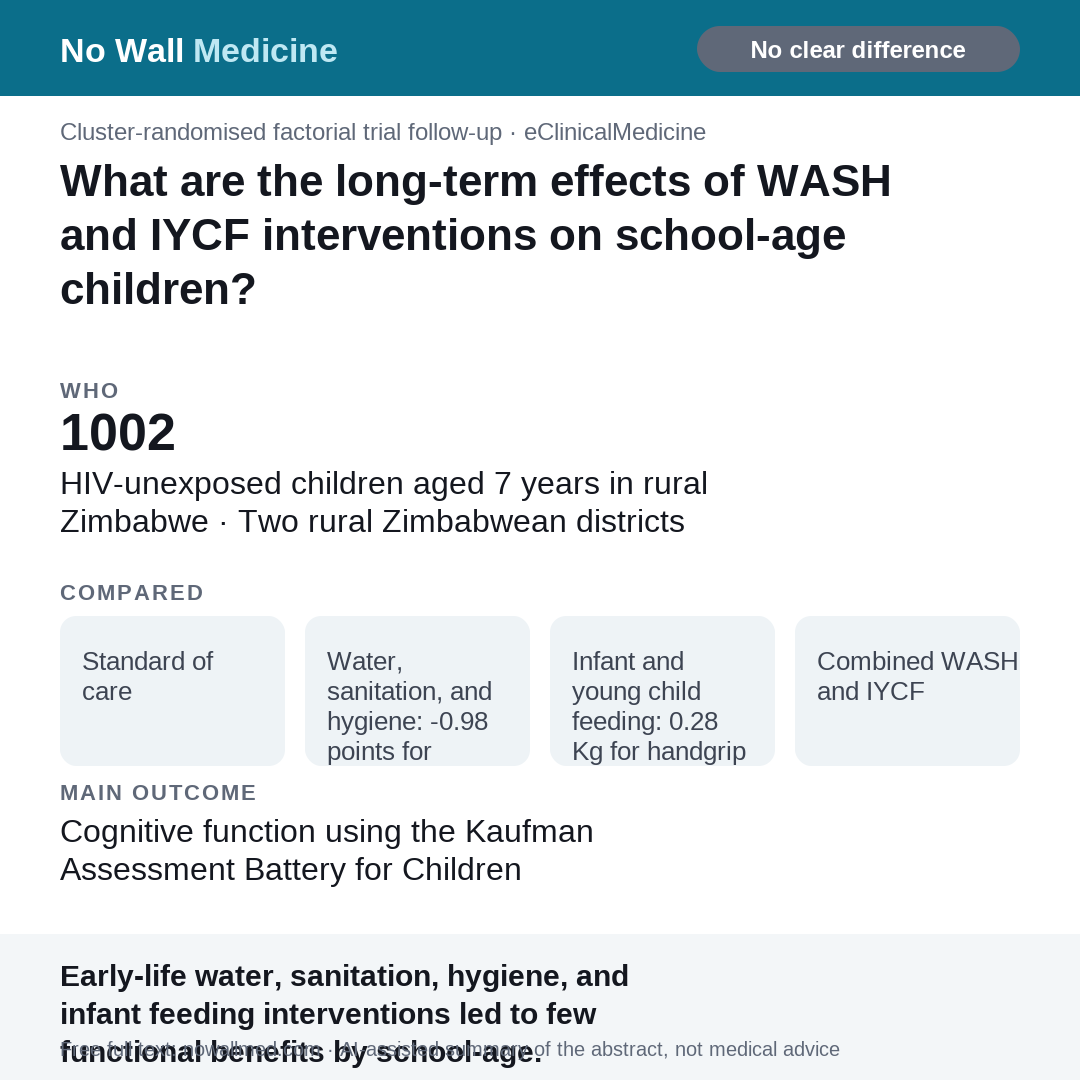
What are the long-term effects of WASH and IYCF interventions on school-age children?
Who
1002
HIV-unexposed children aged 7 years in rural Zimbabwe · Two rural Zimbabwean districts
Compared
Standard of care
Water, sanitation, and hygiene: -0.98 points for socioemotional function (95% CI -1.73, -0.22)
Infant and young child feeding: 0.28 Kg for handgrip strength (95% CI 0.02, 0.53)
Combined WASH and IYCF
Main outcome
Cognitive function using the Kaufman Assessment Battery for Children
Result: no effect of IYCF or WASH on the KABC-II score
Bottom line: Early-life water, sanitation, hygiene, and infant feeding interventions led to few functional benefits by school-age.
Funded by: Wellcome, NIH, Thrasher, and IMMANA
eClinicalMedicine · 2024-11-22Download image
Clinical question: What are the long-term effects of WASH and IYCF interventions on school-age children?
Key points
- Researchers followed 1002 children from a trial in rural Zimbabwe to assess the long-term effects of water, sanitation, and hygiene (WASH) and infant and young child feeding (IYCF) interventions.
- The interventions had no effect on cognitive function scores, but the WASH arms were associated with a small improvement in socioemotional function of -0.98 points.
- Children in the IYCF arms had higher handgrip strength by 0.28 Kg, though this was only seen in boys with an increase of 0.53 Kg.
Headline and key points written with AI from the paper’s abstract, with every number checked against it. Read the paper before relying on them.
Was this summary helpful?
Headline, design, result, key points, caveat and citation as plain text.
Cite this article
Piper JD, Mazhanga C, Mwapaura M, et al. School-age growth and development following infant feeding and/or water, sanitation, and hygiene interventions in rural Zimbabwe: long-term follow-up of a cluster-randomised trial. EClinicalMedicine. 2024;78:102946. doi:10.1016/j.eclinm.2024.102946
Spotted a mistake? Suggest a correction