Screening for Adverse Childhood Experiences in Children: A Systematic Review
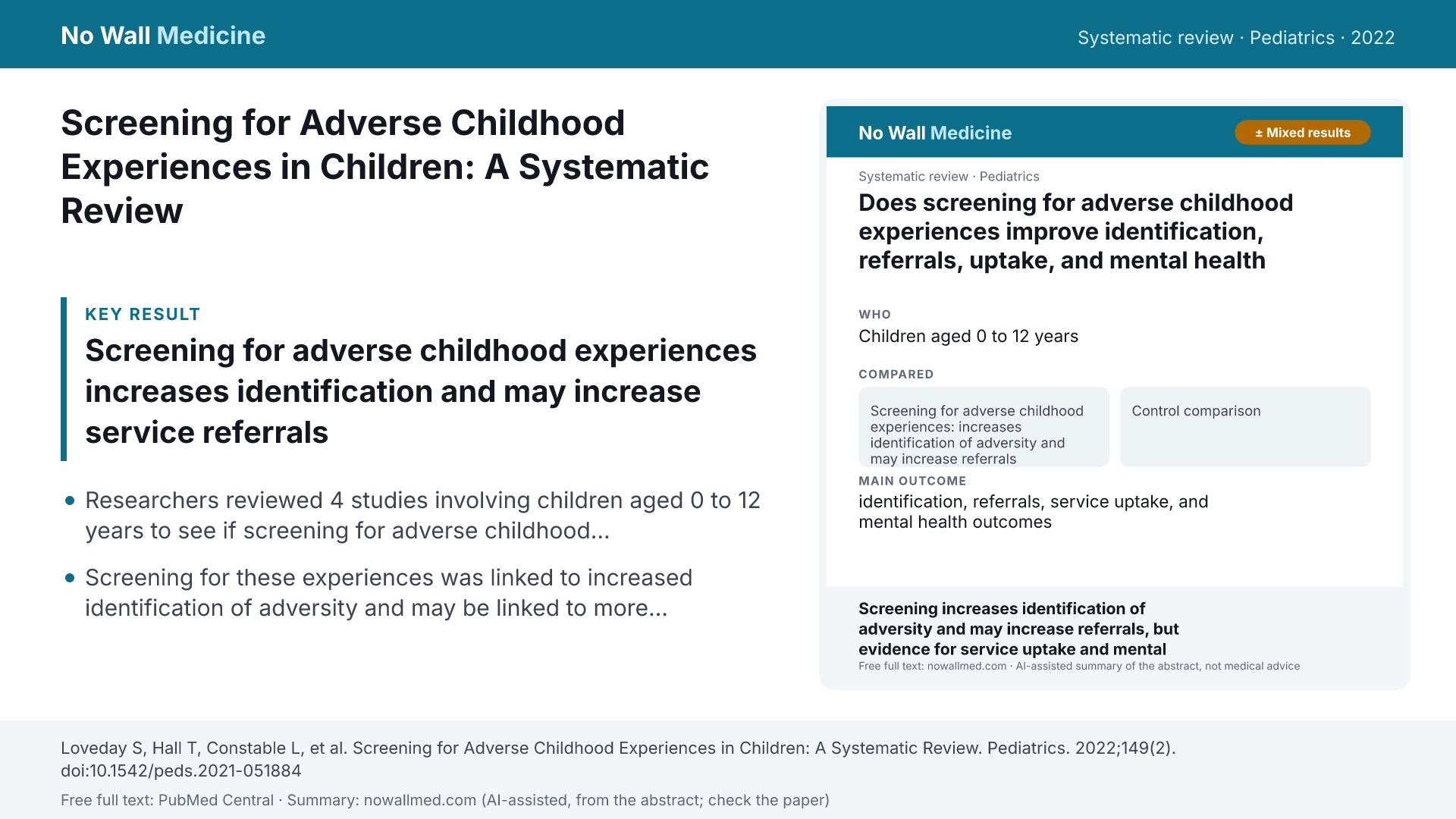
Key result: Screening for adverse childhood experiences increases identification and may increase service referrals
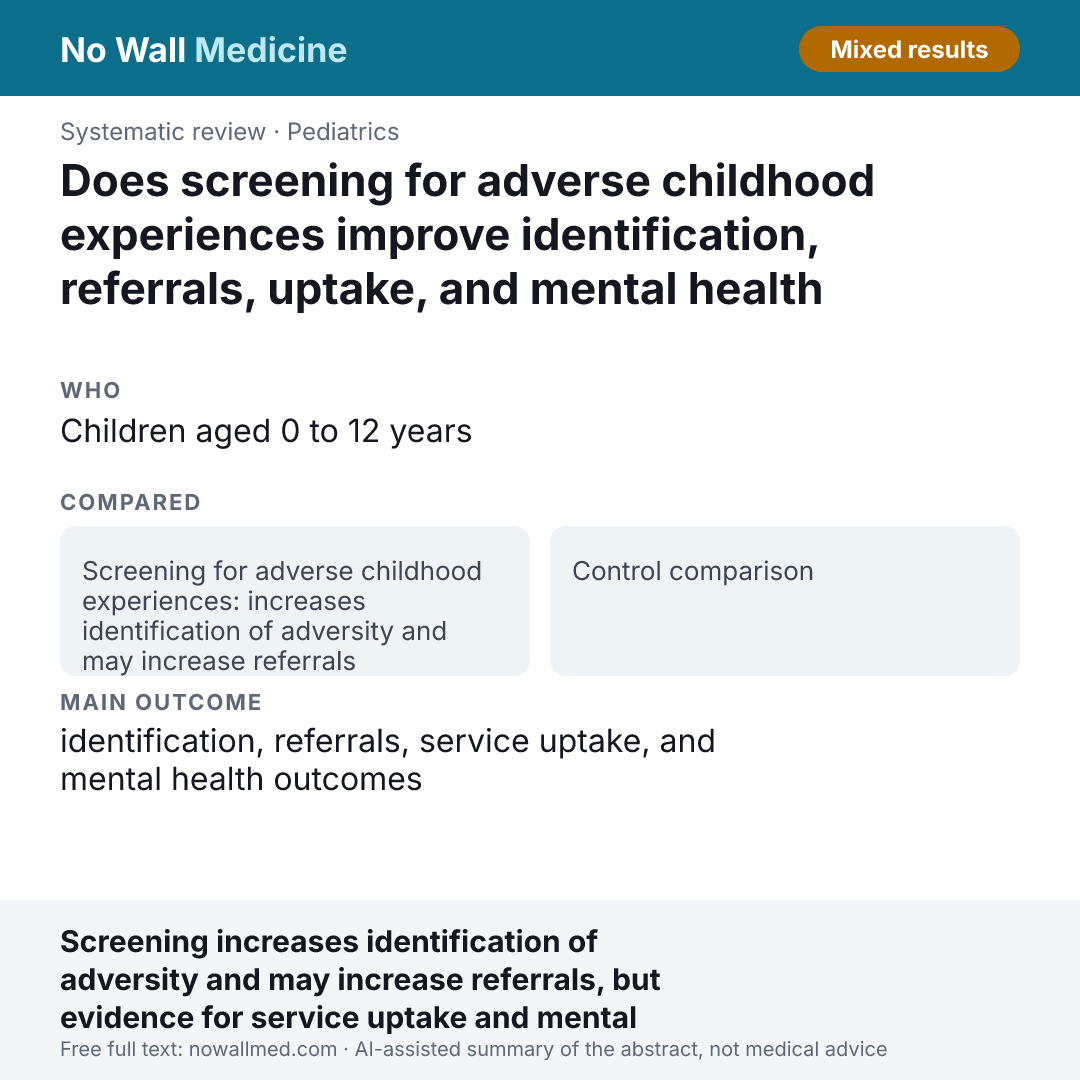
Systematic reviewMixed results
Does screening for adverse childhood experiences improve identification, referrals, uptake, and mental health outcomes?
Who
Children aged 0 to 12 years
Compared
Screening for adverse childhood experiences: increases identification of adversity and may increase referrals
Control comparison
Main outcome
identification, referrals, service uptake, and mental health outcomes
Bottom line: Screening increases identification of adversity and may increase referrals, but evidence for service uptake and mental health is limited.
Limitation: There are few published control trials of moderate quality.
Pediatrics · 2022-02-01 · Save PNG
Key points
- Researchers reviewed 4 studies involving children aged 0 to 12 years to see if screening for adverse childhood experiences improves outcomes.
- Screening for these experiences was linked to increased identification of adversity and may be linked to more referrals to services.
- There were limited data regarding whether screening increases the rate at which families actually use referred services or improves mental health.
Limitation the authors note: There are few published control trials of moderate quality.
Discussion prompts
- Would these patients look like yours? Who was left out?
- Is the main outcome one that matters to patients?
- Is the difference large enough to change what you do?
Cite: Loveday S, Hall T, Constable L, et al. Screening for Adverse Childhood Experiences in Children: A Systematic Review. Pediatrics. 2022;149(2). doi:10.1542/peds.2021-051884
Free full text: PubMed Central · Summary and visual abstract: nowallmed.com/a/screening-for-adverse-childhood-experiences-in-children-a-systematic-1n9wo2n/ (AI-assisted from the abstract; check the paper before relying on it).