Screening for adverse childhood experiences increases identification and may increase service referrals
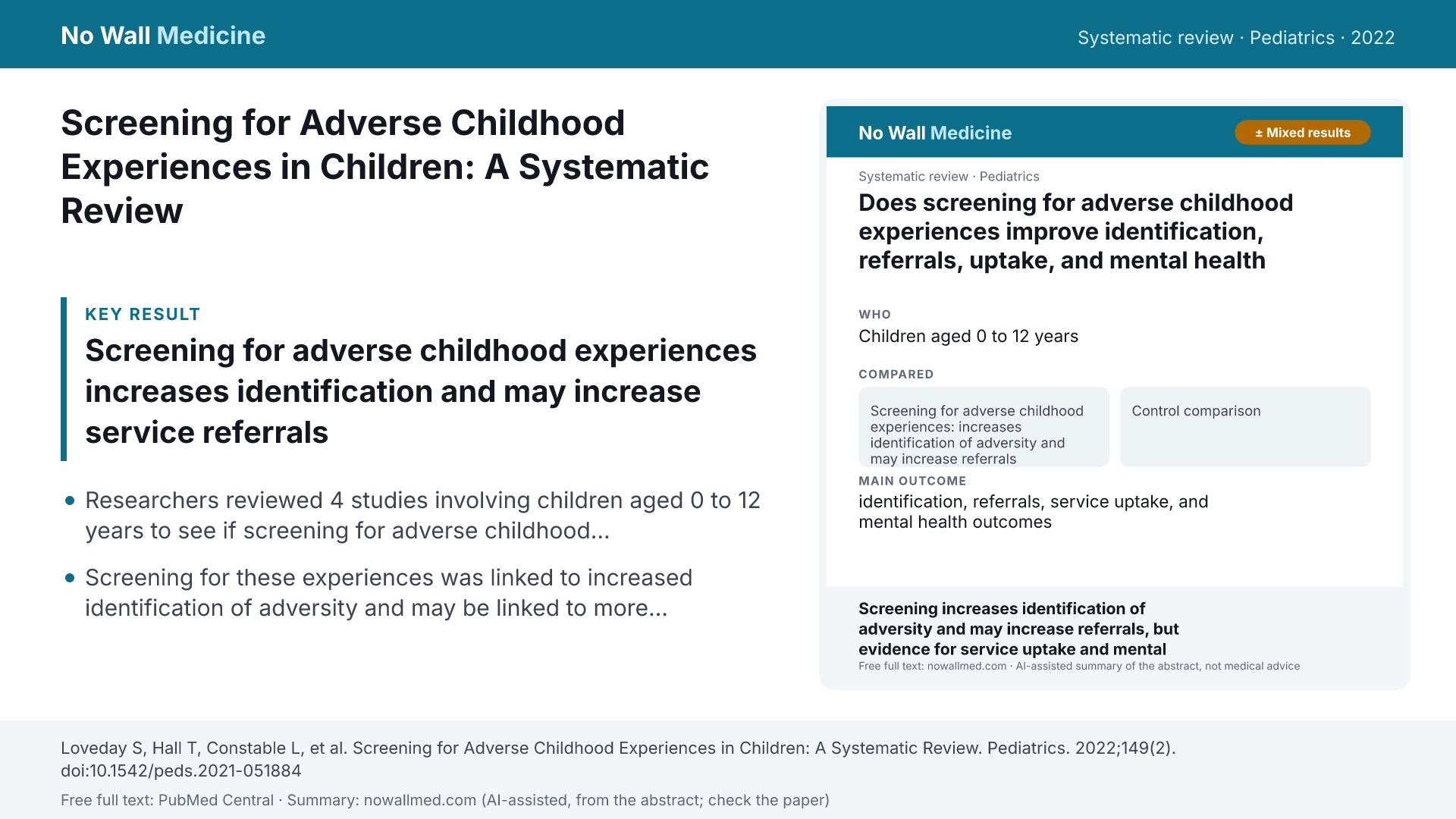
Screening for Adverse Childhood Experiences in Children: A Systematic Review
Systematic reviewMixed results
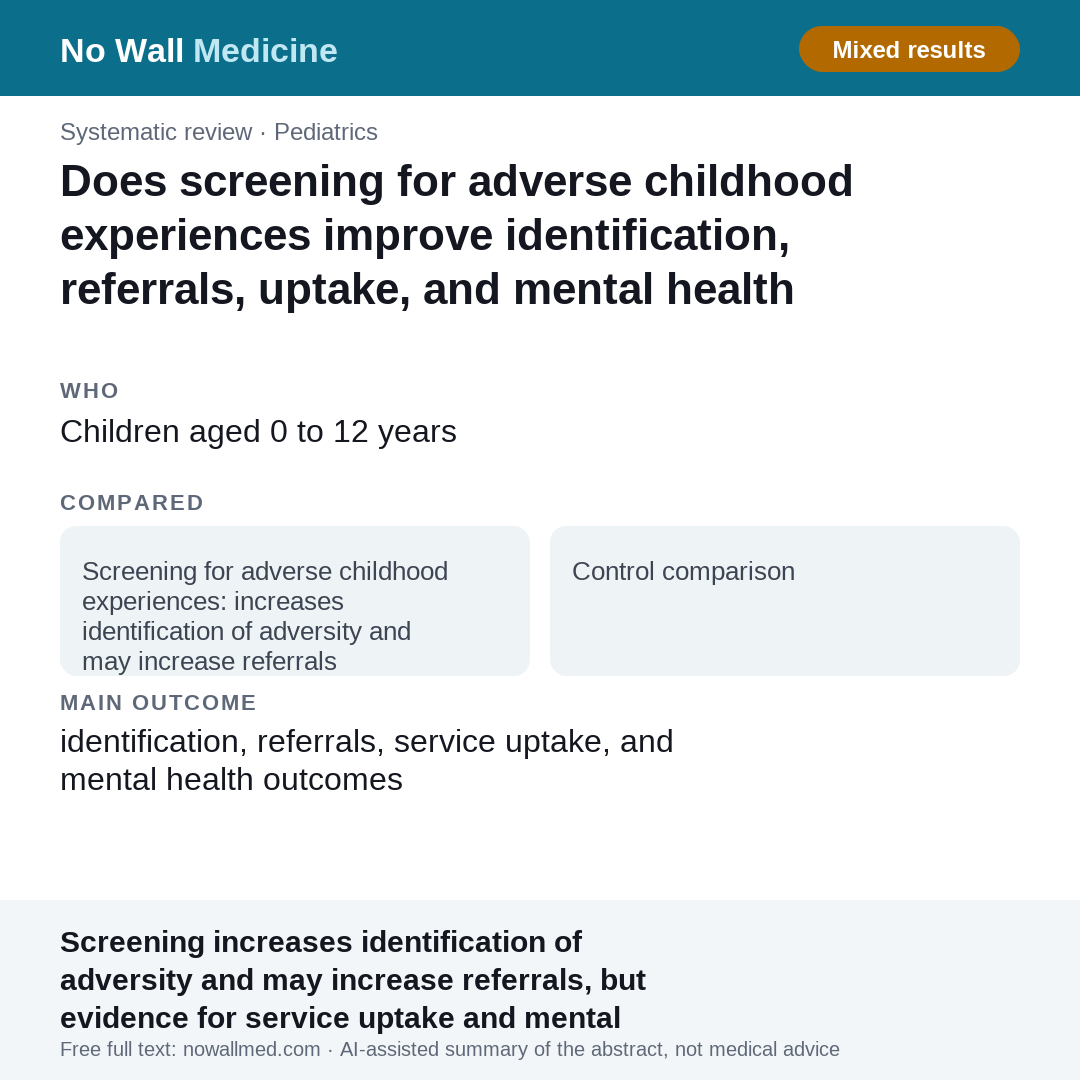
Does screening for adverse childhood experiences improve identification, referrals, uptake, and mental health outcomes?
Who
Children aged 0 to 12 years
Compared
Screening for adverse childhood experiences: increases identification of adversity and may increase referrals
Control comparison
Main outcome
identification, referrals, service uptake, and mental health outcomes
Bottom line: Screening increases identification of adversity and may increase referrals, but evidence for service uptake and mental health is limited.
Limitation: There are few published control trials of moderate quality.
Pediatrics · 2022-02-01Download image
Clinical question: Does screening for adverse childhood experiences improve identification, referrals, uptake, and mental health outcomes?
Why it matters: It is unknown whether screening for adverse childhood experiences improves the identification of adversity, service referrals, service uptake, or mental health outcomes.
Key points
- Researchers reviewed 4 studies involving children aged 0 to 12 years to see if screening for adverse childhood experiences improves outcomes.
- Screening for these experiences was linked to increased identification of adversity and may be linked to more referrals to services.
- There were limited data regarding whether screening increases the rate at which families actually use referred services or improves mental health.
Limitation the authors note: There are few published control trials of moderate quality.
Headline and key points written with AI from the paper’s abstract, with every number checked against it. Read the paper before relying on them.
Was this summary helpful?
Subject terms
Cite this article
Loveday S, Hall T, Constable L, Paton K, Sanci L, Goldfeld S. Screening for Adverse Childhood Experiences in Children: A Systematic Review. Pediatrics. 2022. doi:10.1542/peds.2021-051884
Spotted a mistake? Suggest a correction
Top studies every Monday
The week’s key trials and guidelines in your specialties, plus any topics you follow. By email, free.
Get the weekly digest