Screening methods show varying effectiveness and risks for colorectal cancer detection and mortality
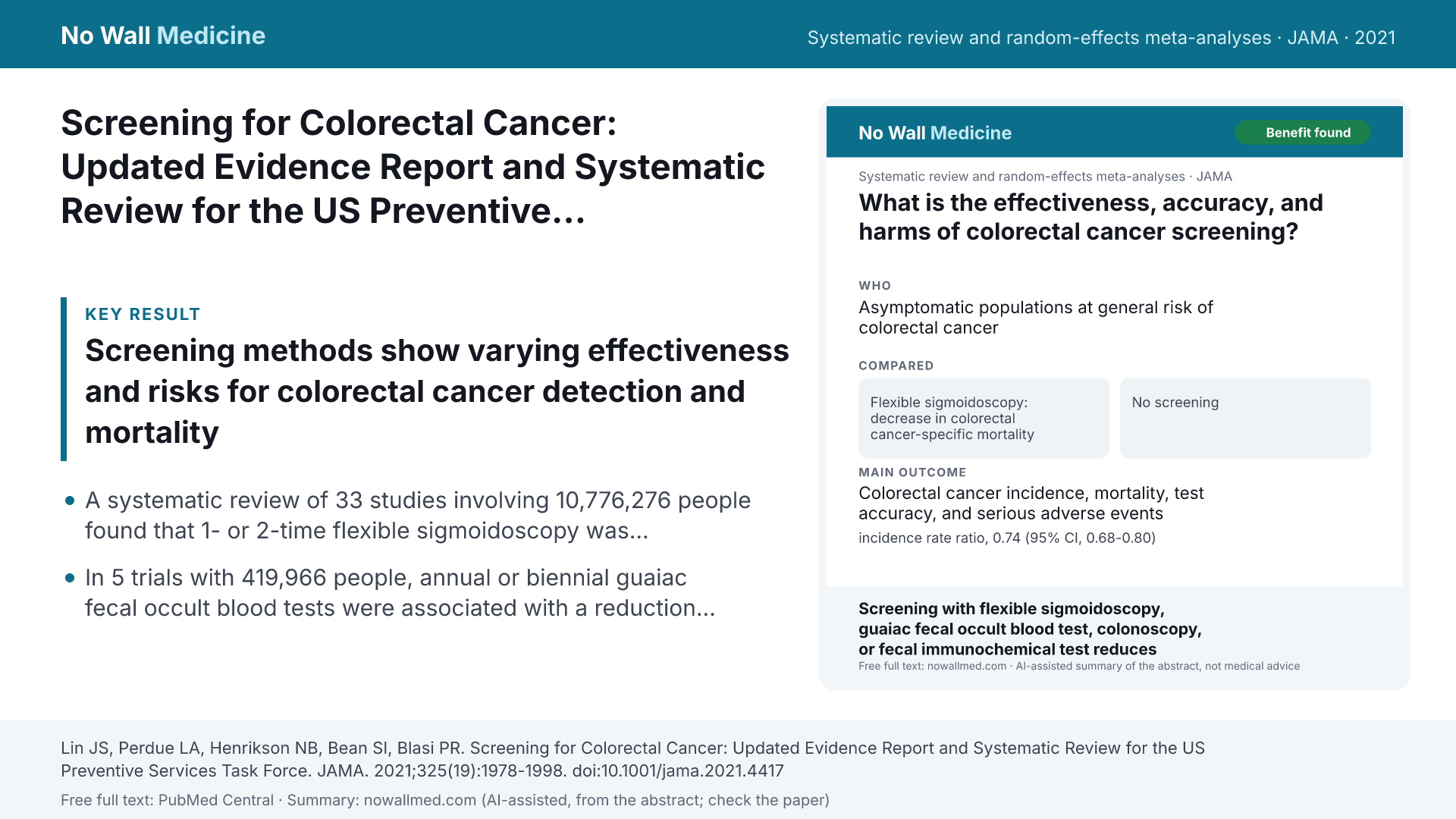
Screening for Colorectal Cancer: Updated Evidence Report and Systematic Review for the US Preventive Services Task Force
Systematic review and random-effects meta-analysesBenefit found
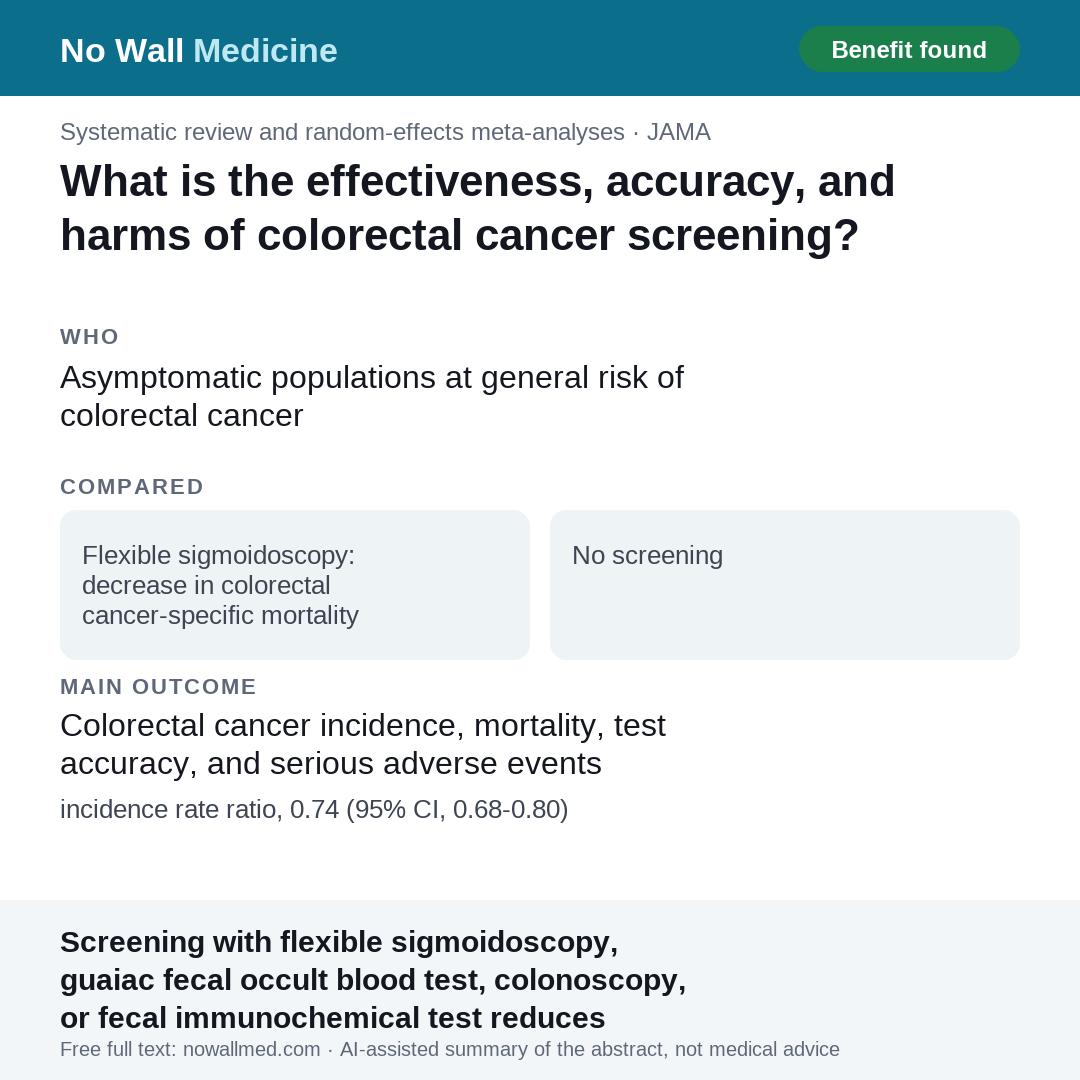
What is the effectiveness, accuracy, and harms of colorectal cancer screening?
Who
Asymptomatic populations at general risk of colorectal cancer
Compared
Flexible sigmoidoscopy: decrease in colorectal cancer-specific mortality
No screening
Main outcome
Colorectal cancer incidence, mortality, test accuracy, and serious adverse events
Result: incidence rate ratio, 0.74 (95% CI, 0.68-0.80)
Bottom line: Screening with flexible sigmoidoscopy, guaiac fecal occult blood test, colonoscopy, or fecal immunochemical test reduces colorectal cancer mortality.
JAMA · 2021-05-18Download image
Clinical question: What is the effectiveness, accuracy, and harms of colorectal cancer screening?
Why it matters: The effectiveness, accuracy, and harms of various colorectal cancer screening options need to be updated to inform clinical guidelines.
Key points
- A systematic review of 33 studies involving 10,776,276 people found that 1- or 2-time flexible sigmoidoscopy was associated with a decrease in colorectal cancer-specific mortality.
- In 5 trials with 419,966 people, annual or biennial guaiac fecal occult blood tests were associated with a reduction in colorectal cancer-specific mortality after 2 to 9 rounds.
- Serious harms of screening colonoscopy included perforations at 3.1/10,000 procedures and major bleeding at 14.6/10,000 procedures.
Headline and key points written with AI from the paper’s abstract, with every number checked against it. Read the paper before relying on them.
Was this summary helpful?
Subject terms
Cite this article
Lin JS, Perdue LA, Henrikson NB, Bean SI, Blasi PR. Screening for Colorectal Cancer: Updated Evidence Report and Systematic Review for the US Preventive Services Task Force. JAMA. 2021. doi:10.1001/jama.2021.4417
Spotted a mistake? Suggest a correction