Questionnaires for work-related asthma show high sensitivity but low specificity in screening tools
Screening tools for work-related asthma and their diagnostic accuracy: a systematic review
Systematic reviewMixed results
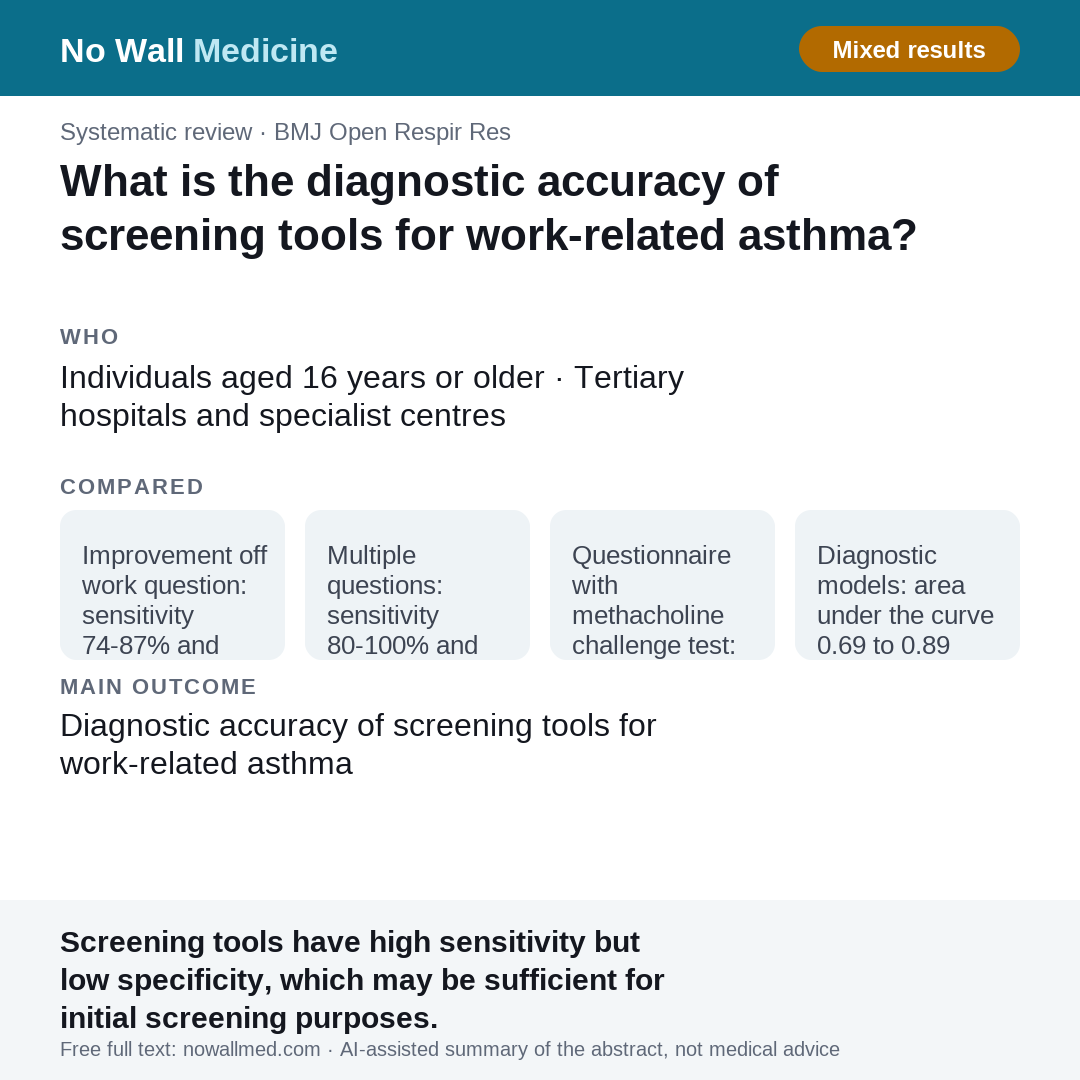
What is the diagnostic accuracy of screening tools for work-related asthma?
Who
Individuals aged 16 years or older · Tertiary hospitals and specialist centres
Compared
Improvement off work question: sensitivity 74-87% and specificity 15-58%
Multiple questions: sensitivity 80-100% and specificity 8-55%
Questionnaire with methacholine challenge test: specificity 75% with sensitivity 65%
Diagnostic models: area under the curve 0.69 to 0.89
Main outcome
Diagnostic accuracy of screening tools for work-related asthma
Bottom line: Screening tools have high sensitivity but low specificity, which may be sufficient for initial screening purposes.
Limitation: Studies are limited, inadequately reported, and need further evaluation in primary care and workplaces.
BMJ Open Respir Res · 2025-07-15Download image
Clinical question: What is the diagnostic accuracy of screening tools for work-related asthma?
Why it matters: The effectiveness and standardization of different screening tools for identifying work-related asthma in clinical settings and workplaces have not been well established.
Key points
- Researchers reviewed 7 studies involving individuals aged 16 years or older to evaluate the accuracy of questionnaires and prediction models for work-related asthma.
- The single question about improvement when away from work had a sensitivity of 74-87% and a specificity of 15-58%.
- Using multiple questions resulted in a sensitivity of 80-100% and a specificity of 8-55%, while adding a methacholine challenge test—a breathing test—increased specificity to 75%.
Limitation the authors note: Studies on screening tools for work-related asthma are limited, inadequately reported, and require further evaluation in primary care populations and workplaces.
Headline and key points written with AI from the paper’s abstract, with every number checked against it. Read the paper before relying on them.
Abstract
Introduction
One in four cases of asthma in adults is caused or worsened by work (work-related asthma: WRA). Early detection of WRA could prevent poor health and employment outcomes, but clinical diagnosis is often missed or delayed. The standardisation and effectiveness of screening tools have not been well established. We aimed to summarise and compare the performance of screening tools for identifying WRA in both clinical settings and workplaces. Methods
We searched for studies that used structured questionnaires or prediction models (with/without physiological tests) to identify WRA in clinical settings or workplaces with individuals aged≥16 years in MEDLINE, Embase, other bibliographic databases and grey literature between 1975 and 2024. Two reviewers independently screened titles, abstracts and full texts for inclusion, extracted data and assessed risk of bias using QUADAS-2 tool (Quality Assessment of Diagnostic Test Accuracy 2) or PROBAST (Prediction Model Risk of Bias Assessment Tool). Screening tools and their indices of accuracy were summarised with paired forest plots of sensitivities and specificities. Results
Of 17 504 identified studies, 7 were included. All were implemented in tertiary hospitals (n=5) and specialist centres (n=2). The screening tools comprised questionnaires alone (individual questions n=3 and multiple questions n=2), questionnaire with methacholine challenge test (n=1) and diagnostic models (n=4). The question 'improvement off work' had sensitivity=74-87% and specificity=15-58% for identifying WRA. Multiple questions had sensitivity=80-100% and specificity=8-55%. Addition of the methacholine challenge test to one questionnaire improved specificity to 75% with sensitivity=65%. Diagnostic models reported area under the curve (AUC) between 0.69 and 0.89, and AUC was improved when adding demographic variables or objective tests. Discussion
A single item 'improvement off work' and multiple questions have high sensitivity but low specificity for WRA, which are sufficient for screening purposes to enhance WRA diagnosis. Adding demographic variables and objective tests can improve specificity or AUC. However, studies on screening tools for WRA are limited and inadequately reported; further evaluations of performance are needed in primary care populations and workplaces. Prospero registration number
CRD42021246031.
Abstract reproduced under the article’s CC BY NC licence.
Topics
Cite this article
Kongsupon N, Adab P, Jordan RE, Huntley CC, Rattanakanokchai S, Wallbanks S. Screening tools for work-related asthma and their diagnostic accuracy: a systematic review. BMJ Open Respir Res. 2025. doi:10.1136/bmjresp-2025-003251
Spotted a mistake? Suggest a correction
Top studies every Monday
The week’s key trials and guidelines in your specialties, plus any topics you follow. By email, free.
Get the weekly digest