Structured stroke prevention package did not reduce recurrent strokes or death in Indian patients
Secondary prevention with a structured semi-interactive stroke prevention package in INDIA (SPRINT INDIA): a multicentre, randomised controlled trial
Multicentre, randomised, clinical trialNo clear difference
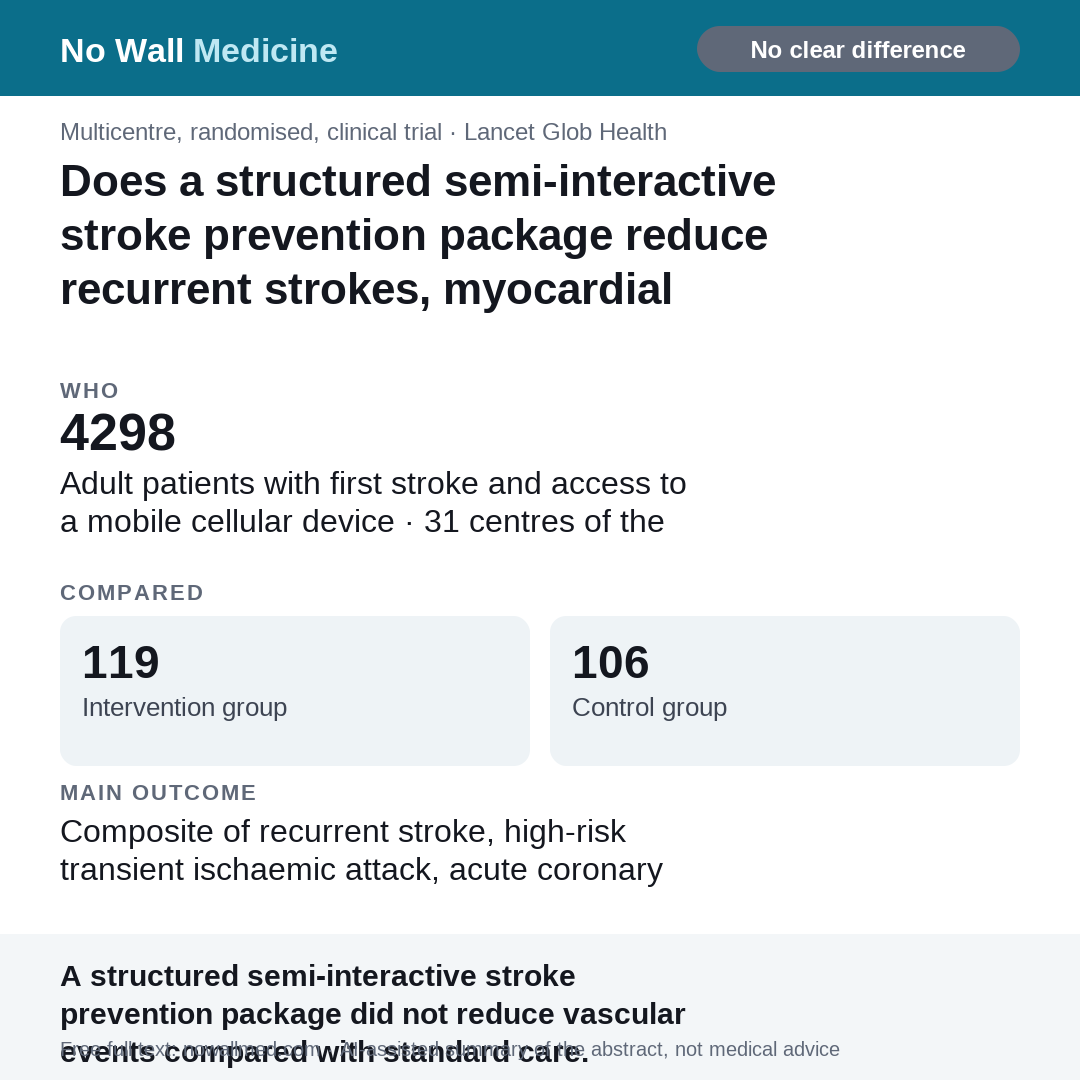
Does a structured semi-interactive stroke prevention package reduce recurrent strokes, myocardial infarction, and death?
Who
4298
Adult patients with first stroke and access to a mobile cellular device · 31 centres of the Indian Stroke Clinical Trial Network
Compared
119Intervention group (5·5%)
106Control group (4·9%)
Main outcome
Composite of recurrent stroke, high-risk transient ischaemic attack, acute coronary syndrome, and death
Result: adjusted odds ratio 1·12 (95% CI 0·85-1·47)
Bottom line: A structured semi-interactive stroke prevention package did not reduce vascular events compared with standard care.
Limitation: Possibility of type 2 error due to reduced power and high number of patients not followed up.
Funded by: Indian Council of Medical Research
Lancet Glob Health · 2023-02-16Download image
Clinical question: Does a structured semi-interactive stroke prevention package reduce recurrent strokes, myocardial infarction, and death?
Why it matters: It was unknown if a structured semi-interactive stroke prevention package could reduce recurrent strokes, heart attacks, and death in patients after their first stroke in India.
Key points
- Researchers randomised 4298 adult patients in India to receive either a structured prevention package with SMS messages and videos or standard care.
- The primary outcome of recurrent stroke, high-risk transient ischaemic attack, acute coronary syndrome, or death occurred in 5.5% of the intervention group and 4.9% of the control group.
- The intervention group showed higher rates of alcohol cessation at 85% compared to 78% in the control group and better medication compliance at 93.6% versus 89.8%.
Limitation the authors note: The authors noted a possibility of type 2 error due to reduced power because fewer events occurred and many patients could not be followed up.
Headline and key points written with AI from the paper’s abstract, with every number checked against it. Read the paper before relying on them.
Was this summary helpful?
Abstract
Background
There is a high burden of stroke, including recurrent stroke, in India. We aimed to assess the effect of a structured semi-interactive stroke prevention package in patients with subacute stroke to reduce recurrent strokes, myocardial infarction, and death. Methods
This was a multicentre, randomised, clinical trial conducted in 31 centres of the Indian Stroke Clinical Trial Network (INSTRuCT). Adult patients with first stroke and access to a mobile cellular device were randomly allocated (1:1) to intervention and control groups by the research coordinators at each centre using a central, in-house, web-based randomisation system. The participants and research coordinators at each centre were not masked to group assignment. The intervention group received regular short SMS messages and videos that promoted risk factor control and medication adherence and an educational workbook, in one of 12 languages, and the control group received standard care. The primary outcome was a composite of recurrent stroke, high-risk transient ischaemic attack, acute coronary syndrome, and death at 1 year. The outcome and safety analyses were done in the intention-to-treat population. The trial is registered with ClinicalTrials.gov, NCT03228979 and Clinical Trials Registry-India (CTRI/2017/09/009600) and was stopped for futility after interim analysis. Findings
Between April 28, 2018, and Nov 30, 2021, 5640 patients were assessed for eligibility. 4298 patients were randomised to the intervention group (n=2148) or control group (n=2150). 620 patients were not followed up at 6 months and a further 595 patients were not followed up at 1 year because the trial was stopped for futility after interim analysis. 45 patients were lost to follow-up before 1 year. Acknowledgment of receipt of the SMS messages and videos by the intervention group patients was low (17%). The primary outcome occurred in 119 (5·5%) of 2148 patients in the intervention group and 106 (4·9%) of 2150 patients in the control group (adjusted odds ratio 1·12; 95% CI 0·85-1·47; p=0·370). Among the secondary outcome measures, alcohol cessation and smoking cessation were higher in the intervention group than in the control group (alcohol cessation 231 [85%] of 272 in the intervention group vs 255 [78%] of 326 in the control group; p=0·036; smoking cessation 202 [83%] vs 206 [75%]; p=0·035). Medication compliance was better in the intervention group than in the control group (1406 [93·6%] of 1502 vs 1379 [89·8%] of 1536; p<0·001). There was no significant difference between the two groups in other secondary outcome measures at 1 year: blood pressure, fasting blood sugar (mg/dL), low-density lipoprotein cholesterol (mg/dL), and triglycerides (mg/dL), BMI, modified Rankin Scale, and physical activity. Interpretation
A structured semi-interactive stroke prevention package did not reduce vascular events when compared with standard care. However, there was an improvement in some lifestyle behavioural factors, including adherence to medication, which might have long-term benefits. There was a possibility of type 2 error owing to reduced power since there were fewer events and a high number of patients could not be followed up. Funding
Indian Council of Medical Research.
Abstract reproduced under the article’s CC BY licence.
Subject terms
Cite this article
SPRINT INDIA trial collaborators. Secondary prevention with a structured semi-interactive stroke prevention package in INDIA (SPRINT INDIA): a multicentre, randomised controlled trial. Lancet Glob Health. 2023. doi:10.1016/S2214-109X(22)00544-7
Spotted a mistake? Suggest a correction
Top studies every Monday
The week’s key trials and guidelines in your specialties, plus any topics you follow. By email, free.
Get the weekly digest