Group-based self-management programme for chronic obstructive pulmonary disease showed no significant difference in symptom scores
Self-management programme of activity coping and education-SPACE for COPD(C)-in primary care: a pragmatic randomised trial
Prospective, single-blinded randomised controlled trialNo clear difference
Is a group-based self-management programme effective for patients with chronic obstructive pulmonary disease?
Who
193
Participants with chronic obstructive pulmonary disease · Primary care
Compared
Intervention (group-based self-management programme)
Control (usual care)
Main outcome
Change in COPD Assessment Test at 6 months
Bottom line: The group-based self-management programme was feasible and acceptable but showed no significant difference in COPD Assessment Test scores.
BMJ Open Respir Res · 2022-10-17Download image
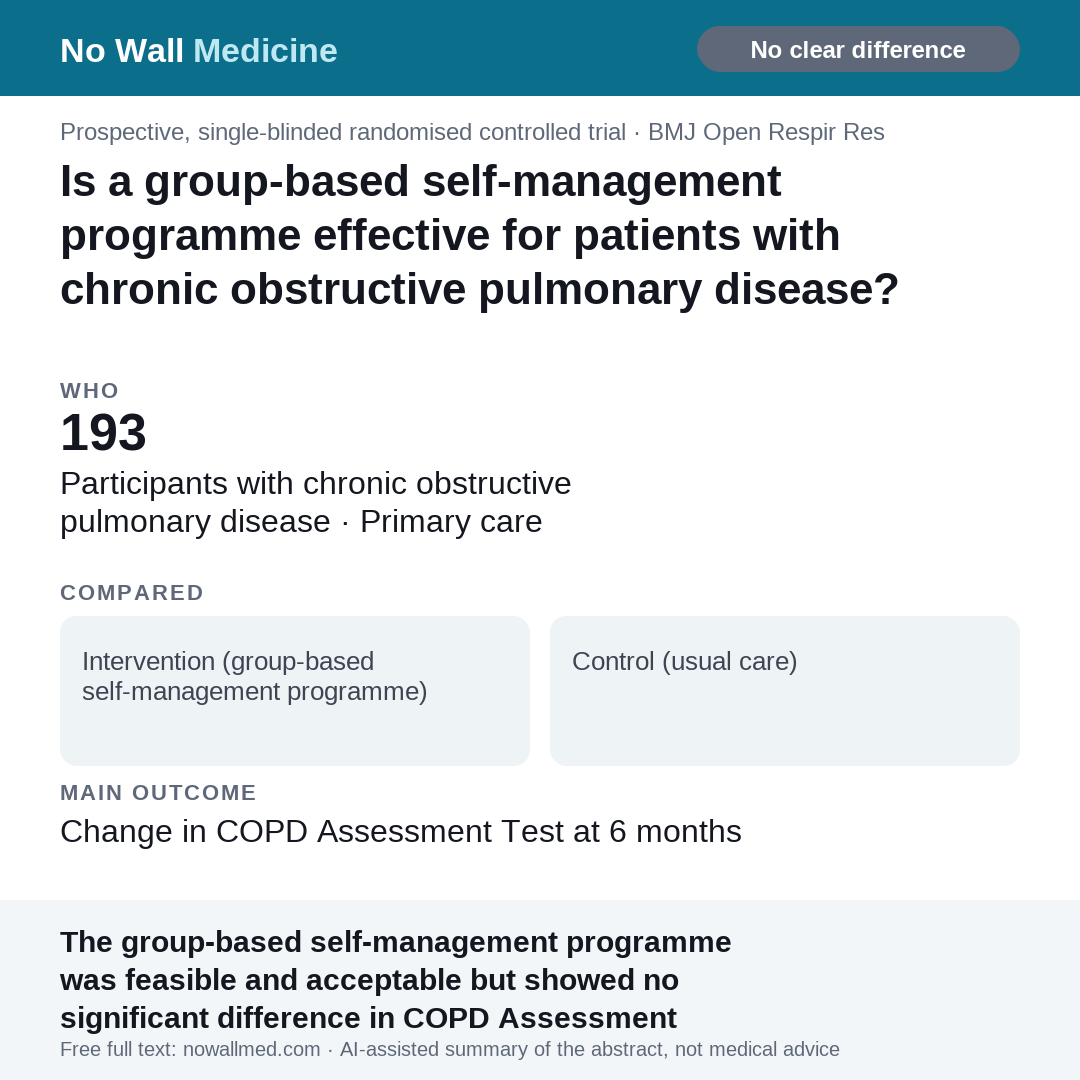
Clinical question: Is a group-based self-management programme effective for patients with chronic obstructive pulmonary disease?
Why it matters: It was unknown if a group-based self-management programme for chronic obstructive pulmonary disease is feasible, acceptable, and effective when delivered by healthcare professionals in primary care.
Key points
- Researchers conducted a randomized controlled trial with 193 participants to compare a six-session group self-management programme against usual care.
- The intervention group showed no significant difference in the COPD Assessment Test, a tool used to measure symptom impact, compared to the control group at 6 months.
- The group intervention was associated with improvements in patient activation, knowledge, mastery, and fatigue compared to usual care.
Headline and key points written with AI from the paper’s abstract, with every number checked against it. Read the paper before relying on them.
Abstract
Introduction
We have previously developed a supported self-management programme (SMP): Self-management Programme of Activity, Coping and Education for chronic obstructive pulmonary disease (COPD), which was successfully delivered on an individual basis. Payers expressed an interest in delivering the intervention in groups. Aim
To explore the feasibility, acceptability and clinical effectiveness of the intervention delivered and supported by healthcare professionals (HCPs) in groups within primary care. Methods
A prospective, single-blinded randomised controlled trial was conducted, with follow-up at 6 and 9 months. Participants were randomly assigned to control (usual care) or intervention (a six-session, group-based SMP delivered over 5 months). The primary outcome was change in COPD Assessment Test (CAT) at 6 months.Semistructured focus groups were conducted with intervention participants to understand feasibility and acceptability. A focus group was conducted with HCPs who delivered the intervention to gain insight into any potential facilitators/barriers to implementing the intervention in practice. All qualitative data were analysed thematically. Results
193 participants were recruited, (median Medical Research Council (MRC) grade 2). There was no significant difference between the intervention and control group for the primary outcome (CAT). However, an improvement in self-reported patient activation (at 6 and 9 months), knowledge (at 6 months), mastery (at 6 and 9 months) and fatigue (at 6 months), in the intervention group compared with usual care was demonstrated.Qualitative results indicated that the intervention was acceptable to patients who took part in the intervention and HCPs valued the intervention, suggesting it might be best delivered early in the disease process. Conclusions
A supported self-management intervention is feasible and acceptable when delivered as a group-based intervention, by HCPs in the community.
Abstract reproduced under the article’s CC BY NC licence.
Topics
Cite this article
Bourne C, Houchen-Wolloff L, Patel P, Bankart J, Singh S. Self-management programme of activity coping and education-SPACE for COPD(C)-in primary care: a pragmatic randomised trial. BMJ Open Respir Res. 2022. doi:10.1136/bmjresp-2022-001443
Spotted a mistake? Suggest a correction
Top studies every Monday
The week’s key trials and guidelines in your specialties, plus any topics you follow. By email, free.
Get the weekly digest