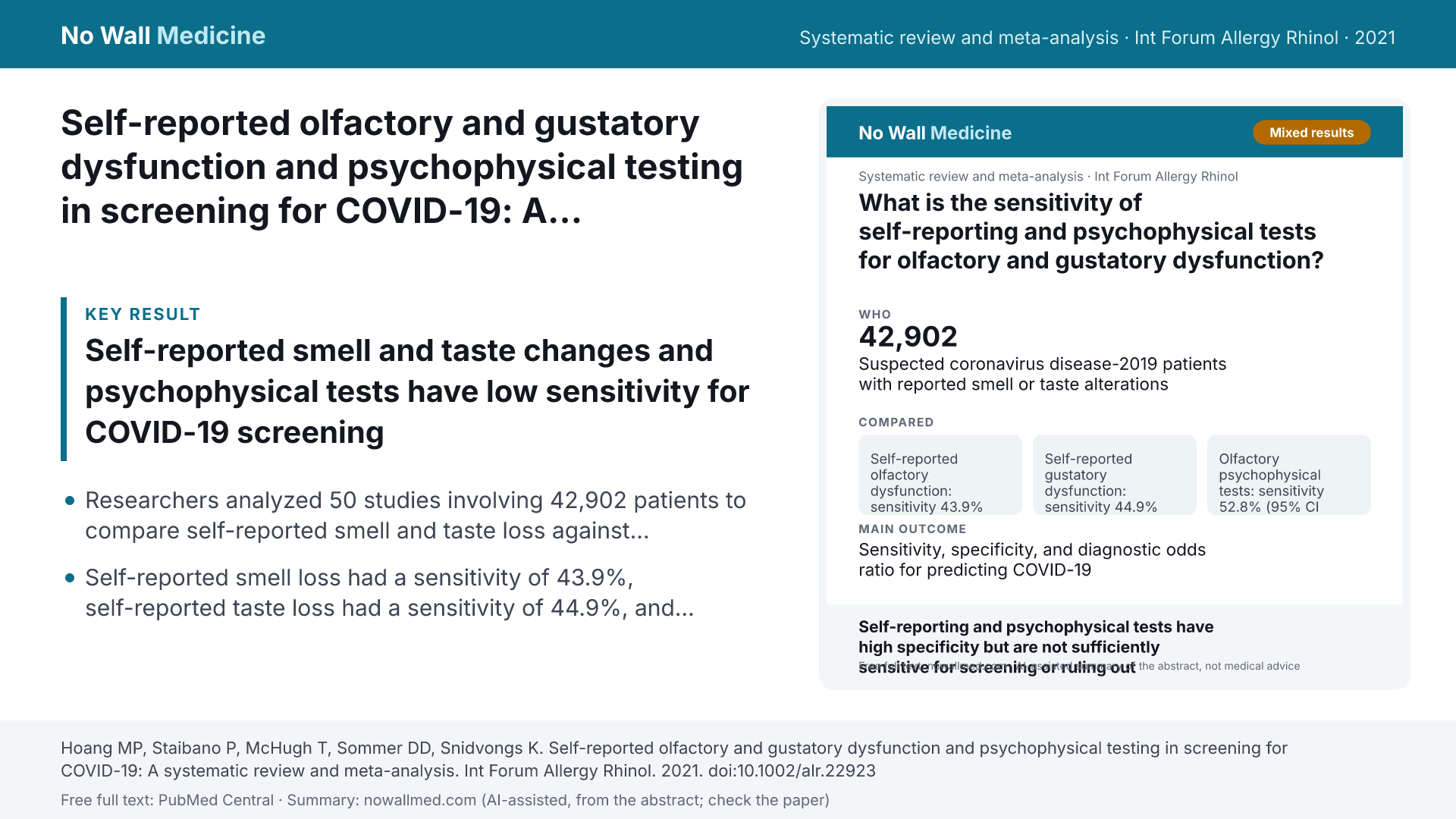
Self-reported smell and taste changes and psychophysical tests have low sensitivity for COVID-19 screening
Self-reported olfactory and gustatory dysfunction and psychophysical testing in screening for COVID-19: A systematic review and meta-analysis
Systematic review and meta-analysisMixed results
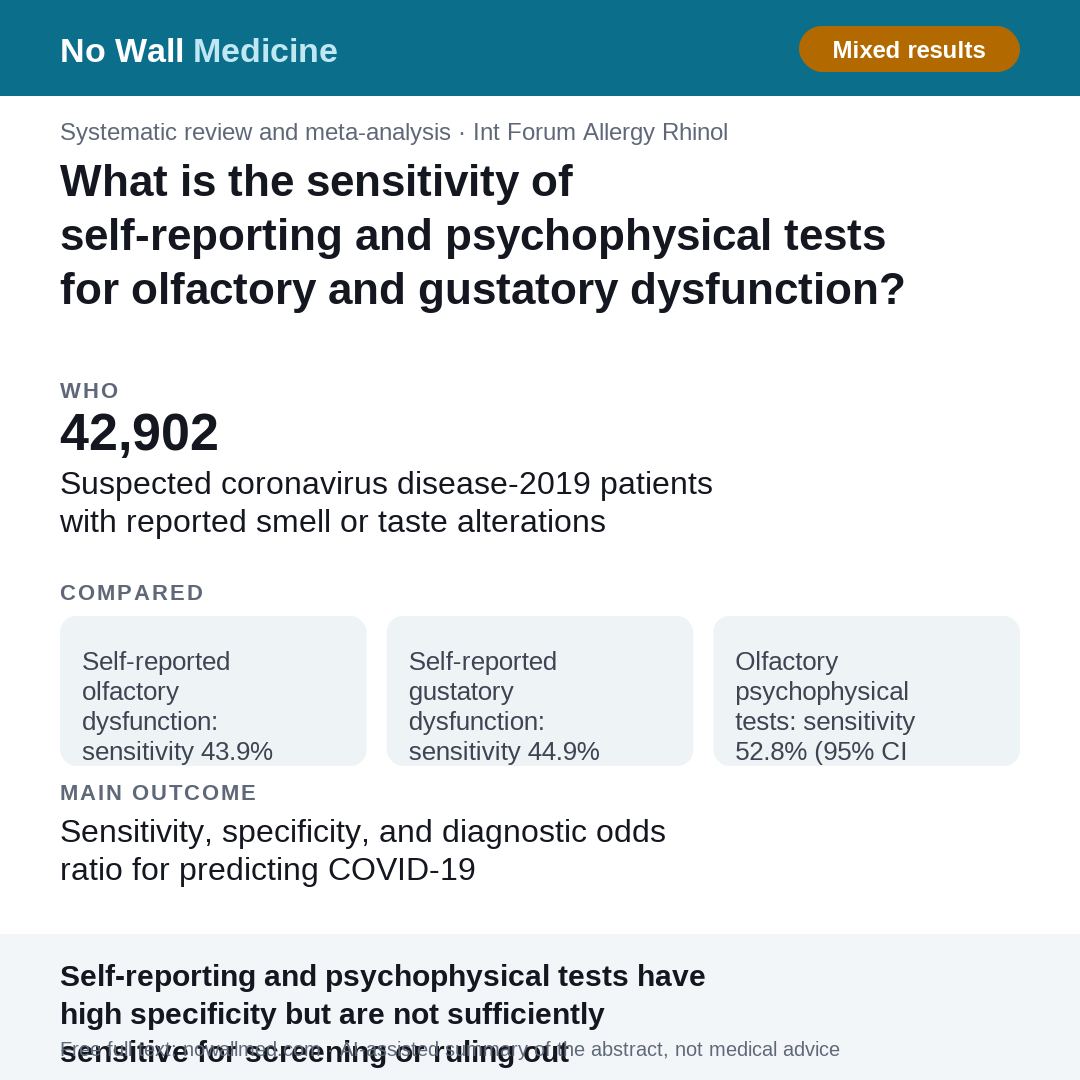
What is the sensitivity of self-reporting and psychophysical tests for olfactory and gustatory dysfunction?
Who
42,902
Suspected coronavirus disease-2019 patients with reported smell or taste alterations
Compared
Self-reported olfactory dysfunction: sensitivity 43.9% (95% CI 37.8%-50.2%)
Self-reported gustatory dysfunction: sensitivity 44.9% (95% CI 36.4%-53.8%)
Olfactory psychophysical tests: sensitivity 52.8% (95% CI 25.5%-78.6%)
Main outcome
Sensitivity, specificity, and diagnostic odds ratio for predicting COVID-19
Bottom line: Self-reporting and psychophysical tests have high specificity but are not sufficiently sensitive for screening or ruling out COVID-19.
Limitation: Psychophysical tests were unvalidated and limited.
Int Forum Allergy Rhinol · 2021-12-06Download image
Clinical question: What is the sensitivity of self-reporting and psychophysical tests for olfactory and gustatory dysfunction?
Why it matters: The sensitivity of self-reporting and psychophysical testing for detecting smell and taste changes in COVID-19 screening remains unclear.
Key points
- Researchers analyzed 50 studies involving 42,902 patients to compare self-reported smell and taste loss against objective psychophysical testing for COVID-19.
- Self-reported smell loss had a sensitivity of 43.9%, self-reported taste loss had a sensitivity of 44.9%, and smell psychophysical tests had a sensitivity of 52.8%.
- All methods showed high specificity, with self-reported smell loss at 91.8%, self-reported taste loss at 91.5%, and smell psychophysical tests at 88.0%.
Headline and key points written with AI from the paper’s abstract, with every number checked against it. Read the paper before relying on them.
Was this summary helpful?
Subject terms
Cite this article
Hoang MP, Staibano P, McHugh T, Sommer DD, Snidvongs K. Self-reported olfactory and gustatory dysfunction and psychophysical testing in screening for COVID-19: A systematic review and meta-analysis. Int Forum Allergy Rhinol. 2021. doi:10.1002/alr.22923
Spotted a mistake? Suggest a correction
Top studies every Monday
The week’s key trials and guidelines in your specialties, plus any topics you follow. By email, free.
Get the weekly digest