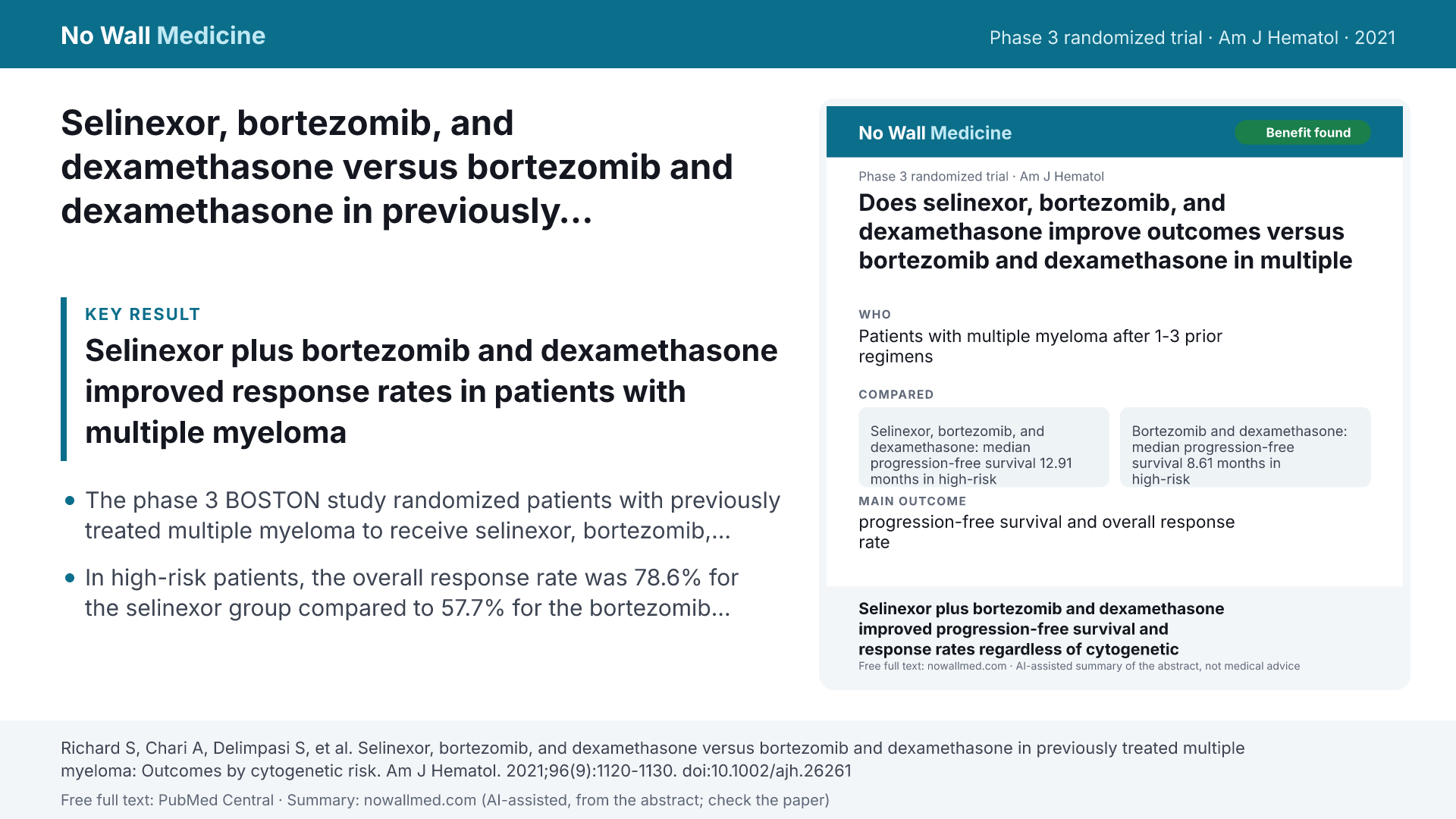
Selinexor plus bortezomib and dexamethasone improved response rates in patients with multiple myeloma
Selinexor, bortezomib, and dexamethasone versus bortezomib and dexamethasone in previously treated multiple myeloma: Outcomes by cytogenetic risk
Phase 3 randomized trialBenefit found
Does selinexor, bortezomib, and dexamethasone improve outcomes versus bortezomib and dexamethasone in multiple myeloma?
Who
Patients with multiple myeloma after 1-3 prior regimens
Compared
Selinexor, bortezomib, and dexamethasone: median progression-free survival 12.91 months in high-risk
Bortezomib and dexamethasone: median progression-free survival 8.61 months in high-risk
Main outcome
progression-free survival and overall response rate
Result: hazard ratio 0.73 (95% CI 0.4673 to 1.1406)
Bottom line: Selinexor plus bortezomib and dexamethasone improved progression-free survival and response rates regardless of cytogenetic risk.
Am J Hematol · 2021-07-05 · Save PNG
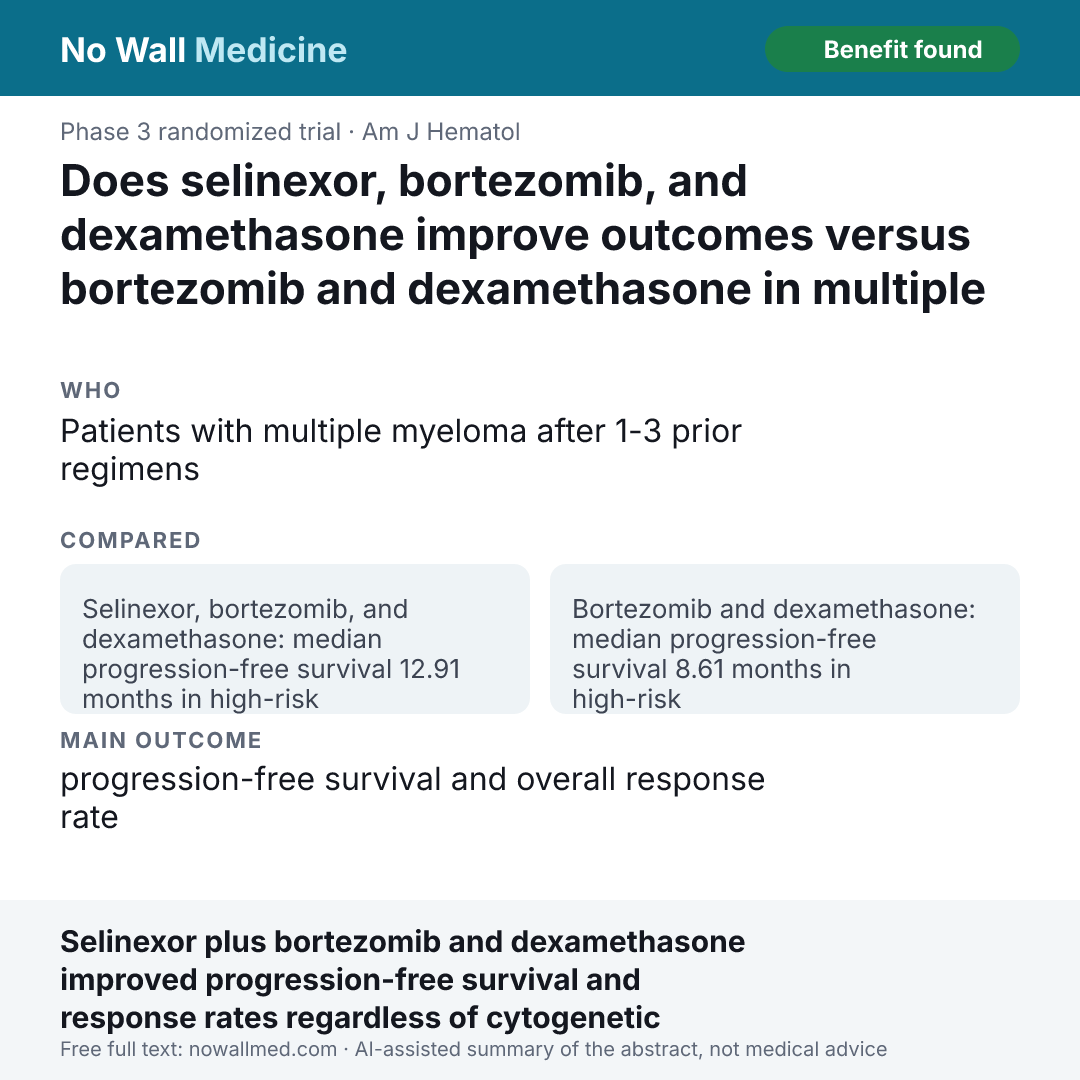
Clinical question: Does selinexor, bortezomib, and dexamethasone improve outcomes versus bortezomib and dexamethasone in multiple myeloma?
Key points
- The phase 3 BOSTON study randomized patients with previously treated multiple myeloma to receive selinexor, bortezomib, and dexamethasone or bortezomib and dexamethasone alone.
- In high-risk patients, the overall response rate was 78.6% for the selinexor group compared to 57.7% for the bortezomib and dexamethasone group.
- In standard-risk patients, median progression-free survival was 16.62 months for the selinexor group and 9.46 months for the bortezomib and dexamethasone group.
Headline and key points written with AI from the paper’s abstract, with every number checked against it. Read the paper before relying on them.
Was this summary helpful?
Subject terms
Headline, design, result, key points, caveat and citation as plain text.
Cite this article
Richard S, Chari A, Delimpasi S, et al. Selinexor, bortezomib, and dexamethasone versus bortezomib and dexamethasone in previously treated multiple myeloma: Outcomes by cytogenetic risk. Am J Hematol. 2021;96(9):1120-1130. doi:10.1002/ajh.26261
Spotted a mistake? Suggest a correction