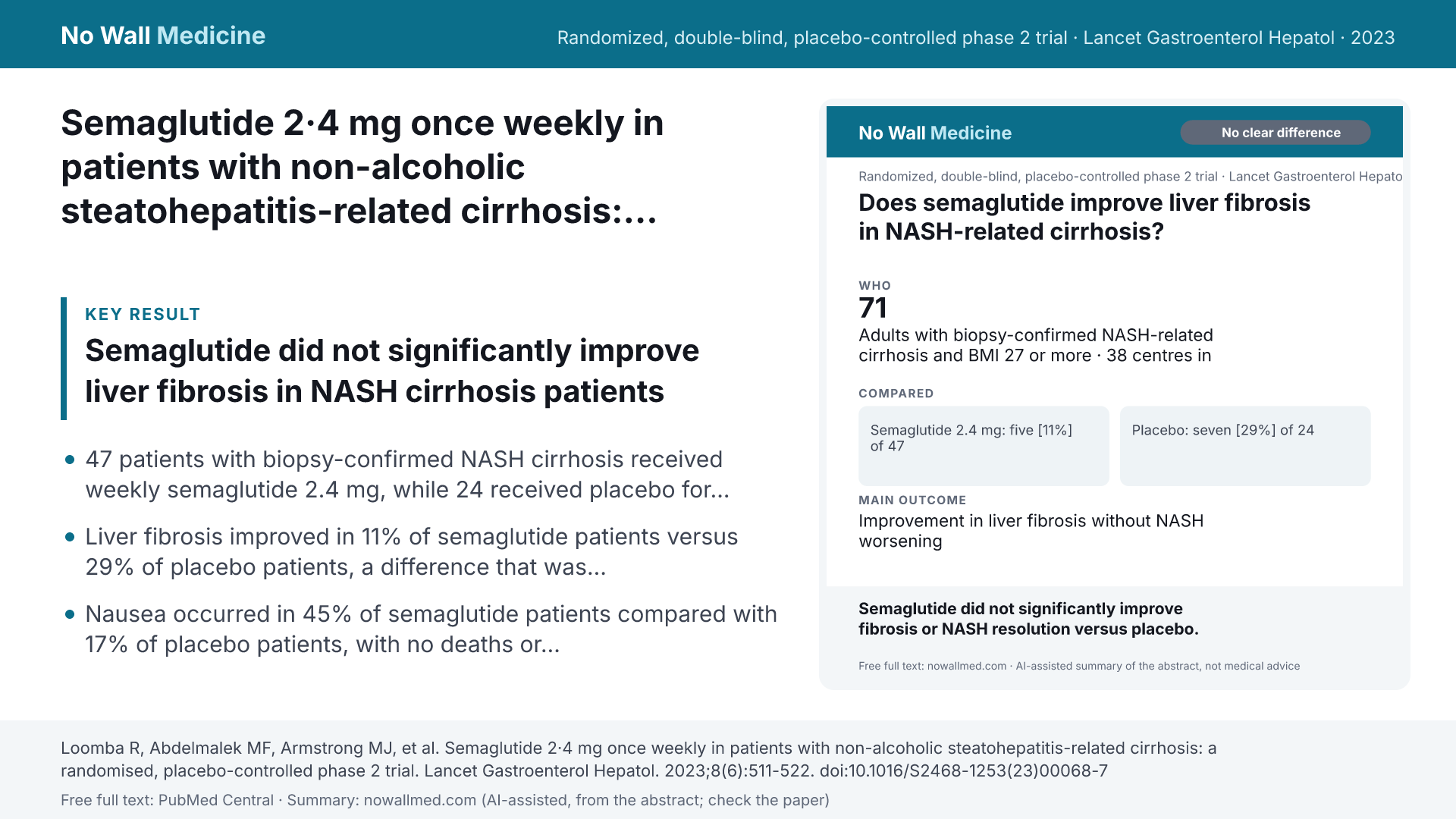
Semaglutide did not significantly improve liver fibrosis in NASH cirrhosis patients
Semaglutide 2·4 mg once weekly in patients with non-alcoholic steatohepatitis-related cirrhosis: a randomised, placebo-controlled phase 2 trial
Same trial (NCT03987451)
Papers we list that report this registered trial, oldest first. Read a secondary analysis alongside the main results.
- Main results
This paper Lancet Gastroenterol Hepatol 2023-03 - Secondary analysis Benefit found
Semaglutide weight loss was similar for people with or without type 2 diabetes Diabetes Obes Metab 2024-11
Key points
- 47 patients with biopsy-confirmed NASH cirrhosis received weekly semaglutide 2.4 mg, while 24 received placebo for 48 weeks.
- Liver fibrosis improved in 11% of semaglutide patients versus 29% of placebo patients, a difference that was not statistically significant.
- Nausea occurred in 45% of semaglutide patients compared with 17% of placebo patients, with no deaths or decompensating events.
Headline and key points written with AI from the paper’s abstract, with every number checked against it. Read the paper before relying on them.
Was this summary helpful?
Abstract
Background
Patients with non-alcoholic steatohepatitis (NASH)-related cirrhosis are at high risk of liver-related and all-cause morbidity and mortality. We investigated the efficacy and safety of the glucagon-like peptide-1 analogue semaglutide in patients with NASH and compensated cirrhosis. Methods
This double-blind, placebo-controlled phase 2 trial enrolled patients from 38 centres in Europe and the USA. Adults with biopsy-confirmed NASH-related cirrhosis and body-mass index (BMI) of 27 kg/m2 or more were randomly assigned (2:1) to receive either once-weekly subcutaneous semaglutide 2·4 mg or visually matching placebo. Patients were randomly allocated via an interactive web response system, stratified by presence or absence of type 2 diabetes. Patients, investigators, and those assessing outcomes were masked to treatment assignment. The primary endpoint was the proportion of patients with an improvement in liver fibrosis of one stage or more without worsening of NASH after 48 weeks, assessed by biopsy in the intention-to-treat population. Safety was assessed in all patients who received at least one dose of study drug. The trial is closed and completed, and registered with ClinicalTrials.gov, number NCT03987451. Findings
71 patients were enrolled between June 18, 2019, and April 22, 2021; 49 (69%) patients were female and 22 (31%) were male. Patients had a mean age of 59·5 years (SD 8·0) and mean BMI of 34·9 kg/m2 (SD 5·9); 53 (75%) patients had diabetes. 47 patients were randomly assigned to the semaglutide group and 24 to the placebo group. After 48 weeks, there was no statistically significant difference between the two groups in the proportion of patients with an improvement in liver fibrosis of one stage or more without worsening of NASH (five [11%] of 47 patients in the semaglutide group vs seven [29%] of 24 in the placebo group; odds ratio 0·28 [95% CI 0·06-1·24; p=0·087). There was also no significant difference between groups in the proportion of patients who achieved NASH resolution (p=0·29). Similar proportions of patients in each group reported adverse events (42 [89%] patients in the semaglutide group vs 19 [79%] in the placebo group) and serious adverse events (six [13%] vs two [8%]). The most common adverse events were nausea (21 [45%] vs four [17%]), diarrhoea (nine [19%] vs two [8%]), and vomiting (eight [17%] vs none). Hepatic and renal function remained stable. There were no decompensating events or deaths. Interpretation
In patients with NASH and compensated cirrhosis, semaglutide did not significantly improve fibrosis or achievement of NASH resolution versus placebo. No new safety concerns were raised. Funding
Novo Nordisk A/S.
Abstract reproduced under the article’s CC BY NC ND licence.
Subject terms
Headline, design, result, key points, caveat and citation as plain text.
Cite this article
Loomba R, Abdelmalek MF, Armstrong MJ, et al. Semaglutide 2·4 mg once weekly in patients with non-alcoholic steatohepatitis-related cirrhosis: a randomised, placebo-controlled phase 2 trial. Lancet Gastroenterol Hepatol. 2023;8(6):511-522. doi:10.1016/S2468-1253(23)00068-7
Spotted a mistake? Suggest a correction