Sensor measurements of knee brace use show low agreement with patient self-reports
Sensor-based measures of knee brace adherence have low agreement with self-report methods: A multi-measure study among knee osteoarthritis patients
Single-arm observational analysisHarm found
How do sensor-based and self-report methods agree on knee brace adherence?
Who
60
Adults with symptomatic knee osteoarthritis
Compared
83%Self-report questionnaires at 12 weeks
83%Short message service at 12 weeks
Temperature sensor at 12 weeks: 60% and 58%
Main outcome
Proportion of participants meeting minimum brace use
Result: SRQ vs Sensor at 12 weeks: 74%, 0.35 (0.10, 0.60)
Bottom line: Self-report methods substantially overestimate knee brace wearing time compared to objective temperature sensor measurements.
Osteoarthritis Cartilage · 2026-07-13Download image
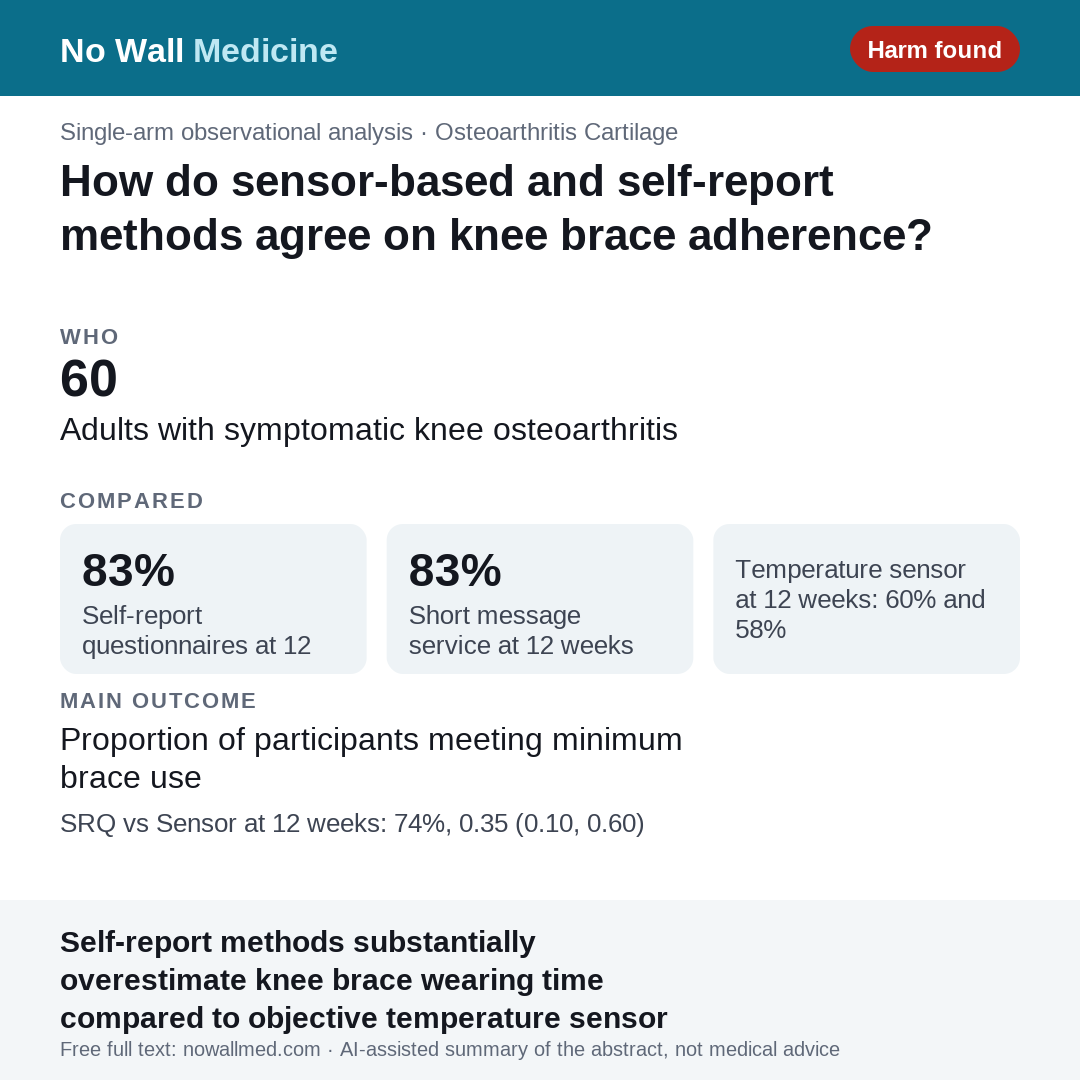
Clinical question: How do sensor-based and self-report methods agree on knee brace adherence?
Why it matters: It is unclear how well objective sensor data matches the self-reported brace wearing time provided by patients in clinical trials and practice.
Key points
- Researchers studied 60 adults with knee osteoarthritis to compare self-report questionnaires, text message questions, and skin temperature sensors over 26 weeks.
- At 12 weeks, 83% of patients reported meeting minimum brace use via questionnaires, while the temperature sensor showed only 60% and 58% adherence.
- By 26 weeks, self-reports estimated 72% adherence while the temperature sensor showed only 43% and 37% adherence.
Headline and key points written with AI from the paper’s abstract, with every number checked against it. Read the paper before relying on them.
Topics
Cite this article
Callaghan MJ, Felson DT, Holden MA, Borrelli B, Nicholls E, Birrell F. Sensor-based measures of knee brace adherence have low agreement with self-report methods: A multi-measure study among knee osteoarthritis patients. Osteoarthritis Cartilage. 2026. doi:10.1016/j.joca.2026.06.005
Spotted a mistake? Suggest a correction