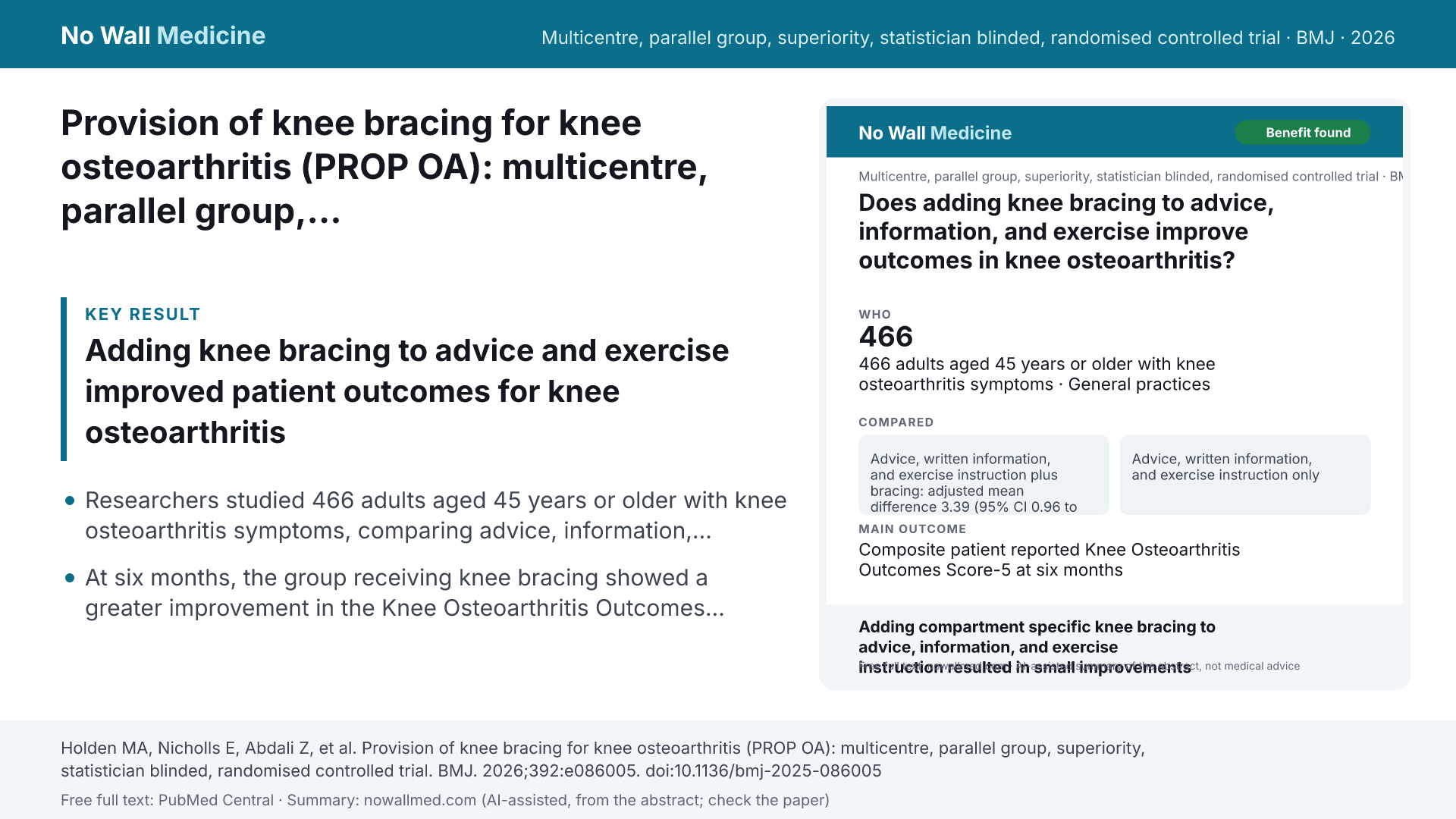
Adding knee bracing to advice and exercise improved patient outcomes for knee osteoarthritis
Provision of knee bracing for knee osteoarthritis (PROP OA): multicentre, parallel group, superiority, statistician blinded, randomised controlled trial
Multicentre, parallel group, superiority, statistician blinded, randomised controlled trialBenefit found
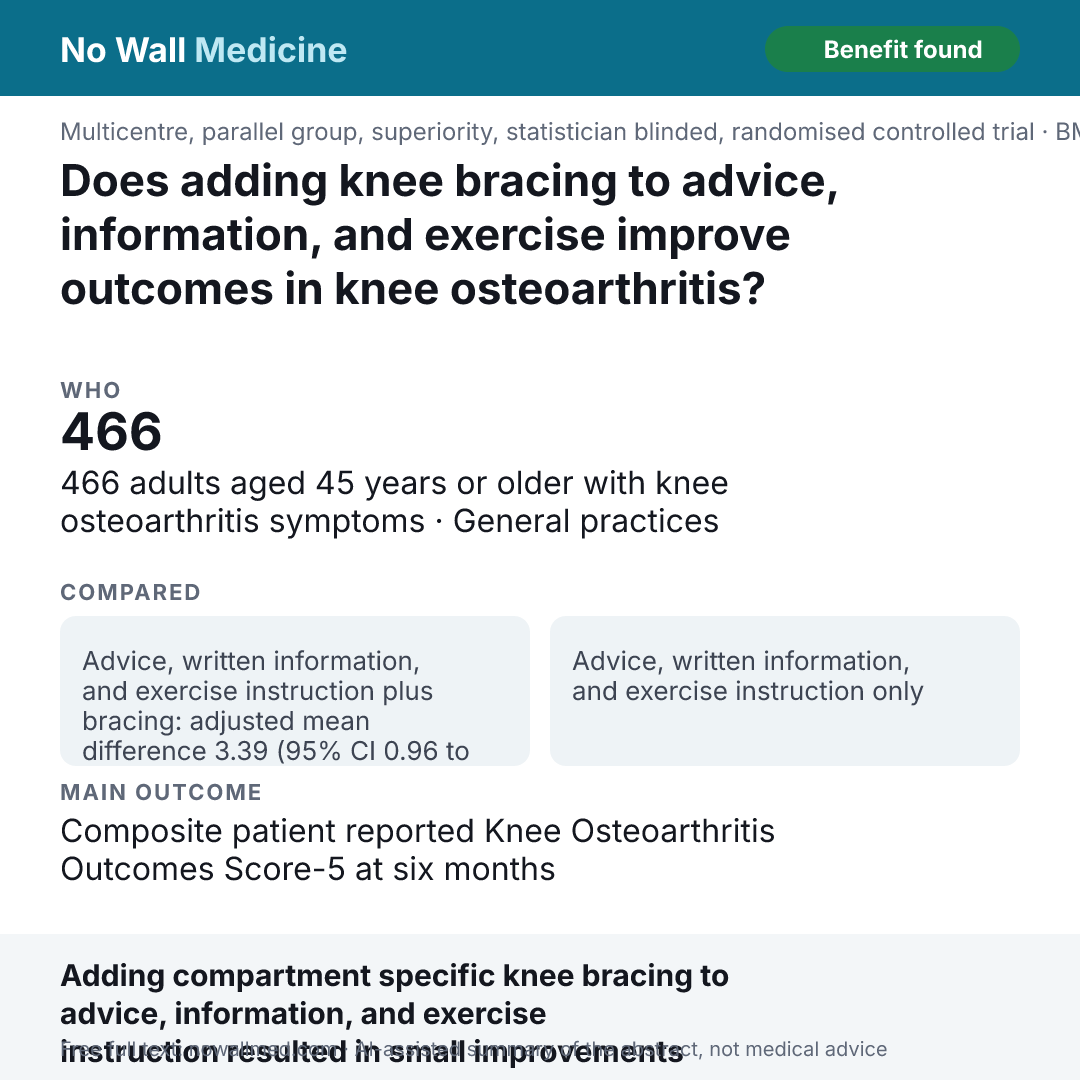
Does adding knee bracing to advice, information, and exercise improve outcomes in knee osteoarthritis?
Who
466
466 adults aged 45 years or older with knee osteoarthritis symptoms · General practices and community in England
Compared
Advice, written information, and exercise instruction plus bracing: adjusted mean difference 3.39 (95% CI 0.96 to 5.82)
Advice, written information, and exercise instruction only
Main outcome
Composite patient reported Knee Osteoarthritis Outcomes Score-5 at six months
Result: adjusted mean difference 3.39 (95% CI 0.96 to 5.82)
Bottom line: Adding compartment specific knee bracing to advice, information, and exercise instruction resulted in small improvements in patient reported outcomes.
BMJ · 2026-01-26 · Save PNG
Same trial (ISRCTN28555470)
Papers we list that report this registered trial, oldest first. Read a secondary analysis alongside the main results.
- Main results Benefit found
This paper BMJ 2026-01 - Secondary analysis Harm found
Sensor measurements of knee brace use show low agreement with patient self-reports Osteoarthritis Cartilage 2026-07
Clinical question: Does adding knee bracing to advice, information, and exercise improve outcomes in knee osteoarthritis?
Key points
- Researchers studied 466 adults aged 45 years or older with knee osteoarthritis symptoms, comparing advice, information, and exercise to the same care plus knee bracing.
- At six months, the group receiving knee bracing showed a greater improvement in the Knee Osteoarthritis Outcomes Score than the group receiving only advice and exercise.
- The largest observed effect was a reduction in pain at six months, with an adjusted mean difference of 6.13 on a 0 to 100 scale.
Headline and key points written with AI from the paper’s abstract, with every number checked against it. Read the paper before relying on them.
Was this summary helpful?
Abstract
Objective
To determine whether adding compartment specific knee bracing with an adherence intervention to advice, written information, and exercise instruction (AIE+B) is superior to advice, written information, and exercise instruction (AIE) only in improving patient reported outcomes in people with knee osteoarthritis. Design
Multicentre, parallel group, superiority, statistician blinded, randomised (1:1; block; stratified; centralised web based) controlled trial. Setting
Recruitment through general practices and the community in Cheshire, Manchester, North Tyneside, and Staffordshire, England; enrolment 25 November 2019 to 16 September 2022. Participants
466 adults aged ≥45 years with symptoms of knee osteoarthritis. Interventions
AIE was delivered in one in-person consultation by a trained physiotherapist. Individuals randomised to the AIE+B group were also fitted with a patellofemoral, tibiofemoral unloading, or neutral stabilising knee brace, according to their predominant compartmental distribution of knee osteoarthritis, and were offered a two week follow-up consultation. Brief motivational interviewing with targeted text reminders supported brace adherence. Main outcome measures
The primary outcome was a composite patient reported Knee Osteoarthritis Outcomes Score (KOOS)-5 (0-100) at six months after randomisation. Key secondary outcomes were KOOS-5 at three and 12 months, KOOS-5 subscale scores, and pain on weight bearing activity at three, six, and 12 months. Results
466 participants (mean age 64 (standard deviation 9) years; 46% female participants) were randomised, with 401 (86%), 394 (85%), and 370 (79%) participants followed up with analysable data at three, six, and 12 months, respectively. At six months, greater improvement in KOOS-5 was seen in the AIE+B group than in the AIE group (adjusted mean difference 3.39, 95% confidence interval (CI) 0.96 to 5.82; effect size 0.24). Secondary outcomes showed the benefits of AIE+B over AIE that diminished over time. The largest effects observed were for pain reduction (KOOS pain (0-100) adjusted mean difference at six months 6.13, 95% CI 3.36 to 8.91; effect size 0.39). Adverse events were minor and expected. Conclusions
Adding compartment specific knee bracing and an adherence intervention to advice, written information, and exercise instruction resulted in small improvements in patient reported outcomes among individuals with knee osteoarthritis. This safe intervention offers a potential treatment option for this common condition. Trial registration
ISRCTN28555470.
Abstract reproduced under the article’s CC BY licence.
Subject terms
Headline, design, result, key points, caveat and citation as plain text.
Cite this article
Holden MA, Nicholls E, Abdali Z, et al. Provision of knee bracing for knee osteoarthritis (PROP OA): multicentre, parallel group, superiority, statistician blinded, randomised controlled trial. BMJ. 2026;392:e086005. doi:10.1136/bmj-2025-086005
Spotted a mistake? Suggest a correction