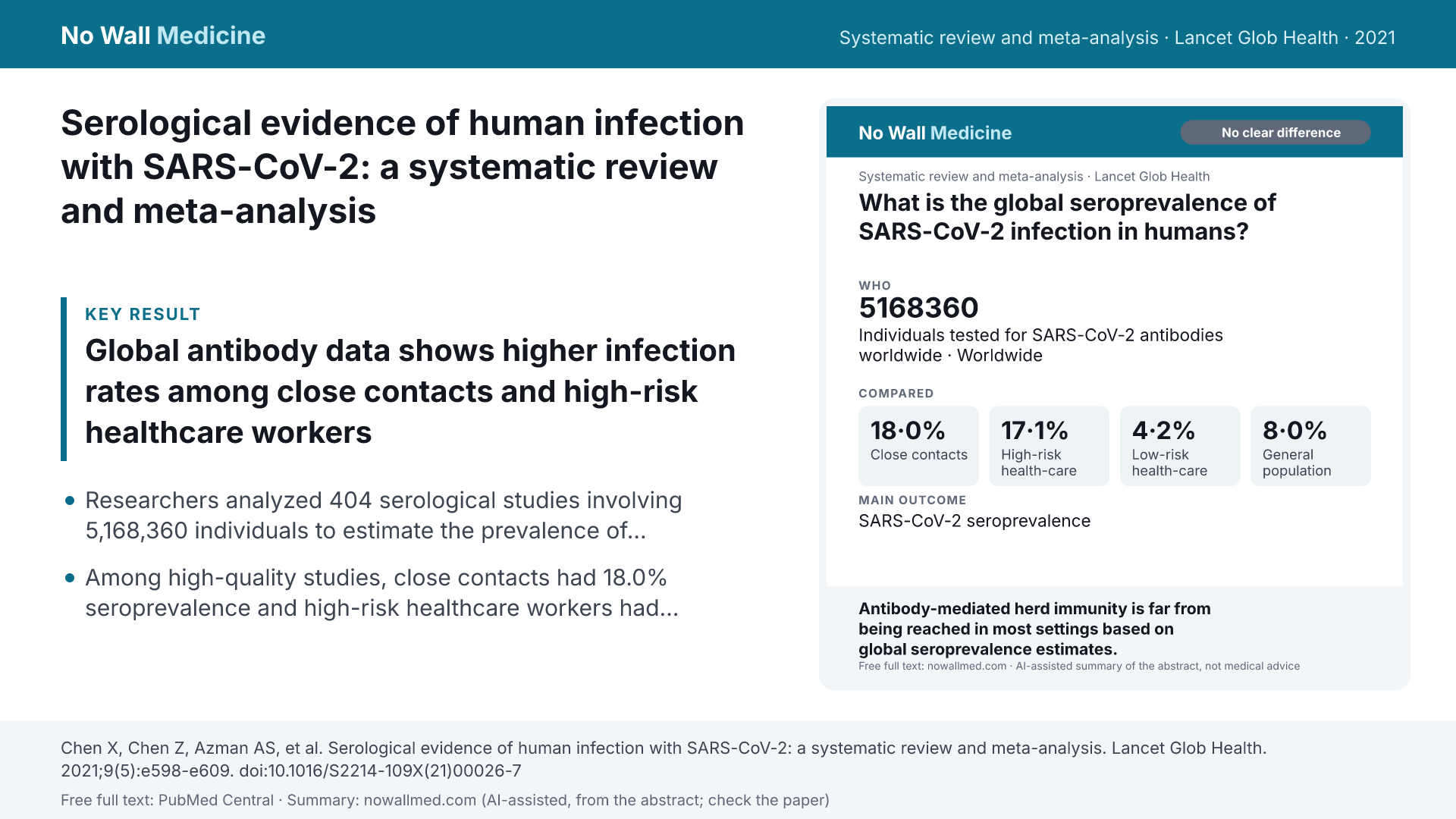
Global antibody data shows higher infection rates among close contacts and high-risk healthcare workers
Serological evidence of human infection with SARS-CoV-2: a systematic review and meta-analysis
Systematic review and meta-analysisNo clear difference
What is the global seroprevalence of SARS-CoV-2 infection in humans?
Who
5168360
Individuals tested for SARS-CoV-2 antibodies worldwide · Worldwide
Compared
18·0%Close contacts (95% CI 15·7-20·3)
17·1%High-risk health-care workers (9·9-24·4)
4·2%Low-risk health-care workers (1·5-6·9)
8·0%General population (6·8-9·2)
Main outcome
SARS-CoV-2 seroprevalence
Bottom line: Antibody-mediated herd immunity is far from being reached in most settings based on global seroprevalence estimates.
Lancet Glob Health · 2021-03-08 · Save PNG
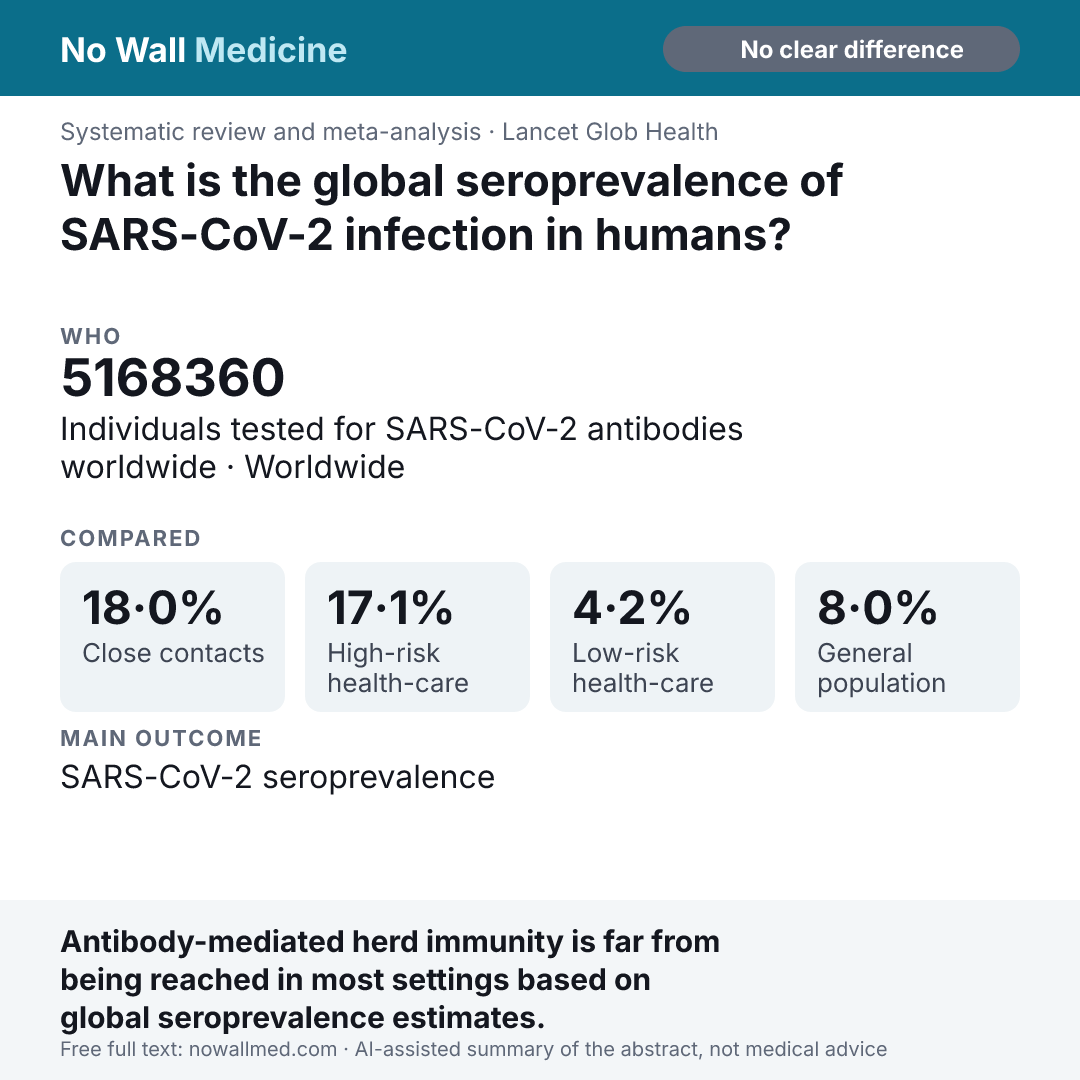
Clinical question: What is the global seroprevalence of SARS-CoV-2 infection in humans?
Why it matters: The true proportion of the population infected with SARS-CoV-2 remains uncertain due to the limitations of routine virus confirmation data.
Key points
- Researchers analyzed 404 serological studies involving 5,168,360 individuals to estimate the prevalence of SARS-CoV-2 antibodies.
- Among high-quality studies, close contacts had 18.0% seroprevalence and high-risk healthcare workers had 17.1%, compared to 4.2% for low-risk healthcare workers and 8.0% for the general population.
- The ratio of infections identified by antibodies to those confirmed by virus testing was 56.5 in India, compared to 6.9 in the Americas and 8.4 in Europe.
Headline and key points written with AI from the paper’s abstract, with every number checked against it. Read the paper before relying on them.
Was this summary helpful?
Abstract
Background
A rapidly increasing number of serological surveys for antibodies to SARS-CoV-2 have been reported worldwide. We aimed to synthesise, combine, and assess this large corpus of data. Methods
In this systematic review and meta-analysis, we searched PubMed, Embase, Web of Science, and five preprint servers for articles published in English between Dec 1, 2019, and Dec 22, 2020. Studies evaluating SARS-CoV-2 seroprevalence in humans after the first identified case in the area were included. Studies that only reported serological responses among patients with COVID-19, those using known infection status samples, or any animal experiments were all excluded. All data used for analysis were extracted from included papers. Study quality was assessed using a standardised scale. We estimated age-specific, sex-specific, and race-specific seroprevalence by WHO regions and subpopulations with different levels of exposures, and the ratio of serology-identified infections to virologically confirmed cases. This study is registered with PROSPERO, CRD42020198253. Findings
16 506 studies were identified in the initial search, 2523 were assessed for eligibility after removal of duplicates and inappropriate titles and abstracts, and 404 serological studies (representing tests in 5 168 360 individuals) were included in the meta-analysis. In the 82 studies of higher quality, close contacts (18·0%, 95% CI 15·7-20·3) and high-risk health-care workers (17·1%, 9·9-24·4) had higher seroprevalence than did low-risk health-care workers (4·2%, 1·5-6·9) and the general population (8·0%, 6·8-9·2). The heterogeneity between included studies was high, with an overall I2 of 99·9% (p<0·0001). Seroprevalence varied greatly across WHO regions, with the lowest seroprevalence of general populations in the Western Pacific region (1·7%, 95% CI 0·0-5·0). The pooled infection-to-case ratio was similar between the region of the Americas (6·9, 95% CI 2·7-17·3) and the European region (8·4, 6·5-10·7), but higher in India (56·5, 28·5-112·0), the only country in the South-East Asia region with data. Interpretation
Antibody-mediated herd immunity is far from being reached in most settings. Estimates of the ratio of serologically detected infections per virologically confirmed cases across WHO regions can help provide insights into the true proportion of the population infected from routine confirmation data. Funding
National Science Fund for Distinguished Young Scholars, Key Emergency Project of Shanghai Science and Technology Committee, Program of Shanghai Academic/Technology Research Leader, National Science and Technology Major project of China, the US National Institutes of Health. Translation
For the Chinese translation of the abstract see Supplementary Materials section.
Abstract reproduced under the article’s CC BY NC ND licence.
Subject terms
Headline, design, result, key points, caveat and citation as plain text.
Cite this article
Chen X, Chen Z, Azman AS, et al. Serological evidence of human infection with SARS-CoV-2: a systematic review and meta-analysis. Lancet Glob Health. 2021;9(5):e598-e609. doi:10.1016/S2214-109X(21)00026-7
Spotted a mistake? Suggest a correction