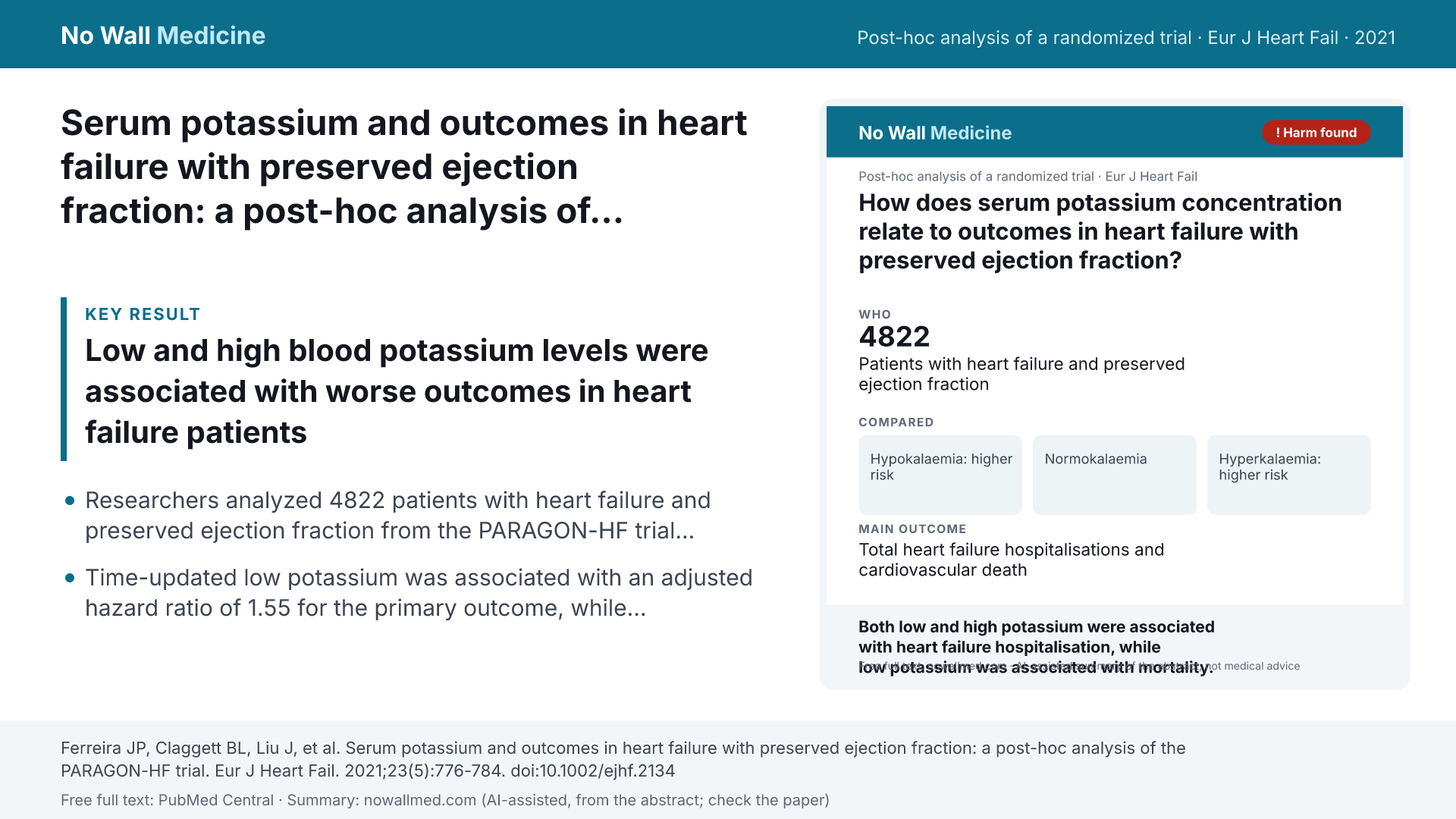
Low and high blood potassium levels were associated with worse outcomes in heart failure patients
Serum potassium and outcomes in heart failure with preserved ejection fraction: a post-hoc analysis of the PARAGON-HF trial
Post-hoc analysis of a randomized trialHarm found
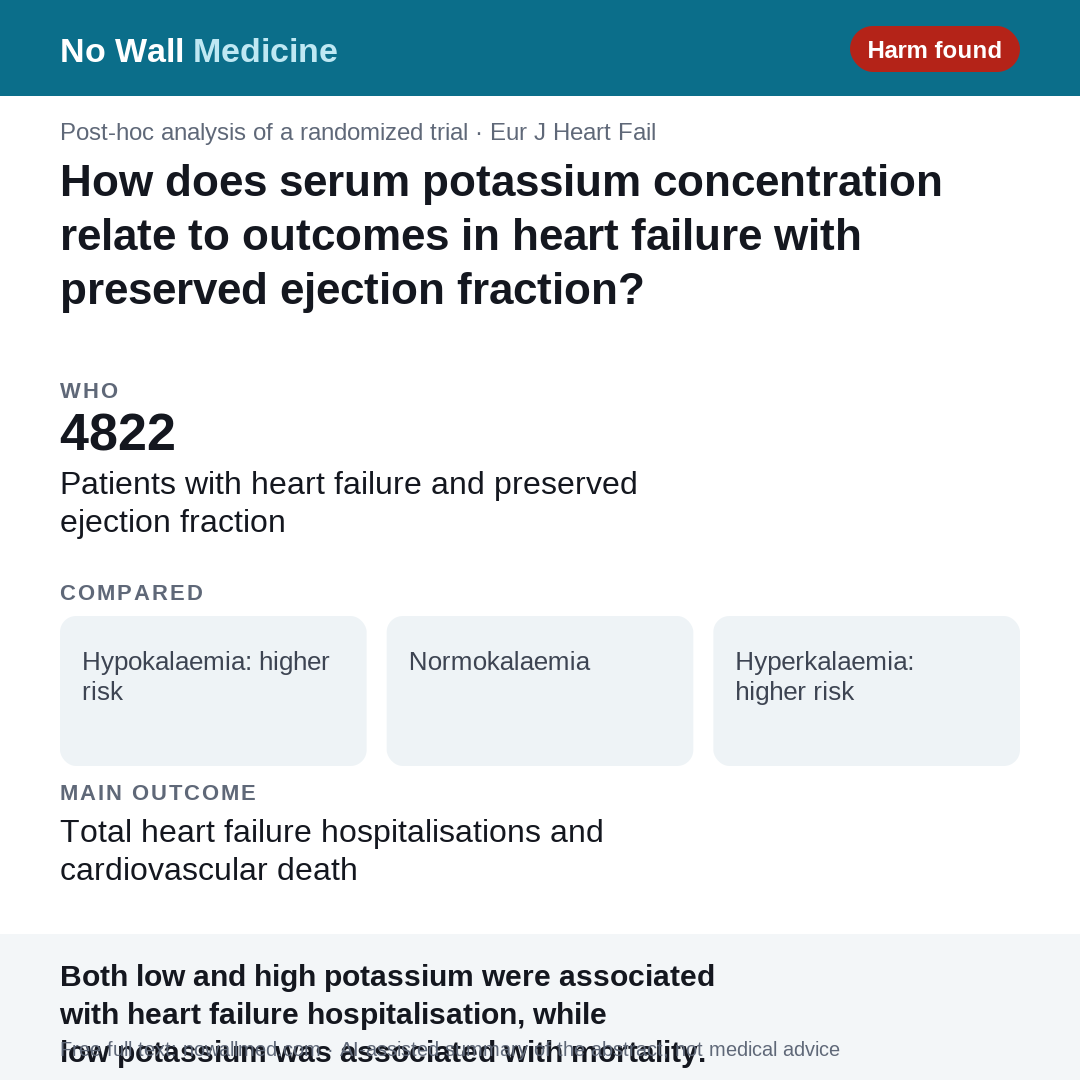
How does serum potassium concentration relate to outcomes in heart failure with preserved ejection fraction?
Who
4822
Patients with heart failure and preserved ejection fraction
Compared
Hypokalaemia: higher risk
Normokalaemia
Hyperkalaemia: higher risk
Main outcome
Total heart failure hospitalisations and cardiovascular death
Result: hypokalaemia adjusted hazard ratio 1.55 (95% CI 1.30-1.85); hyperkalaemia adjusted hazard ratio 1.21 (95% CI 1.02-1.44)
Bottom line: Both low and high potassium were associated with heart failure hospitalisation, while low potassium was associated with mortality.
Eur J Heart Fail · 2021-03-08Download image
Clinical question: How does serum potassium concentration relate to outcomes in heart failure with preserved ejection fraction?
Why it matters: The relationship between serum potassium concentration and clinical outcomes in patients with heart failure and preserved ejection fraction is not well-established.
Key points
- Researchers analyzed 4822 patients with heart failure and preserved ejection fraction from the PARAGON-HF trial to examine the link between potassium levels and clinical outcomes.
- Time-updated low potassium was associated with an adjusted hazard ratio of 1.55 for the primary outcome, while high potassium was associated with an adjusted hazard ratio of 1.21.
- Low potassium was associated with a higher risk of all-cause, cardiovascular, and non-cardiovascular death, particularly in patients with impaired kidney function.
Headline and key points written with AI from the paper’s abstract, with every number checked against it. Read the paper before relying on them.
Was this summary helpful?
Subject terms
Cite this article
Ferreira JP, Claggett BL, Liu J, et al. Serum potassium and outcomes in heart failure with preserved ejection fraction: a post-hoc analysis of the PARAGON-HF trial. Eur J Heart Fail. 2021. doi:10.1002/ejhf.2134
Spotted a mistake? Suggest a correction