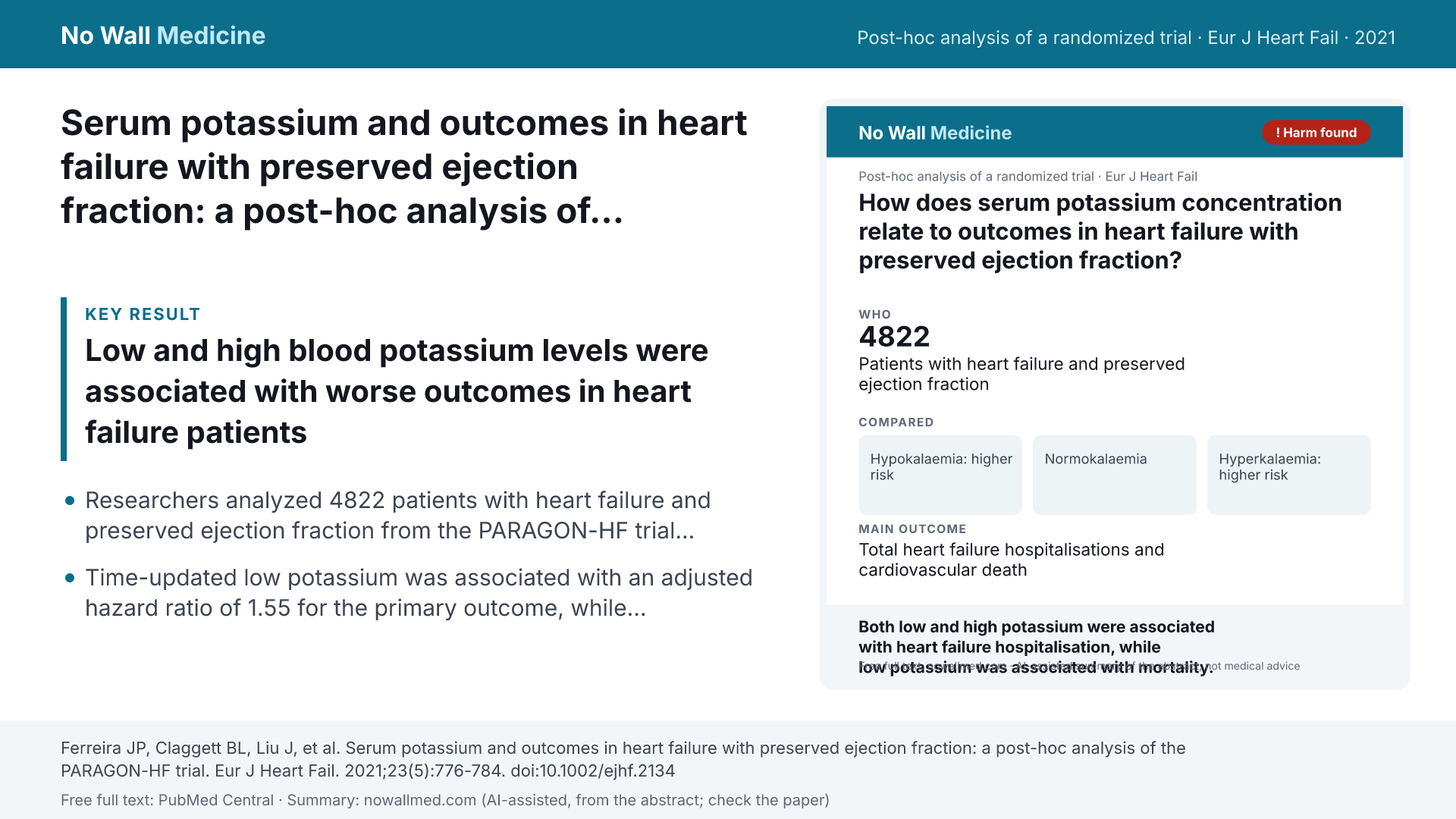
Serum potassium and outcomes in heart failure with preserved ejection fraction: a post-hoc analysis of the PARAGON-HF trial
Key result: Low and high blood potassium levels were associated with worse outcomes in heart failure patients
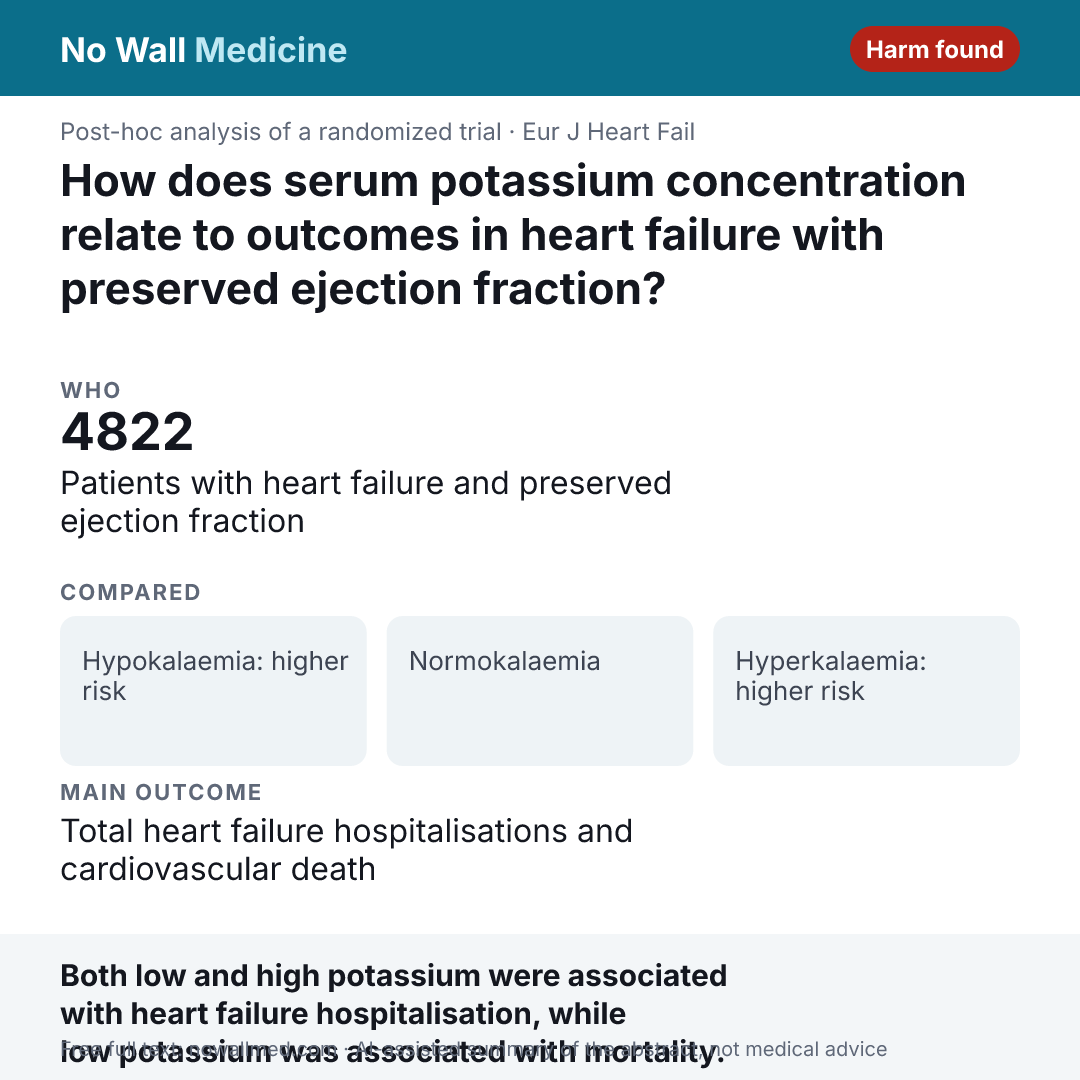
Post-hoc analysis of a randomized trialHarm found
How does serum potassium concentration relate to outcomes in heart failure with preserved ejection fraction?
Who
4822
Patients with heart failure and preserved ejection fraction
Compared
Hypokalaemia: higher risk
Normokalaemia
Hyperkalaemia: higher risk
Main outcome
Total heart failure hospitalisations and cardiovascular death
Result: hypokalaemia adjusted hazard ratio 1.55 (95% CI 1.30-1.85); hyperkalaemia adjusted hazard ratio 1.21 (95% CI 1.02-1.44)
Bottom line: Both low and high potassium were associated with heart failure hospitalisation, while low potassium was associated with mortality.
Eur J Heart Fail · 2021-03-08 · Save PNG
Key points
- Researchers analyzed 4822 patients with heart failure and preserved ejection fraction from the PARAGON-HF trial to examine the link between potassium levels and clinical outcomes.
- Time-updated low potassium was associated with an adjusted hazard ratio of 1.55 for the primary outcome, while high potassium was associated with an adjusted hazard ratio of 1.21.
- Low potassium was associated with a higher risk of all-cause, cardiovascular, and non-cardiovascular death, particularly in patients with impaired kidney function.
Why it matters: The relationship between serum potassium concentration and clinical outcomes in patients with heart failure and preserved ejection fraction is not well-established.
Discussion prompts
- Would these patients look like yours? Who was left out?
- Is the main outcome one that matters to patients?
- Is the difference large enough to change what you do?
Cite: Ferreira JP, Claggett BL, Liu J, et al. Serum potassium and outcomes in heart failure with preserved ejection fraction: a post-hoc analysis of the PARAGON-HF trial. Eur J Heart Fail. 2021. doi:10.1002/ejhf.2134
Free full text: PubMed Central · Summary and visual abstract: nowallmed.com/a/serum-potassium-and-outcomes-in-heart-failure-with-preserved-ejection-vxyg2x/ (AI-assisted from the abstract; check the paper before relying on it).