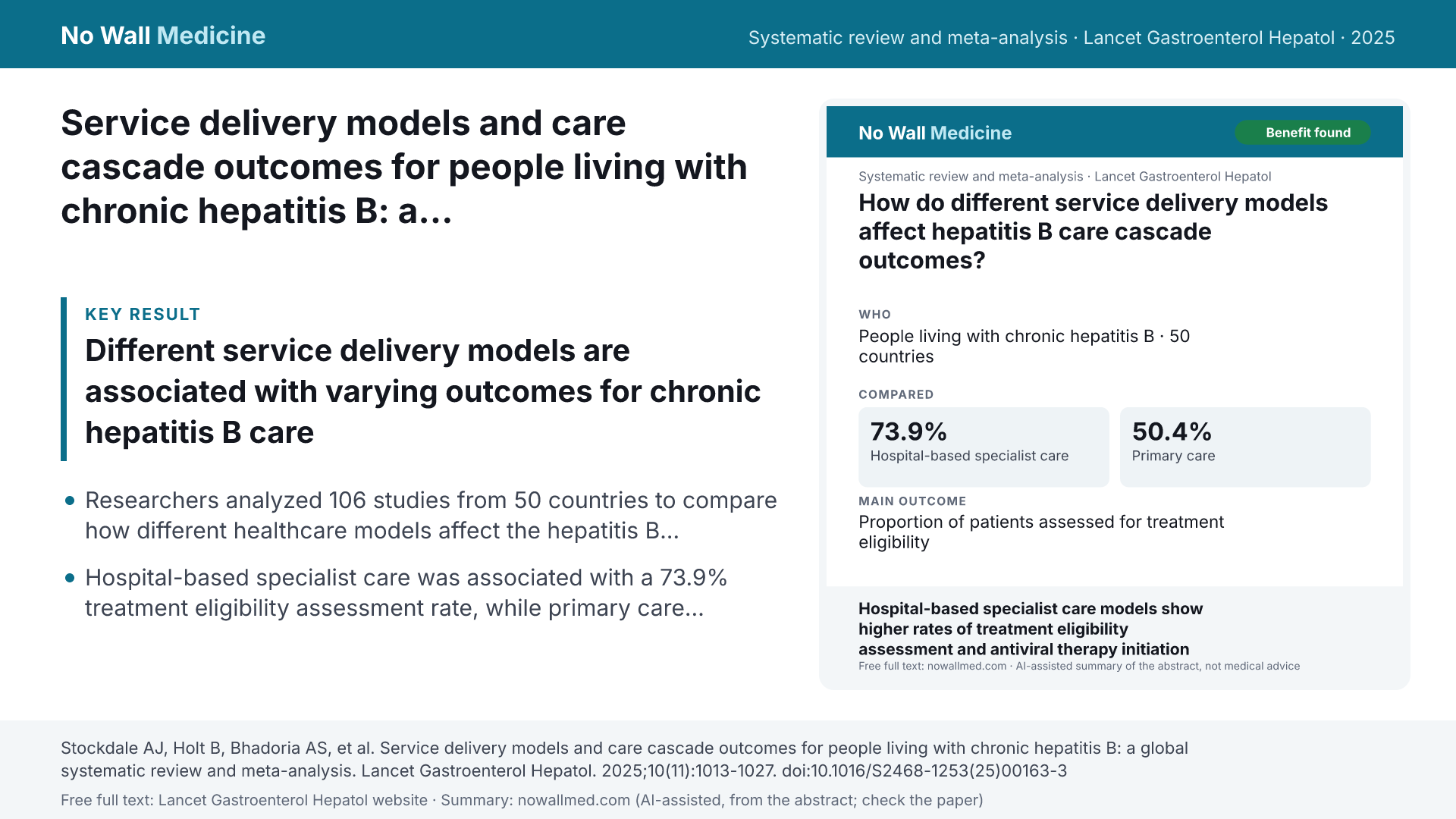
Different service delivery models are associated with varying outcomes for chronic hepatitis B care
Service delivery models and care cascade outcomes for people living with chronic hepatitis B: a global systematic review and meta-analysis
Systematic review and meta-analysisBenefit found
How do different service delivery models affect hepatitis B care cascade outcomes?
Who
People living with chronic hepatitis B · 50 countries
Compared
73.9%Hospital-based specialist care (95% CI 65.8-80.6)
50.4%Primary care (25.9-74.8)
Main outcome
Proportion of patients assessed for treatment eligibility
Result: risk ratio 2.07 (95% CI 1.65-2.59)
Bottom line: Hospital-based specialist care models show higher rates of treatment eligibility assessment and antiviral therapy initiation compared to primary care.
Lancet Gastroenterol Hepatol · 2025-08-14 · Save PNG
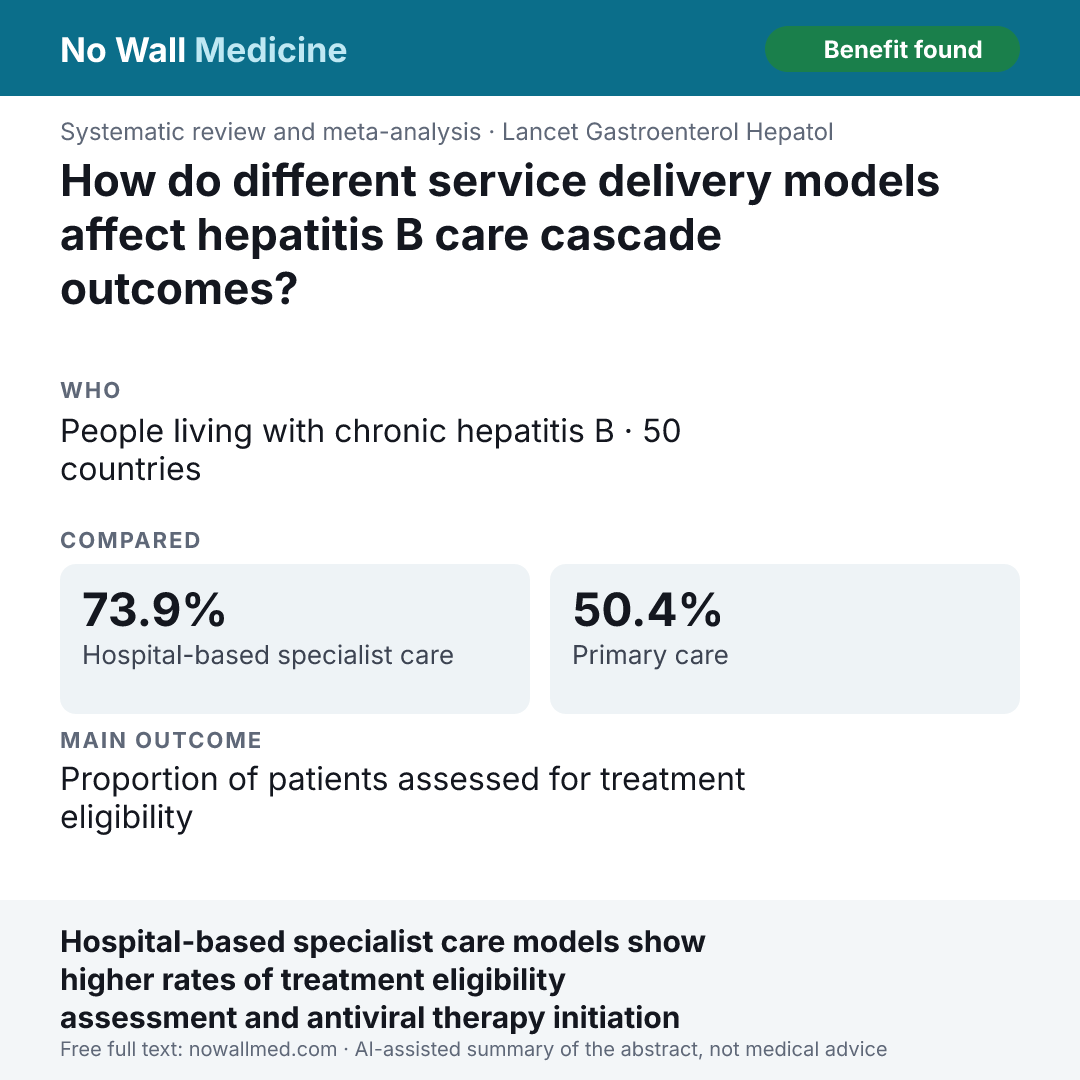
Clinical question: How do different service delivery models affect hepatitis B care cascade outcomes?
Why it matters: Only 13% of the 254 million people with chronic hepatitis B were diagnosed and 3% were treated in 2022, creating a gap in care provision.
Key points
- Researchers analyzed 106 studies from 50 countries to compare how different healthcare models affect the hepatitis B care cascade.
- Hospital-based specialist care was associated with a 73.9% treatment eligibility assessment rate, while primary care was associated with 50.4%.
- Community screening with linkage to specialist care was associated with a 97.7% rate of starting antiviral therapy when eligible.
Headline and key points written with AI from the paper’s abstract, with every number checked against it. Read the paper before relying on them.
Was this summary helpful?
Abstract
Background
Chronic hepatitis B is a leading cause of cirrhosis and hepatocellular carcinoma globally. In 2022, only 13% of the 254 million people with chronic hepatitis B were diagnosed and 3% were treated, highlighting a major gap in care provision. We aimed to comprehensively review service delivery models and their outcomes across the hepatitis B care cascade. Methods
For this systematic review and meta-analysis, we searched PubMed, Embase, and Scopus for observational and interventional studies of chronic hepatitis B service delivery models that reported care outcomes, published between May 1, 2013, and July 15, 2024, with no language restrictions. Care cascade outcomes were the proportion of people diagnosed with hepatitis B who were assessed for treatment eligibility; the proportion of eligible people who started antiviral therapy; the proportion retained in care; and the proportion on therapy who had HBV DNA viral suppression. We evaluated pooled outcomes across hospital-based specialist care; co-managed care between primary and specialist care; community screening with linkage to specialist care; community screening with passive linkage to care; community test and treat clinics; primary care; and integrated care with antenatal, non-communicable disease, HIV, prison health, and substance misuse services and clinics, using a generalised linear mixed model with logit link and study random effects. For within-study comparisons of different models, we used inverse variance weighting to estimate the pooled risk ratio (RR). Heterogeneity was assessed with I2. This study is registered with PROSPERO (CRD42023410009). Findings
Of 4883 studies identified in the search, we included 106 studies comprising 110 cohorts from 50 countries in our meta-analysis. 45 (41%) of 110 cohorts were from low-income and middle-income countries and 65 (59%) were from high-income countries. 76 (72%) of 106 studies were observational, 23 (22%) were non-randomised interventional studies, and seven (7%) were randomised trials. Treatment eligibility assessment occurred in 73·9% (95% CI 65·8-80·6; I2=98·5%) of patients for hospital-based specialist care (20 cohorts), 63·1% (53·0-72·2; I2=99·9%) for co-managed care (23 cohorts), 50·4% (25·9-74·8; I2=99·7%) for primary care (four cohorts), 82·3% (58·7-93·8; I2=96·1%) for community screening with linkage to specialist care (ten cohorts), 33·2% (23·1-45·1; I2=98·6%) for community screening with passive linkage to care (three cohorts), 56·9% (40·2-72·1; I2=98·8%) for diagnosis in antenatal clinics and post-delivery linkage to specialist care (five cohorts), 75·0% (37·7-93·7; I2=0·0%) for integrated care with harm reduction services (two cohorts), and 85·4% (78·0-90·6; I2=0·0%) for integrated care with prison health services (two cohorts). Initiation of antiviral therapy when eligible was 78·1% (95% CI 68·1-85·7; I2=99·2%) in hospital-based specialist care (25 cohorts), 67·2% (55·5-77·1; I2=95·8%) in co-managed care (11 cohorts), 49·3% (32·4-66·4; I2=87·9%) in primary care (four cohorts), 97·7% (80·6-99·8; I2=39·2%) in community screening with linkage to specialist care (seven cohorts), and 49·4% (22·1-77·0; I2=84·0%) for integrated care with non-communicable disease clinics (two cohorts). Higher rates of treatment eligibility assessment (RR 2·07 [95% CI 1·65-2·59], p<0·0001; I2=97·1%; three cohorts) and initiation of antiviral therapy (1·45 [1·13-1·85], p=0·0031; I2=0·0%; three cohorts) were observed in hospital-based specialist versus primary care models. Retention in care, assessed between 12 and 48 months, was 87·7% (95% CI 79·9-92·8, I2 =96·7%) in patients on antiviral therapy in hospital-based specialist care (13 cohorts) and 47·2% (95% CI 22·2-73·6, I2=99·5%) in patients not receiving antiviral therapy (two cohorts). Overall, retention was higher in patients with versus without antiviral therapy (RR 1·72 [95% CI 1·16-2·54]; p=0·019). HBV DNA viral suppression for patients on antiviral therapy in specialist care (nine cohorts) was 73·1% (95% CI 64·3-80·4; I2=92·0%) after a median of 12 months on antiviral therapy (IQR 12-33). Interpretation
Considerable attrition was seen across the chronic hepatitis B care cascade, with low rates of retention especially in patients not on antiviral therapy. Assessment for treatment eligibility and initiation of antiviral therapy were lower in primary versus hospital-based specialist care models. Chronic hepatitis B services need to adopt strategies to optimise linkage to care after diagnosis, initiation of antiviral therapy if eligible, adherence to antiviral therapy and retention in care, as promoted in 2024 WHO hepatitis B guidelines. Further research is also needed to explore simplified care models integrated with existing services to promote access. Funding
World Health Organization.
Abstract reproduced under the article’s CC BY licence.
Subject terms
Headline, design, result, key points, caveat and citation as plain text.
Cite this article
Stockdale AJ, Holt B, Bhadoria AS, et al. Service delivery models and care cascade outcomes for people living with chronic hepatitis B: a global systematic review and meta-analysis. Lancet Gastroenterol Hepatol. 2025;10(11):1013-1027. doi:10.1016/S2468-1253(25)00163-3
Spotted a mistake? Suggest a correction