Severe maternal morbidity in the high income setting: a systematic review of composite definitions
Systematic reviewMixed results
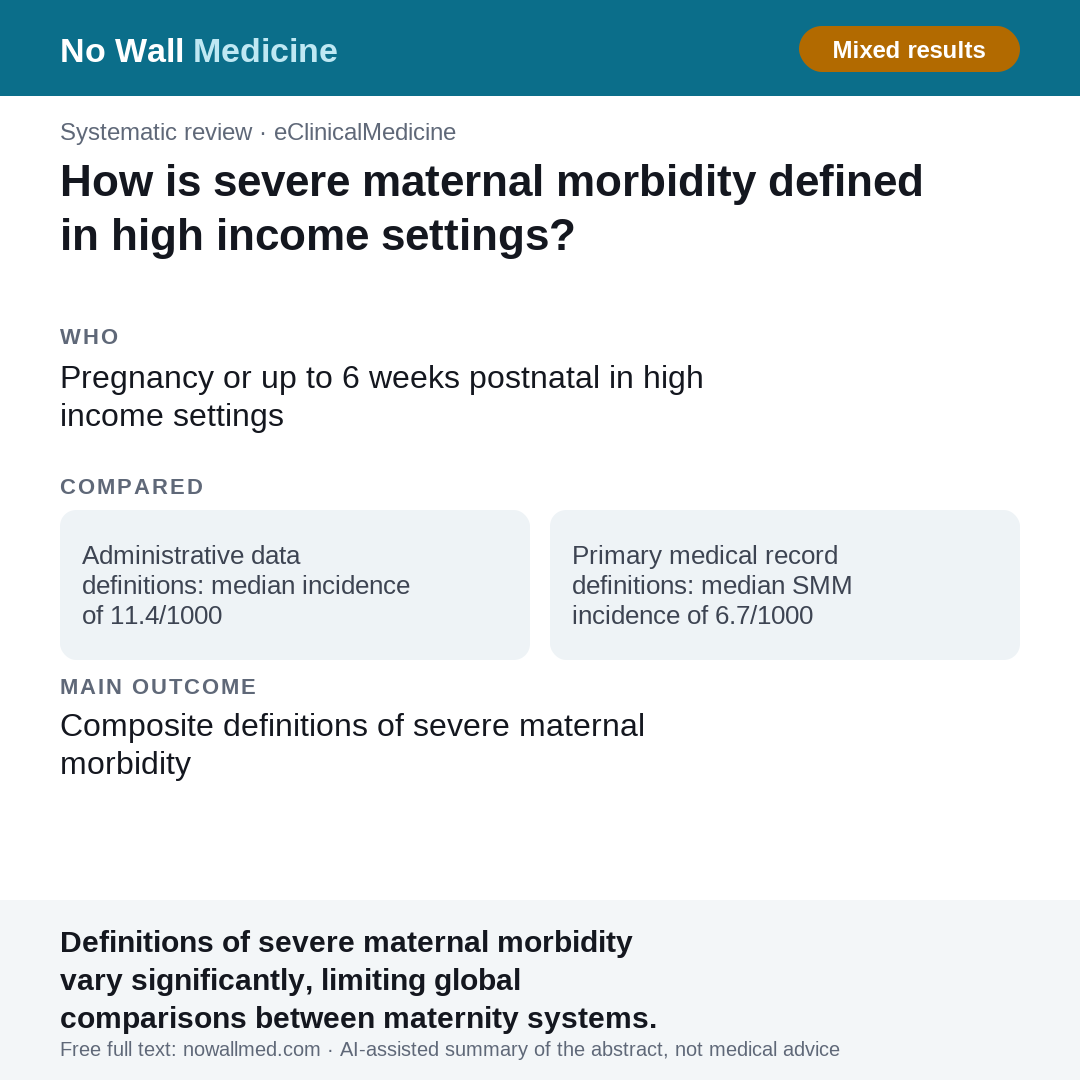
How is severe maternal morbidity defined in high income settings?
Who
Pregnancy or up to 6 weeks postnatal in high income settings
Compared
Administrative data definitions: median incidence of 11.4/1000
Primary medical record definitions: median SMM incidence of 6.7/1000
Main outcome
Composite definitions of severe maternal morbidity
Bottom line: Definitions of severe maternal morbidity vary significantly, limiting global comparisons between maternity systems.
Limitation: Variation in the sources of additional routine data required to construct a definition limited comparability.
Funded by: Medical Research Council and National Institute for Health Research
eClinicalMedicine · 2025-02-13Download image
Clinical question: How is severe maternal morbidity defined in high income settings?
Abstract
Background
Severe maternal morbidity (SMM) is an important indicator for the improvement of maternity care. Measurement of SMM varies, limiting global comparisons. To promote concordance we studied how SMM has been defined in epidemiological practice. Methods
Comprehensive composite definitions of SMM in pregnancy or up to 6 weeks postnatal that captured both obstetric and non-obstetric processes in high-income settings were identified through a prospectively registered (PROSPERO CRD42023421377) systematic search of PubMed, Embase, and Google Scholar 01/01/1993-31/08/2024. Clinical concepts, diagnostic and procedural codes captured by definitions of SMM were compared and the variation between definitions was described. Findings
The initial search identified 7852 records and 40 studies were included: 28 studies that reported 32 definitions of SMM for use with administrative data, with median incidence of 11.4/1000, and 13 studies that reported 13 definitions for use with the primary medical record, with median SMM incidence of 6.7/1000. The majority of definitions included cardiac, respiratory, and renal dysfunction or failure; haemorrhagic, thrombotic or infective morbidity; and critical interventions. Up to 75% of cases of SMM under some definitions involved transfusion. The main source of variation between definitions was the selection and definition of common obstetric diagnoses. Variation in the sources of additional routine data required to construct a definition also limited comparability. Interpretation
Despite common approaches to defining SMM, there are opportunities to improve comparability. No two definitions for use with administrative data in different settings involved a similar incidence and set of components and involved a similar distribution of components among cases. Harmonization of the purpose, constituent codes, and sources of data would facilitate comparisons between maternity systems. Funding
This work was supported by the Medical Research Council [MR/X006115/1] as well as the National Institute for Health Research [NIHR204430].
Cite this article
Henderson I, Lynch R, Gerry S, McLeish J, Watkinson P, Knight M. Severe maternal morbidity in the high income setting: a systematic review of composite definitions. eClinicalMedicine. 2025. doi:10.1016/j.eclinm.2025.103105
Spotted a mistake? Suggest a correction
Top studies every Monday
The week’s key trials and guidelines in your specialties, by email. Free.
Get the weekly digest