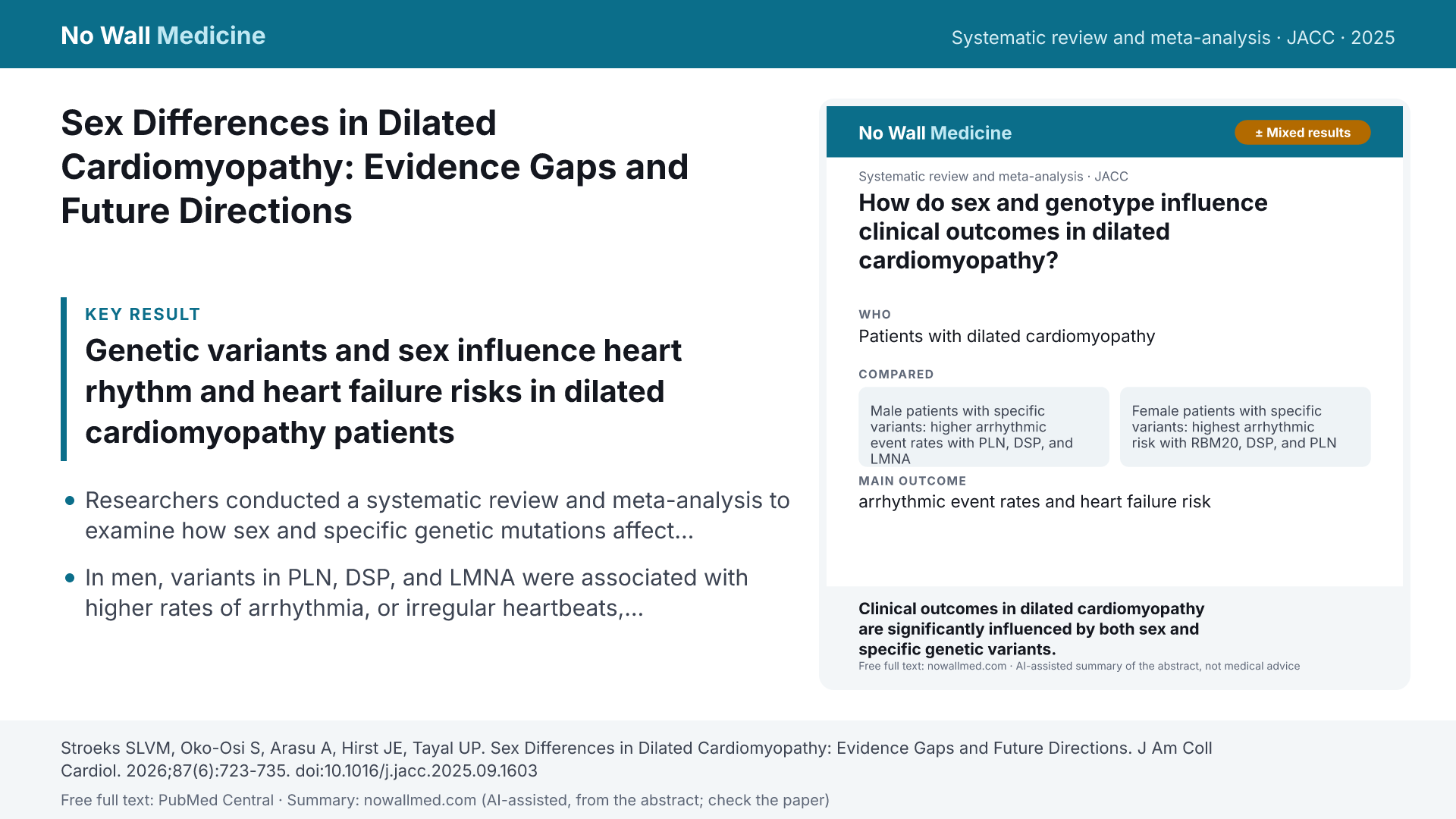
Genetic variants and sex influence heart rhythm and heart failure risks in dilated cardiomyopathy patients
Sex Differences in Dilated Cardiomyopathy: Evidence Gaps and Future Directions
Systematic review and meta-analysisMixed results
How do sex and genotype influence clinical outcomes in dilated cardiomyopathy?
Who
Patients with dilated cardiomyopathy
Compared
Male patients with specific variants: higher arrhythmic event rates with PLN, DSP, and LMNA
Female patients with specific variants: highest arrhythmic risk with RBM20, DSP, and PLN
Main outcome
arrhythmic event rates and heart failure risk
Bottom line: Clinical outcomes in dilated cardiomyopathy are significantly influenced by both sex and specific genetic variants.
JACC · 2025-11-26Download image

Clinical question: How do sex and genotype influence clinical outcomes in dilated cardiomyopathy?
Why it matters: It is uncertain if the higher prevalence of dilated cardiomyopathy in men reflects biological differences or underdiagnosis in women.
Key points
- Researchers conducted a systematic review and meta-analysis to examine how sex and specific genetic mutations affect dilated cardiomyopathy, a condition where the heart becomes enlarged and weak.
- In men, variants in PLN, DSP, and LMNA were associated with higher rates of arrhythmia, or irregular heartbeats, compared to TTNtv and BAG3 carriers.
- In women, RBM20, DSP, and PLN variants were associated with the highest arrhythmia risk, while PLN and LMNA variants were associated with the highest risk of heart failure in both sexes.
Headline and key points written with AI from the paper’s abstract, with every number checked against it. Read the paper before relying on them.
Was this summary helpful?
Subject terms
Cite this article
Stroeks SLVM, Oko-Osi S, Arasu A, Hirst JE, Tayal UP. Sex Differences in Dilated Cardiomyopathy: Evidence Gaps and Future Directions. JACC. 2025. doi:10.1016/j.jacc.2025.09.1603
Spotted a mistake? Suggest a correction