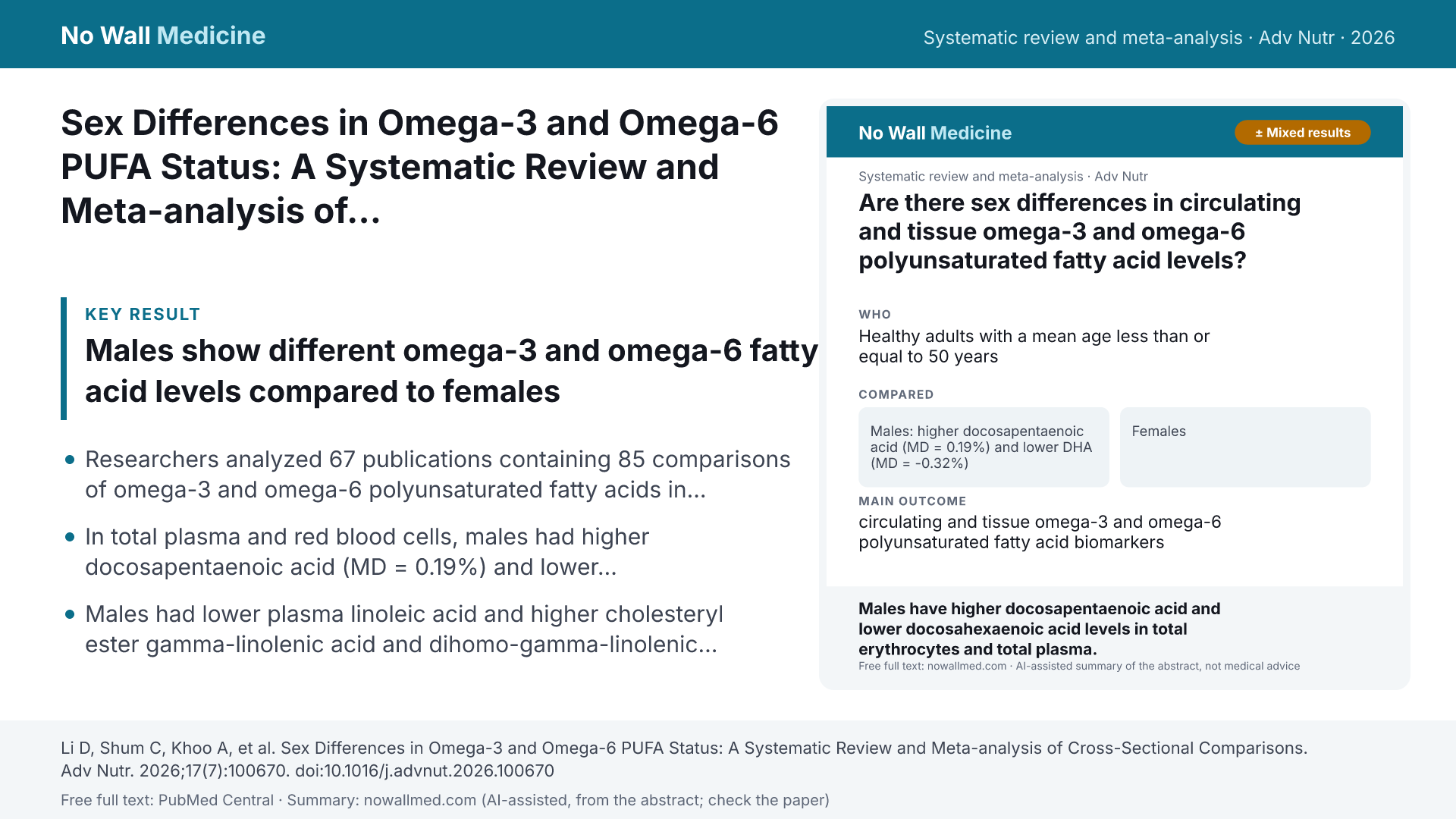
Males show different omega-3 and omega-6 fatty acid levels compared to females
Sex Differences in Omega-3 and Omega-6 PUFA Status: A Systematic Review and Meta-analysis of Cross-Sectional Comparisons
Systematic review and meta-analysisMixed results
Are there sex differences in circulating and tissue omega-3 and omega-6 polyunsaturated fatty acid levels?
Who
Healthy adults with a mean age less than or equal to 50 years
Compared
Males: higher docosapentaenoic acid (MD = 0.19%) and lower DHA (MD = -0.32%)
Females
Main outcome
circulating and tissue omega-3 and omega-6 polyunsaturated fatty acid biomarkers
Result: MD = 0.19%, 95% CI: 0.10%, 0.27% for docosapentaenoic acid; MD = -0.32%, 95% CI: -0.46%, -0.18% for DHA
Bottom line: Males have higher docosapentaenoic acid and lower docosahexaenoic acid levels in total erythrocytes and total plasma.
Limitation: The certainty of the evidence for all outcomes was graded as low or very low.
Adv Nutr · 2026-06-09Download image

Clinical question: Are there sex differences in circulating and tissue omega-3 and omega-6 polyunsaturated fatty acid levels?
Key points
- Researchers analyzed 67 publications containing 85 comparisons of omega-3 and omega-6 polyunsaturated fatty acids in healthy adults with a mean age of 50 years or younger.
- In total plasma and red blood cells, males had higher docosapentaenoic acid (MD = 0.19%) and lower docosahexaenoic acid (MD = -0.32%) than females.
- Males had lower plasma linoleic acid and higher cholesteryl ester gamma-linolenic acid and dihomo-gamma-linolenic acid compared to females.
Limitation the authors note: The certainty of the evidence for all outcomes was graded as low or very low.
Headline and key points written with AI from the paper’s abstract, with every number checked against it. Read the paper before relying on them.
Was this summary helpful?
Subject terms
Headline, design, result, key points, caveat and citation as plain text.
Cite this article
Li D, Shum C, Khoo A, et al. Sex Differences in Omega-3 and Omega-6 PUFA Status: A Systematic Review and Meta-analysis of Cross-Sectional Comparisons. Adv Nutr. 2026. doi:10.1016/j.advnut.2026.100670
Spotted a mistake? Suggest a correction