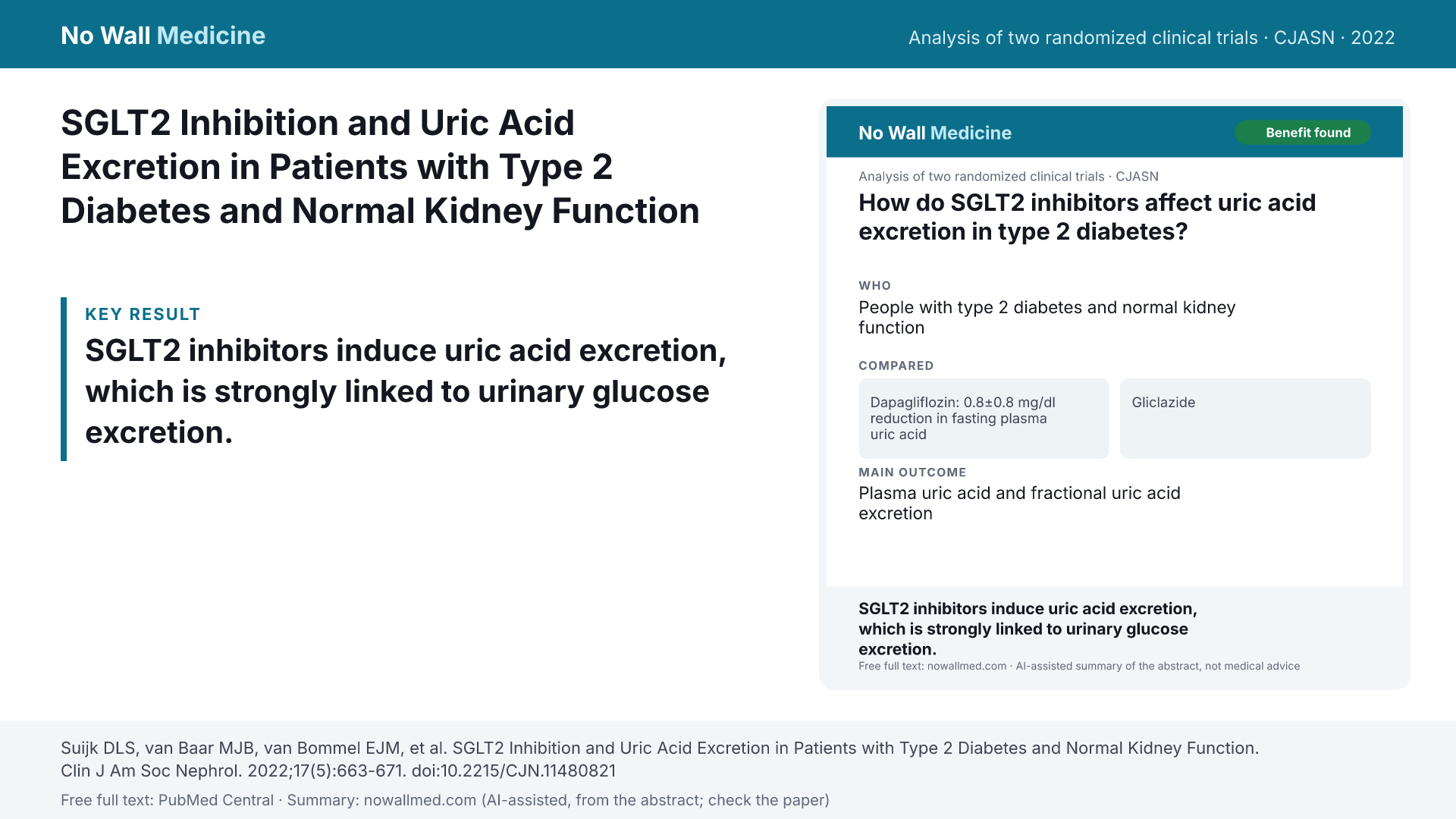
SGLT2 Inhibition and Uric Acid Excretion in Patients with Type 2 Diabetes and Normal Kidney Function
Analysis of two randomized clinical trialsBenefit found
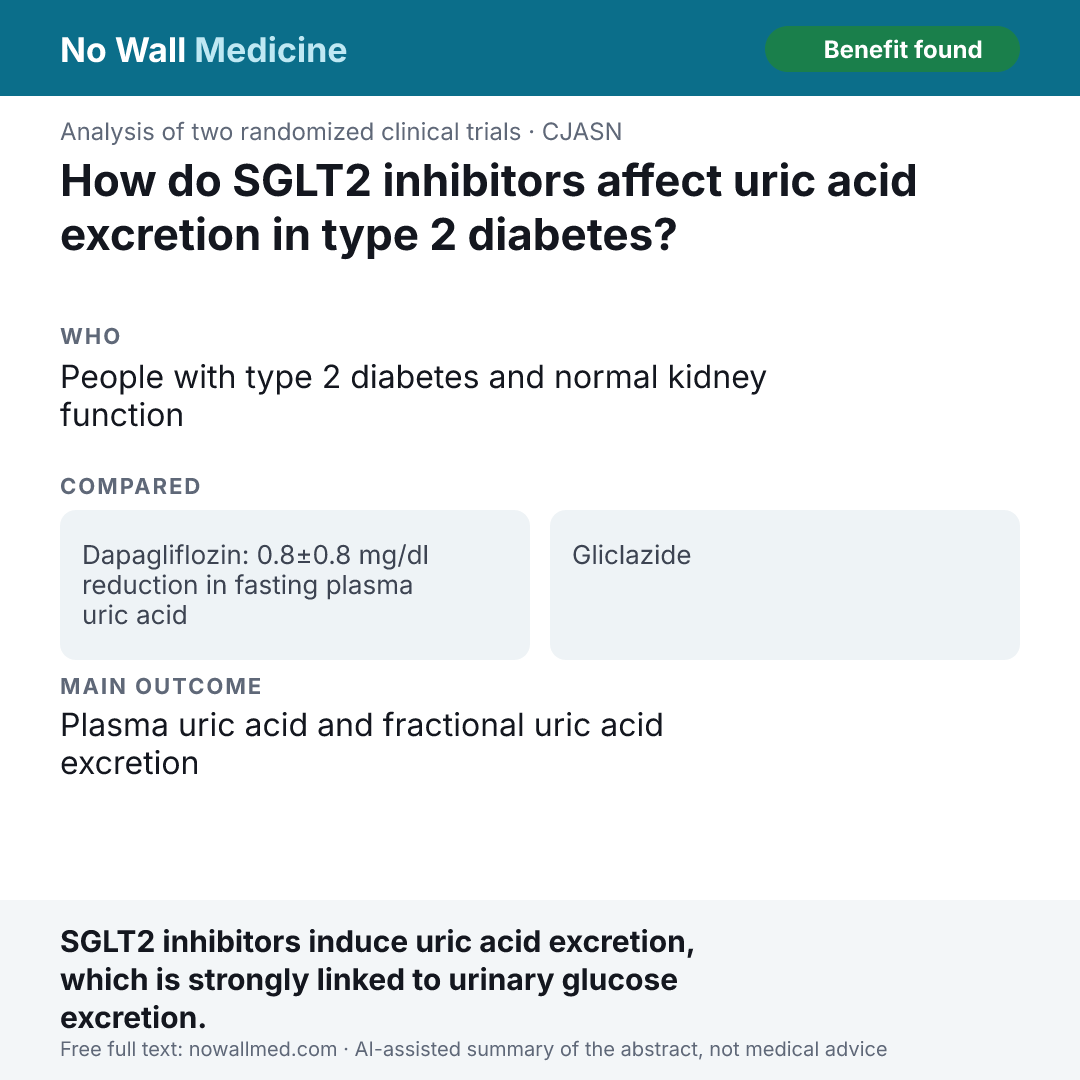
How do SGLT2 inhibitors affect uric acid excretion in type 2 diabetes?
Who
People with type 2 diabetes and normal kidney function
Compared
Dapagliflozin: 0.8±0.8 mg/dl reduction in fasting plasma uric acid
Gliclazide
Main outcome
Plasma uric acid and fractional uric acid excretion
Bottom line: SGLT2 inhibitors induce uric acid excretion, which is strongly linked to urinary glucose excretion.
CJASN · 2022-03-23 · Save PNG
Clinical question: How do SGLT2 inhibitors affect uric acid excretion in type 2 diabetes?
Abstract
Background and objectives
Sodium-glucose transporter 2 (SGLT2) inhibitor-induced uric acid lowering may contribute to kidney-protective effects of the drug class in people with type 2 diabetes. This study investigates mechanisms of plasma uric acid lowering by SGLT2 inhibitors in people with type 2 diabetes with a focus on urate transporter 1. Design, setting, participants, & measurements
We conducted an analysis of two randomized clinical trials. First, in the Renoprotective Effects of Dapagliflozin in Type 2 Diabetes study, 44 people with type 2 diabetes were randomized to dapagliflozin or gliclazide for 12 weeks. Plasma uric acid, fractional uric acid excretion, and hemodynamic kidney function were measured in the fasted state and during clamped euglycemia or hyperglycemia. Second, in the Uric Acid Excretion study, ten people with type 2 diabetes received 1 week of empagliflozin, urate transporter 1 blocker benzbromarone, or their combination in a crossover design, and effects on plasma uric acid, fractional uric acid excretion, and 24-hour uric acid excretion were measured. Results
In the Renoprotective Effects of Dapagliflozin in Type 2 Diabetes study, compared with the fasted state (5.3±1.1 mg/dl), acute hyperinsulinemia and hyperglycemia significantly reduced plasma uric acid by 0.2±0.3 and 0.4±0.3 mg/dl (both P<0.001) while increasing fractional uric acid excretion (by 3.2%±3.1% and 8.9%±4.5%, respectively; both P<0.001). Dapagliflozin reduced plasma uric acid by 0.8±0.8 during fasting, 1.0±1.0 in hyperinsulinemic-euglycemic state, and 0.8±0.7 mg/dl during hyperglycemic conditions (P<0.001), respectively, whereas fractional uric acid excretion in 24-hour urine increased by 3.0%±2.1% (P<0.001) and 2.6%±4.5% during hyperinsulinemic-euglycemic conditions (P=0.003). Fractional uric acid excretion strongly correlated to fractional glucose excretion (r=0.35; P=0.02). In the Uric Acid Excretion study, empagliflozin and benzbromarone both significantly reduced plasma uric acid and increased fractional uric acid excretion. Effects of combination therapy did not differ from benzbromarone monotherapy. Conclusions
In conclusion, SGLT2 inhibitors induce uric acid excretion, which is strongly linked to urinary glucose excretion and is attenuated during concomitant pharmacologic blockade of urate transporter 1. Clinical trial registry name and registration number
Renoprotective Effects of Dapagliflozin in Type 2 Diabetes (RED), NCT02682563; SGLT2 Inhibition: Uric Acid Excretion Study (UREX), NCT05210517.
Subject terms
Headline, design, result, key points, caveat and citation as plain text.
Cite this article
Suijk DLS, van Baar MJB, van Bommel EJM, et al. SGLT2 Inhibition and Uric Acid Excretion in Patients with Type 2 Diabetes and Normal Kidney Function. Clin J Am Soc Nephrol. 2022;17(5):663-671. doi:10.2215/CJN.11480821
Spotted a mistake? Suggest a correction