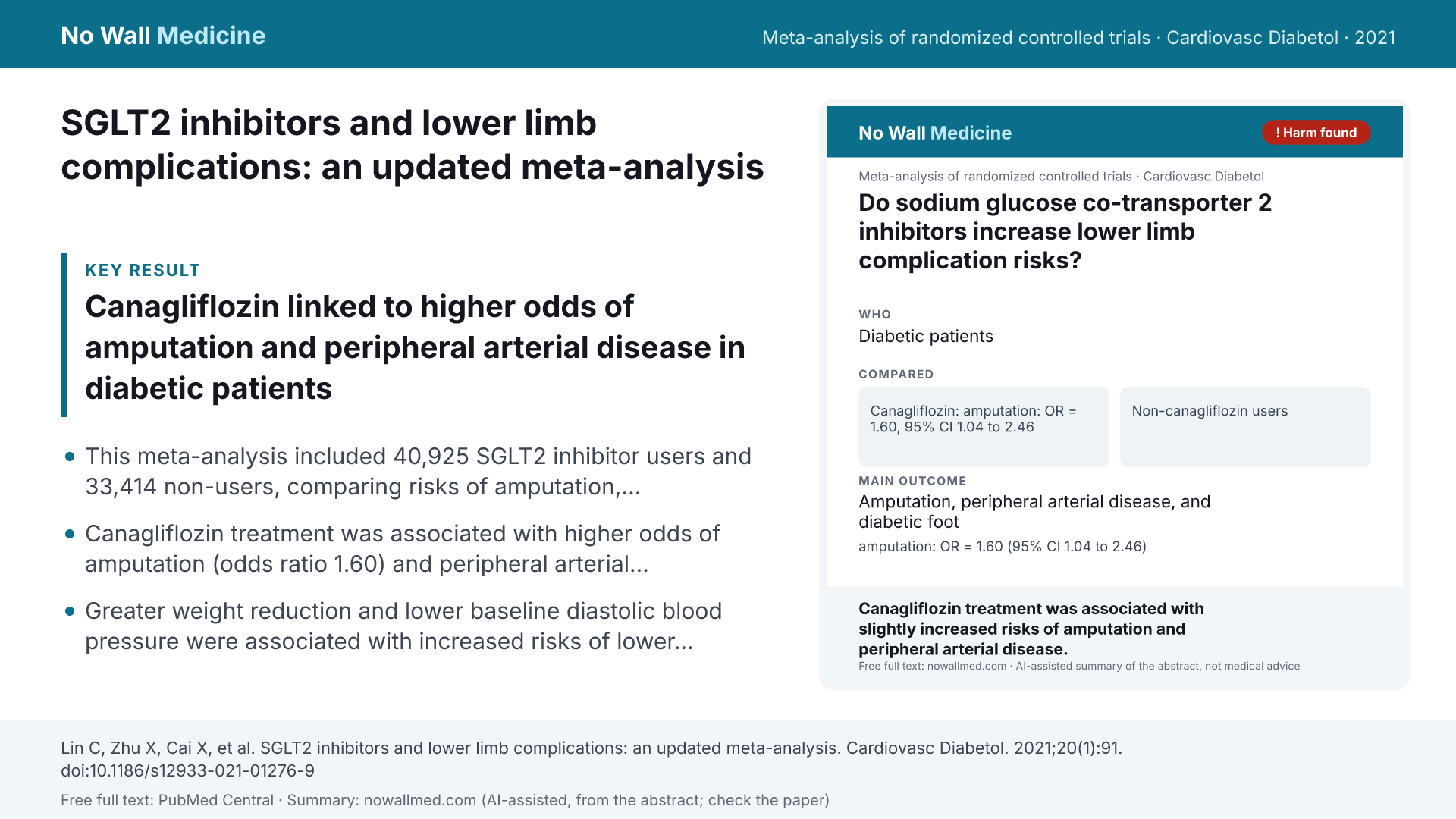
SGLT2 inhibitors and lower limb complications: an updated meta-analysis
Key result: Canagliflozin linked to higher odds of amputation and peripheral arterial disease in diabetic patients
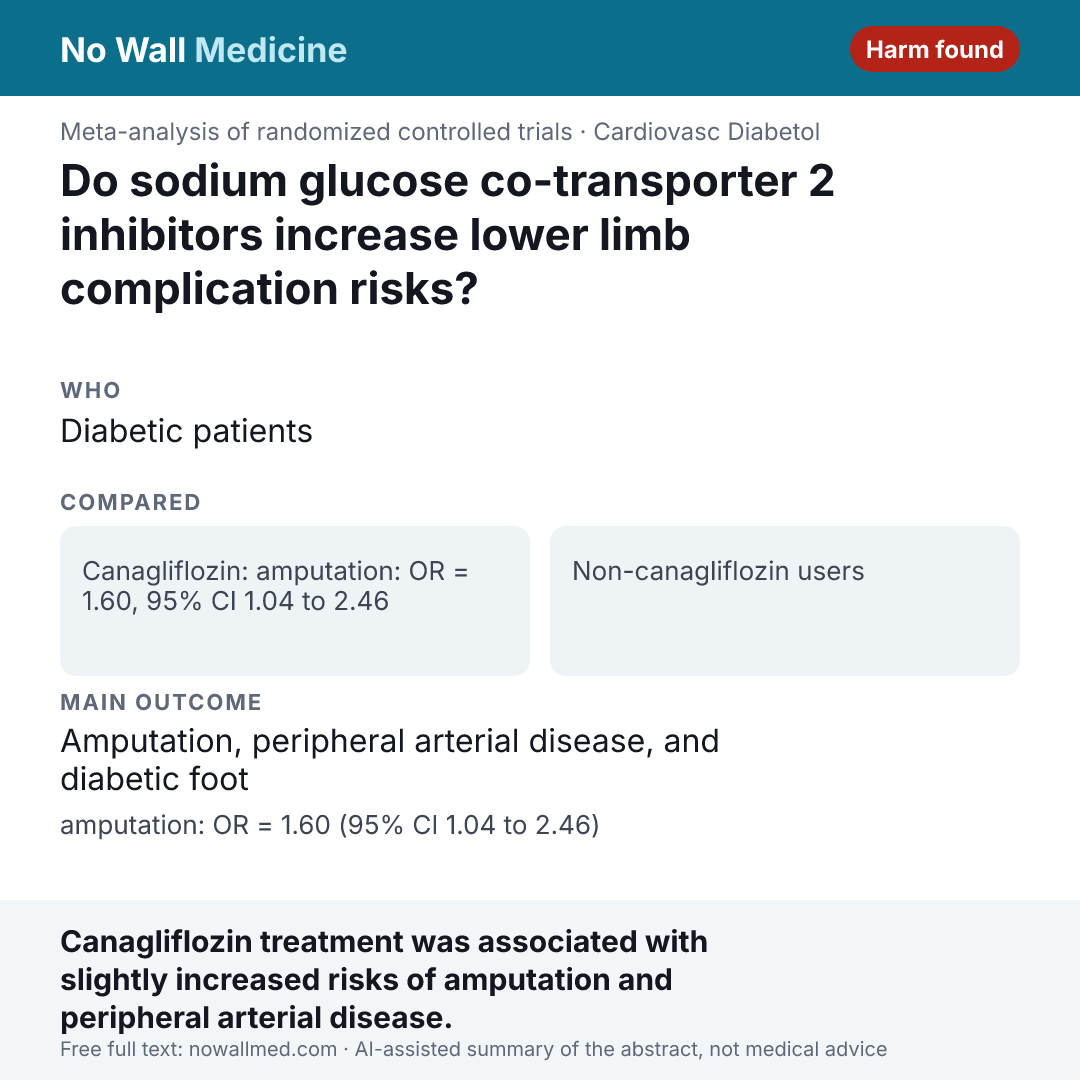
Meta-analysis of randomized controlled trialsHarm found
Do sodium glucose co-transporter 2 inhibitors increase lower limb complication risks?
Who
Diabetic patients
Compared
Canagliflozin: amputation: OR = 1.60, 95% CI 1.04 to 2.46
Non-canagliflozin users
Main outcome
Amputation, peripheral arterial disease, and diabetic foot
Result: amputation: OR = 1.60 (95% CI 1.04 to 2.46)
Bottom line: Canagliflozin treatment was associated with slightly increased risks of amputation and peripheral arterial disease.
Cardiovasc Diabetol · 2021-04-28 · Save PNG
Key points
- This meta-analysis included 40,925 SGLT2 inhibitor users and 33,414 non-users, comparing risks of amputation, peripheral arterial disease, and diabetic foot.
- Canagliflozin treatment was associated with higher odds of amputation (odds ratio 1.60) and peripheral arterial disease (odds ratio 1.53) compared with non-use.
- Greater weight reduction and lower baseline diastolic blood pressure were associated with increased risks of lower limb complications in SGLT2 inhibitor users.
Why it matters: Applies to diabetic patients taking SGLT2 inhibitors; suggests canagliflozin may carry higher odds of specific lower limb complications than other agents.
Discussion prompts
- Would these patients look like yours? Who was left out?
- Is the main outcome one that matters to patients?
- Is the difference large enough to change what you do?
Cite: Lin C, Zhu X, Cai X, et al. SGLT2 inhibitors and lower limb complications: an updated meta-analysis. Cardiovasc Diabetol. 2021;20(1):91. doi:10.1186/s12933-021-01276-9
Free full text: PubMed Central · Summary and visual abstract: nowallmed.com/a/sglt2-inhibitors-and-lower-limb-complications-an-updated-meta-1d8y04h/ (AI-assisted from the abstract; check the paper before relying on it).