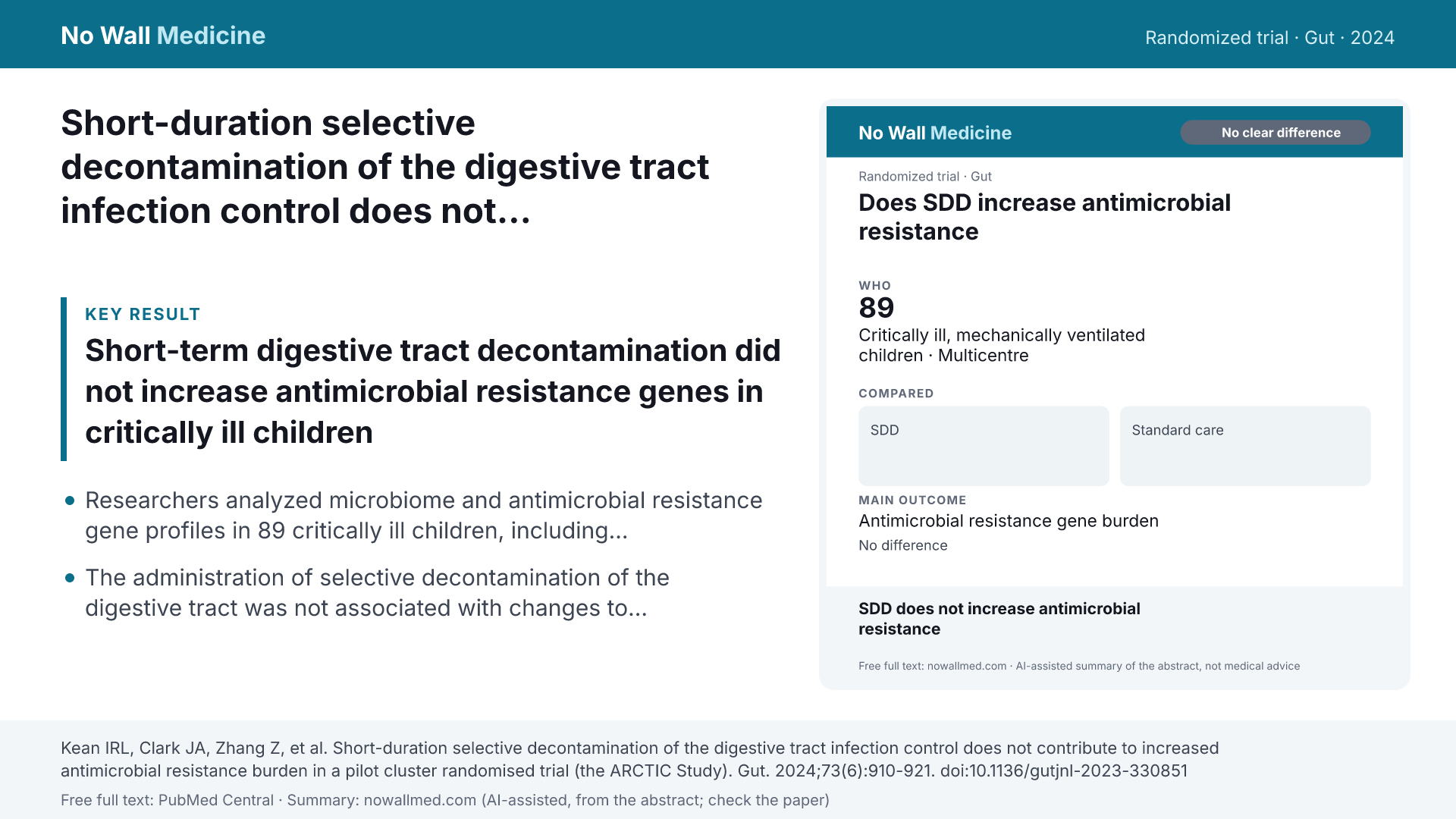
Short-term digestive tract decontamination did not increase antimicrobial resistance genes in critically ill children
Short-duration selective decontamination of the digestive tract infection control does not contribute to increased antimicrobial resistance burden in a pilot cluster randomised trial (the ARCTIC Study)
Randomized trialNo clear difference
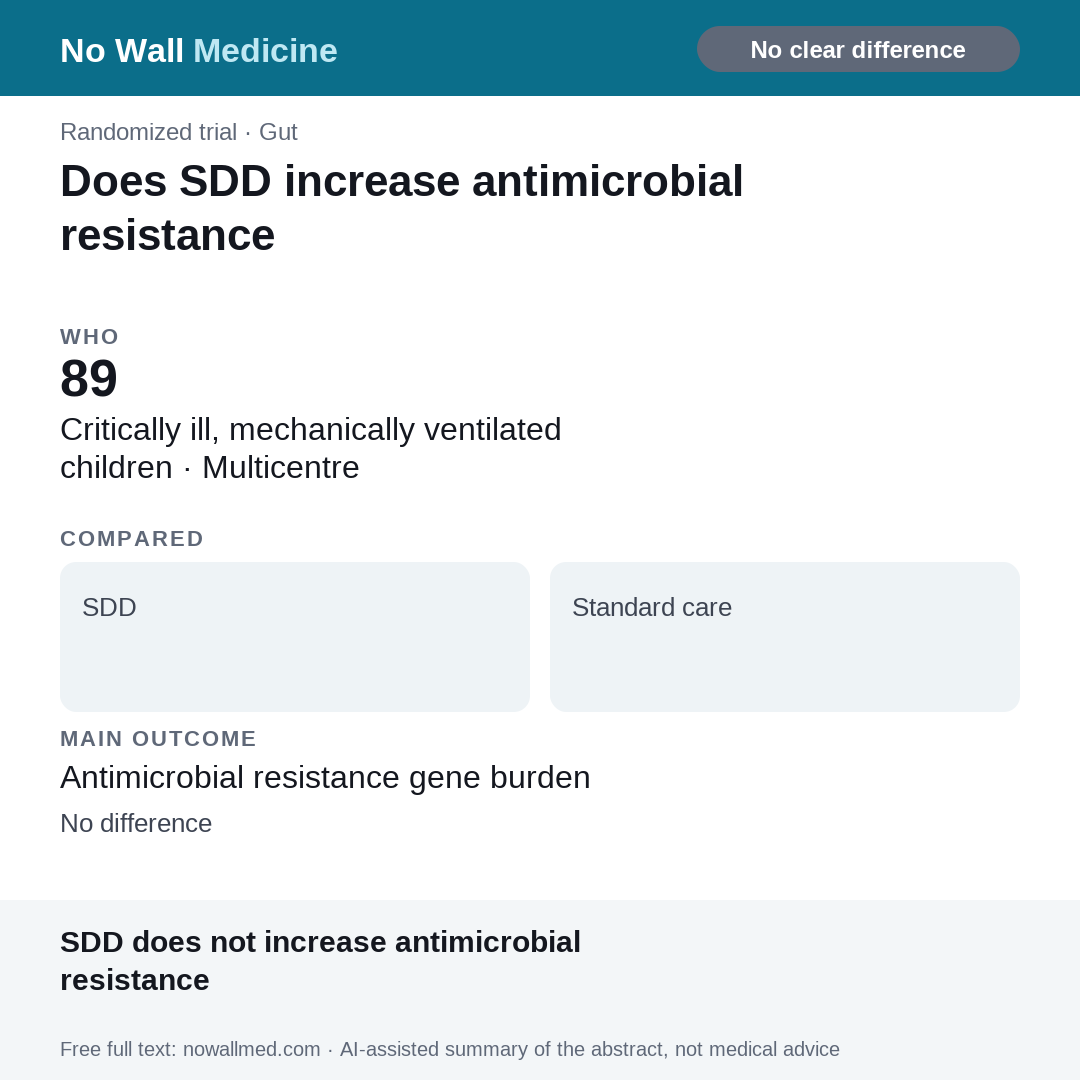
Does SDD increase antimicrobial resistance
Who
89
Critically ill, mechanically ventilated children · Multicentre
Compared
SDD
Standard care
Main outcome
Antimicrobial resistance gene burden
Result: No difference
Bottom line: SDD does not increase antimicrobial resistance
Gut · 2024-05-10Download image
Why it matters: It is unknown whether selective decontamination of the digestive tract increases the burden of antimicrobial resistance genes in critically ill children.
Key points
- Researchers analyzed microbiome and antimicrobial resistance gene profiles in 89 critically ill children, including 17 receiving selective decontamination of the digestive tract and 19 receiving standard care.
- The administration of selective decontamination of the digestive tract was not associated with changes to the clinically relevant antimicrobial resistance gene burden compared to standard care.
- Selective decontamination of the digestive tract was associated with a greater shift in microbiome diversity and a dominance of Actinomycetota bacteria at the end of mechanical ventilation.
Headline and key points written with AI from the paper’s abstract, with every number checked against it. Read the paper before relying on them.
Was this summary helpful?
Abstract
Objective
Selective decontamination of the digestive tract (SDD) is a well-studied but hotly contested medical intervention of enhanced infection control. Here, we aim to characterise the changes to the microbiome and antimicrobial resistance (AMR) gene profiles in critically ill children treated with SDD-enhanced infection control compared with conventional infection control. Design
We conducted shotgun metagenomic microbiome and resistome analysis on serial oropharyngeal and faecal samples collected from critically ill, mechanically ventilated patients in a pilot multicentre cluster randomised trial of SDD. The microbiome and AMR profiles were compared for longitudinal and intergroup changes. Of consented patients, faecal microbiome baseline samples were obtained in 89 critically ill children. Additionally, samples collected during and after critical illness were collected in 17 children treated with SDD-enhanced infection control and 19 children who received standard care. Results
SDD affected the alpha and beta diversity of critically ill children to a greater degree than standard care. At cessation of treatment, the microbiome of SDD patients was dominated by Actinomycetota, specifically Bifidobacterium, at the end of mechanical ventilation. Altered gut microbiota was evident in a subset of SDD-treated children who returned late longitudinal samples compared with children receiving standard care. Clinically relevant AMR gene burden was unaffected by the administration of SDD-enhanced infection control compared with standard care. SDD did not affect the composition of the oral microbiome compared with standard treatment. Conclusion
Short interventions of SDD caused a shift in the microbiome but not of the AMR gene pool in critically ill children at the end mechanical ventilation, compared with standard antimicrobial therapy.
Abstract reproduced under the article’s CC BY licence.
Subject terms
Cite this article
Kean IRL, Clark JA, Zhang Z, Daubney E, White D, Ferrando-Vivas P. Short-duration selective decontamination of the digestive tract infection control does not contribute to increased antimicrobial resistance burden in a pilot cluster randomised trial (the ARCTIC Study). Gut. 2024. doi:10.1136/gutjnl-2023-330851
Spotted a mistake? Suggest a correction