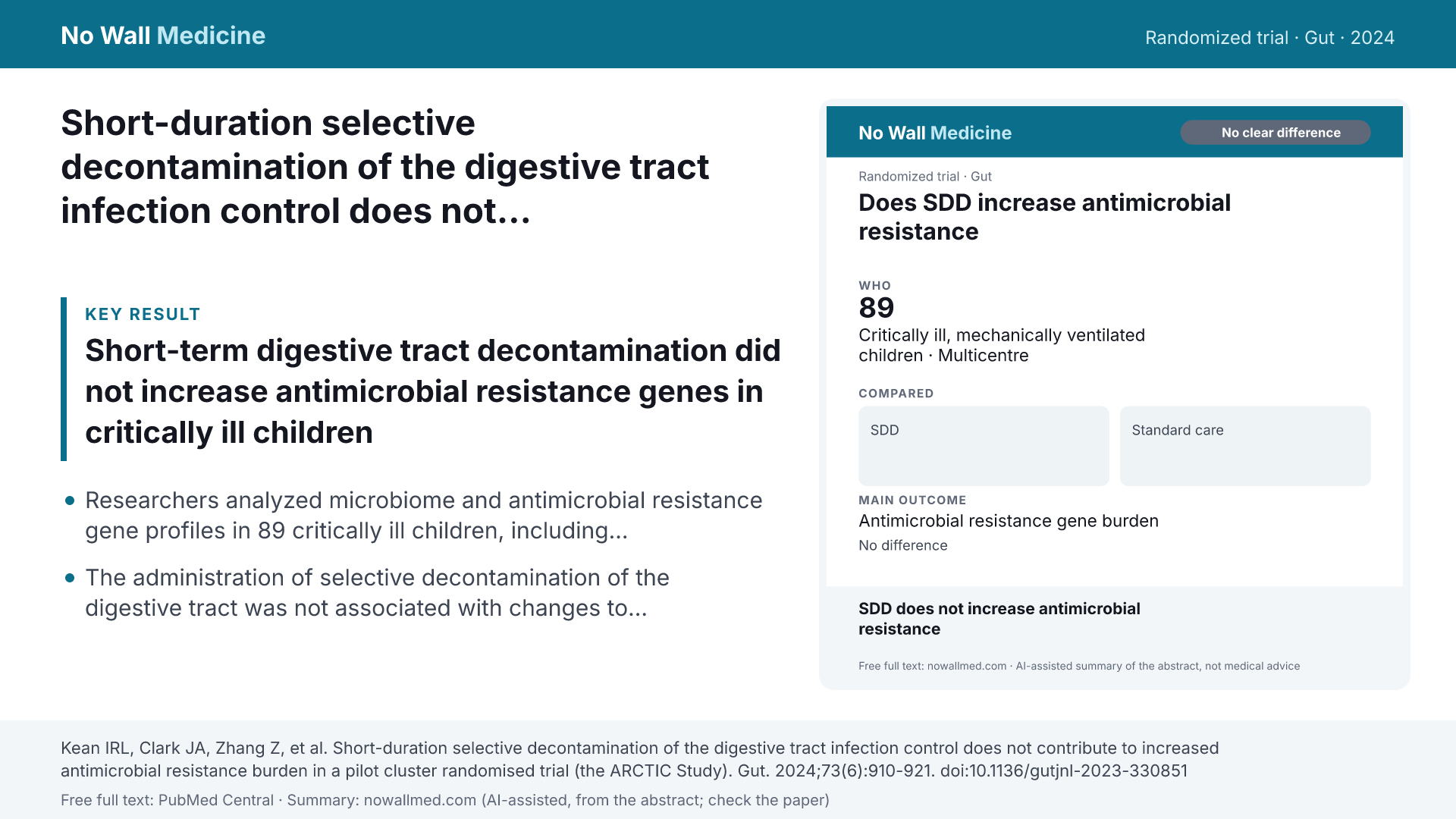
Short-duration selective decontamination of the digestive tract infection control does not contribute to increased antimicrobial resistance burden in a pilot cluster randomised trial (the ARCTIC Study)
Key result: Short-term digestive tract decontamination did not increase antimicrobial resistance genes in critically ill children
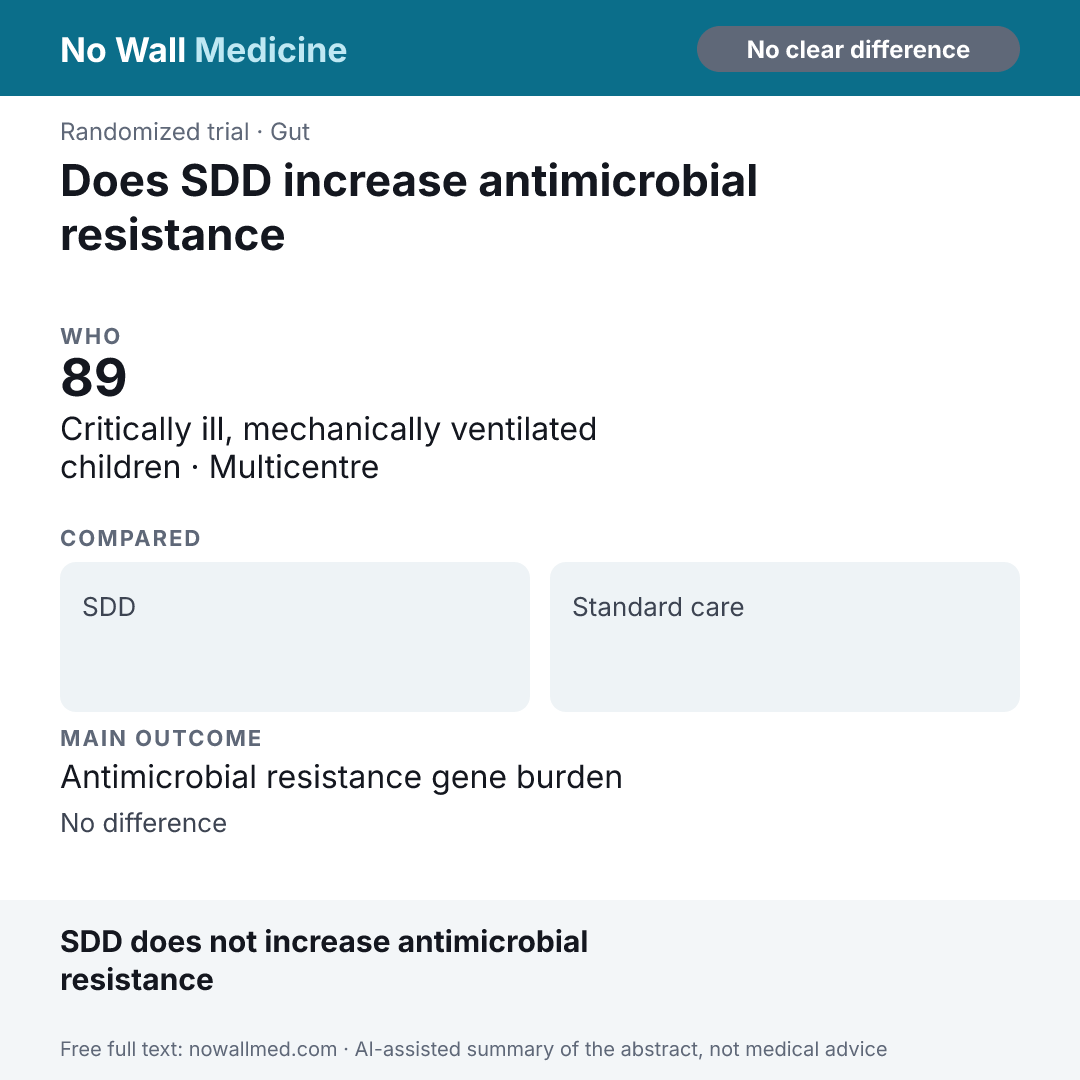
Randomized trialNo clear difference
Does SDD increase antimicrobial resistance
Who
89
Critically ill, mechanically ventilated children · Multicentre
Compared
SDD
Standard care
Main outcome
Antimicrobial resistance gene burden
Result: No difference
Bottom line: SDD does not increase antimicrobial resistance
Gut · 2024-05-10 · Save PNG
Key points
- Researchers analyzed microbiome and antimicrobial resistance gene profiles in 89 critically ill children, including 17 receiving selective decontamination of the digestive tract and 19 receiving standard care.
- The administration of selective decontamination of the digestive tract was not associated with changes to the clinically relevant antimicrobial resistance gene burden compared to standard care.
- Selective decontamination of the digestive tract was associated with a greater shift in microbiome diversity and a dominance of Actinomycetota bacteria at the end of mechanical ventilation.
Discussion prompts
- Would these patients look like yours? Who was left out?
- Is the main outcome one that matters to patients?
- Is the difference large enough to change what you do?
Cite: Kean IRL, Clark JA, Zhang Z, et al. Short-duration selective decontamination of the digestive tract infection control does not contribute to increased antimicrobial resistance burden in a pilot cluster randomised trial (the ARCTIC Study). Gut. 2024;73(6):910-921. doi:10.1136/gutjnl-2023-330851
Free full text: PubMed Central · Summary and visual abstract: nowallmed.com/a/short-duration-selective-decontamination-of-the-digestive-tract-jxxduj/ (AI-assisted from the abstract; check the paper before relying on it).