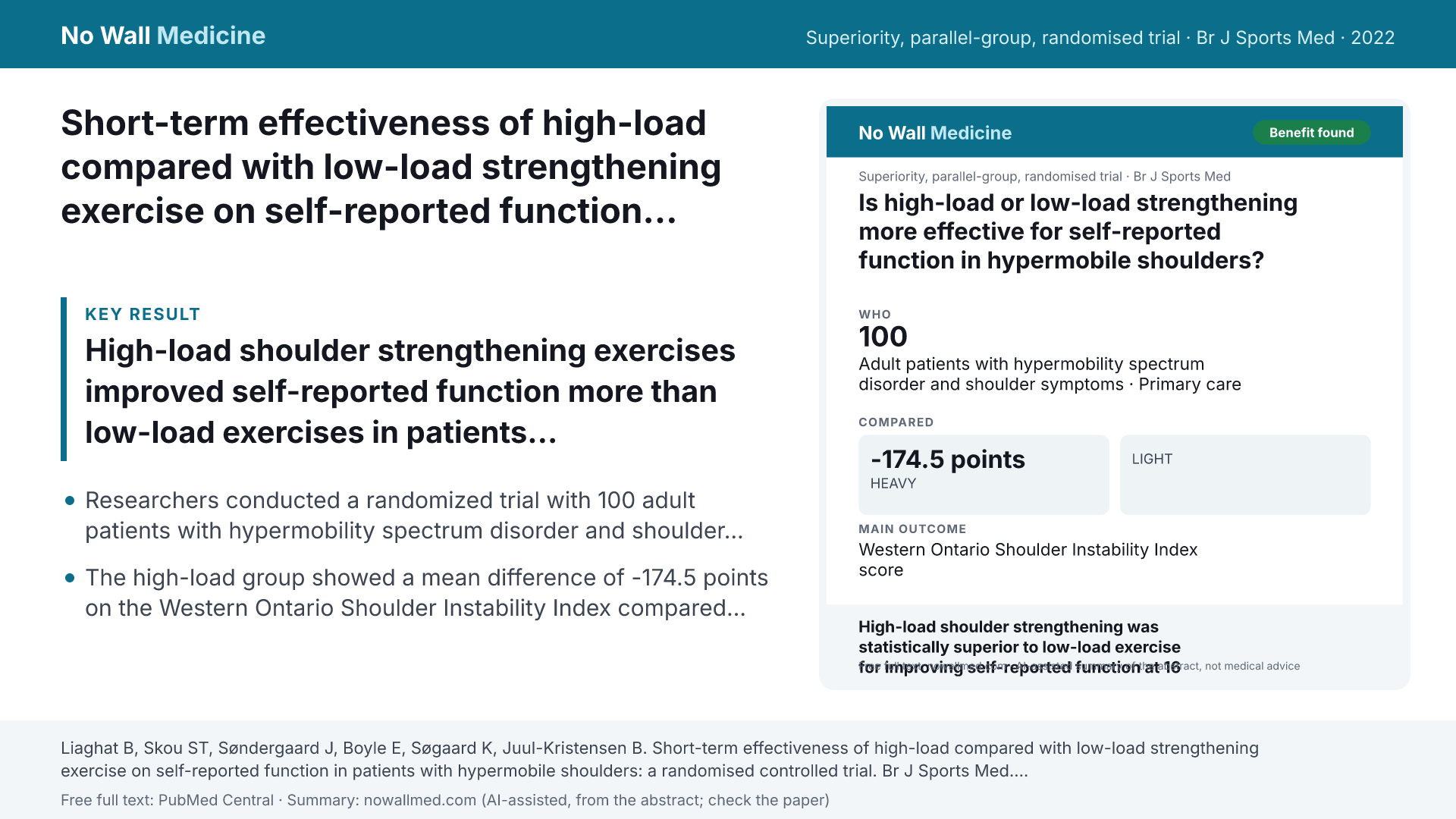
High-load shoulder strengthening exercises improved self-reported function more than low-load exercises in patients with hypermobility
Short-term effectiveness of high-load compared with low-load strengthening exercise on self-reported function in patients with hypermobile shoulders: a randomised controlled trial
Superiority, parallel-group, randomised trialBenefit found
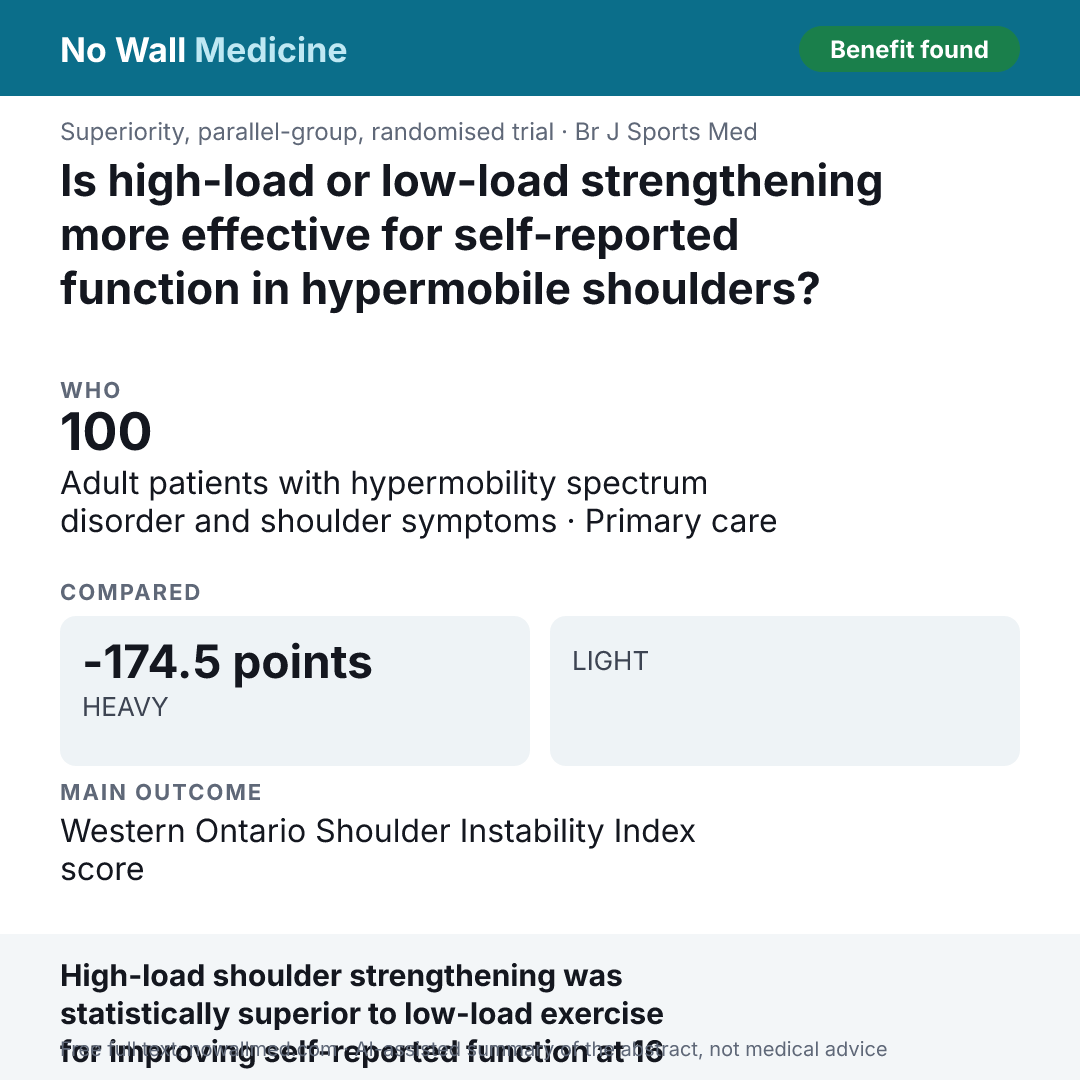
Is high-load or low-load strengthening more effective for self-reported function in hypermobile shoulders?
Who
100
Adult patients with hypermobility spectrum disorder and shoulder symptoms · Primary care
Compared
-174.5 pointsHEAVY
LIGHT
Main outcome
Western Ontario Shoulder Instability Index score
Result: -174.5 points (95% CI -341.4 to -7.7)
Bottom line: High-load shoulder strengthening was statistically superior to low-load exercise for improving self-reported function at 16 weeks.
Br J Sports Med · 2022-06-01 · Save PNG
Same trial (NCT03869307)
Papers we list that report this registered trial, oldest first. Read a secondary analysis alongside the main results.
- Main results Benefit found
This paper Br J Sports Med 2022-06 - Secondary analysis No clear difference
High-load and low-load shoulder exercises showed no significant difference in function after one year Br J Sports Med 2024-03
Clinical question: Is high-load or low-load strengthening more effective for self-reported function in hypermobile shoulders?
Key points
- Researchers conducted a randomized trial with 100 adult patients with hypermobility spectrum disorder and shoulder pain or instability for 16 weeks.
- The high-load group showed a mean difference of -174.5 points on the Western Ontario Shoulder Instability Index compared to the low-load group.
- High-load exercise was associated with more transient muscle soreness (56% vs 37%) and headaches (40% vs 20%) than low-load exercise.
Limitation the authors note: Further studies are needed to confirm the clinical relevance of these findings.
Headline and key points written with AI from the paper’s abstract, with every number checked against it. Read the paper before relying on them.
Was this summary helpful?
Abstract
Objectives
To investigate the short-term effectiveness of high-load versus low-load strengthening exercise on self-reported function in patients with hypermobility spectrum disorder (HSD) and shoulder symptoms. Methods
A superiority, parallel-group, randomised trial (balanced block randomisation, electronic concealment) including adult patients (n=100) from primary care with HSD and shoulder pain and/or shoulder instability ≥3 months. Patients received 16 weeks of shoulder exercises (three sessions/week): HEAVY (n=50, full-range, high-load, supervised twice/week) or LIGHT (n=50, neutral/mid-range, low-load, supervised three times). The primary outcome was the 16-week between-group difference in self-reported function measured with the Western Ontario Shoulder Instability Index (WOSI, scale 0-2100, 0=best, minimal important difference 252 points). Secondary outcomes were self-reported measures including quality of life and clinical tests including shoulder muscle strength and range of motion. An intention-to-treat analysis with multiple imputation was conducted by a blinded biostatistician using linear regression. Results
93 of 100 patients (93%) completed the 16-week evaluation. The mean WOSI score between-group difference significantly favoured HEAVY (-174.5 points, 95% CI -341.4 to -7.7, adjusted for age, sex, baseline score, clustering around clinic). The secondary outcomes were inconclusive, but patients in HEAVY were less likely to have a positive shoulder rotation test >180°, and more likely to rate an important improvement in physical symptoms. There were no serious adverse events, but HEAVY was associated with more transient muscle soreness (56% vs 37%) and headaches (40% vs 20%). Conclusion
High-load shoulder strengthening exercise was statistically superior to low-load strengthening exercise for self-reported function at 16 weeks and may be used in primary care to treat patients with HSD and shoulder pain and/or instability to improve shoulder function in the short term. Further studies are needed to confirm the clinical relevance, and patients should be supported to manage associated minor adverse events. Trial registration number
NCT03869307.
Abstract reproduced under the article’s CC BY NC licence.
Headline, design, result, key points, caveat and citation as plain text.
Cite this article
Liaghat B, Skou ST, Søndergaard J, Boyle E, Søgaard K, Juul-Kristensen B. Short-term effectiveness of high-load compared with low-load strengthening exercise on self-reported function in patients with hypermobile shoulders: a randomised controlled trial. Br J Sports Med. 2022. doi:10.1136/bjsports-2021-105223
Spotted a mistake? Suggest a correction