Experiential learning program improved eHealth literacy and technology use in patients with type 2 diabetes
Short-Term Effects of an eHealth Care Experiential Learning Program Among Patients With Type 2 Diabetes: Randomized Controlled Trial
Randomized controlled trialBenefit found
Does eHealth program improve literacy?
Who
92
Patients with type 2 diabetes · Taiwan
Compared
19.94Intervention
Control
Main outcome
eHealth literacy
Bottom line: eHealth program improves literacy and engagement
J Med Internet Res · 2024-08-16Download image
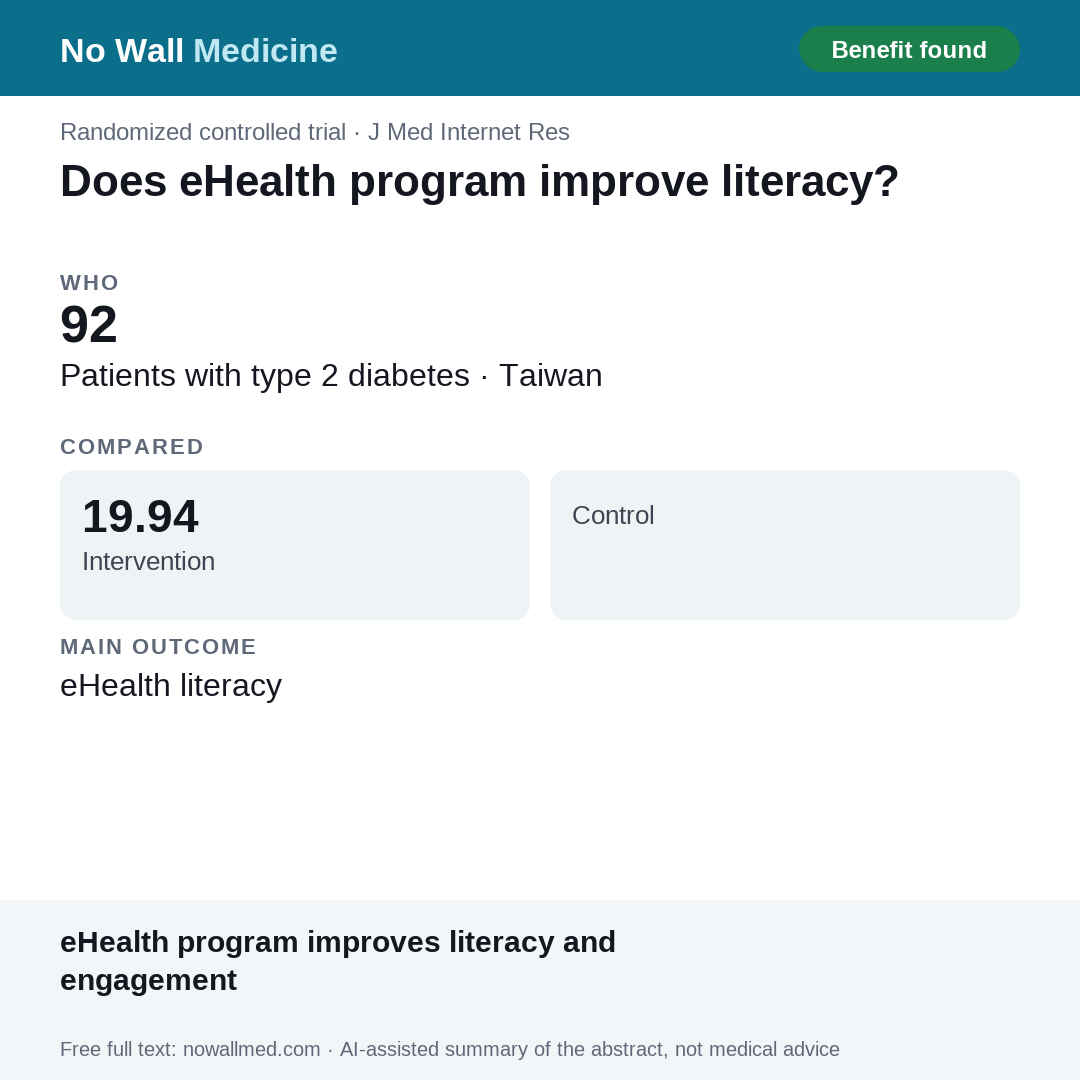
Clinical question: Does eHealth program improve literacy?
Why it matters: It is unknown if experiential learning theory can improve eHealth literacy, patient health engagement, and the use of health technology in people with type 2 diabetes.
Key points
- Researchers studied 92 patients with type 2 diabetes, comparing a 6-session experiential learning program to usual care.
- The intervention group showed significantly higher scores in eHealth literacy, patient health engagement, and eHealth use after the program.
- Improvements in eHealth literacy and eHealth use were maintained by the intervention group 3 months after the program ended.
Headline and key points written with AI from the paper’s abstract, with every number checked against it. Read the paper before relying on them.
Topics
Cite this article
Cheng YS, Lin CP, Chen LA, Hwang WR, Lin YC, Chen YC. Short-Term Effects of an eHealth Care Experiential Learning Program Among Patients With Type 2 Diabetes: Randomized Controlled Trial. J Med Internet Res. 2024. doi:10.2196/53509
Spotted a mistake? Suggest a correction
Top studies every Monday
The week’s key trials and guidelines in your specialties, plus any topics you follow. By email, free.
Get the weekly digest