Thermal ablation for cervical precancer is associated with high satisfaction despite common side effects
Side effects and acceptability measures for thermal ablation as a treatment for cervical precancer in low-income and middle-income countries: a systematic review and meta-synthesis
Key points
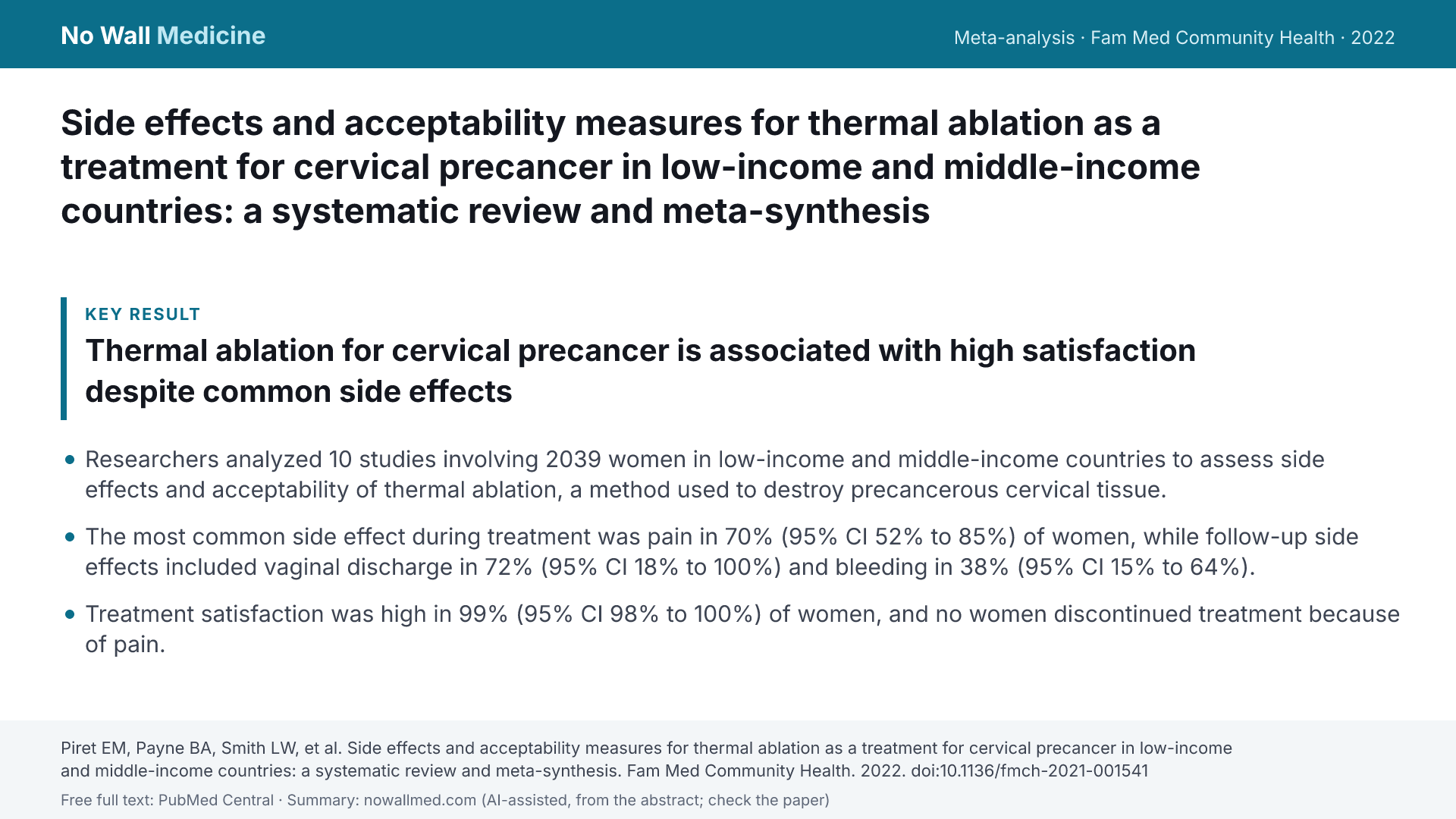
- Researchers analyzed 10 studies involving 2039 women in low-income and middle-income countries to assess side effects and acceptability of thermal ablation, a method used to destroy precancerous cervical tissue.
- The most common side effect during treatment was pain in 70% (95% CI 52% to 85%) of women, while follow-up side effects included vaginal discharge in 72% (95% CI 18% to 100%) and bleeding in 38% (95% CI 15% to 64%).
- Treatment satisfaction was high in 99% (95% CI 98% to 100%) of women, and no women discontinued treatment because of pain.
Limitation the authors note: Significant heterogeneity was found in the screening tests used to identify eligible women and the methods used to determine side effects.
Headline and key points written with AI from the paper’s abstract, with every number checked against it. Read the paper before relying on them.
Was this summary helpful?
Abstract
Objective
Understanding the side effects and acceptability of thermal ablation (TA) is necessary before large-scale application in screen-and-treat programmes can be justified in low-income and middle-income countries (LMICs). Design
Articles were selected for inclusion by two independent reviewers. Risk of bias was assessed using the Downs and Black's criteria. Summary data were extracted, and authors contacted for data when necessary. Proportions of interest and 95% CIs were estimated using a random effects model. Subgroup analysis was performed based on place of treatment and timing of post-treatment follow-up. Heterogeneity was estimated using the I2. Eligibility criteria
Studies that reported one or more side effects or patient acceptability measures after treatment of the cervix using TA in women living in LMICs who completed a cervical cancer screening test. Included articles were clinical trials or observational studies available in English and published before 18 December 2020. Information sources
Ovid MEDLINE, EMBASE, CINAHL, CAB Global Health and WHO Global Index Medicus were searched for this systematic review and meta-synthesis. Results
A total of 1590 abstracts were screened, 84 full text papers reviewed and 15 papers selected for inclusion in the qualitative review, 10 for meta-synthesis (N=2039). Significant heterogeneity was found in screening tests used to identify women eligible for TA and in methods to ascertain side effects. The most commonly reported side effect during treatment was pain (70%, 95% CI 52% to 85%; I2=98.01%) (8 studies; n=1454). No women discontinued treatment due to pain. At treatment follow-up, common side effects included vaginal discharge (72%, 95% CI 18% to 100%; I2=99.55%) (5 studies; n=771) and bleeding (38%, 95% CI 15% to 64%; I2=98.14%) (4 studies; n=856). Satisfaction with treatment was high in 99% (95% CI 98% to 100%; I2=0.00%) of women (3 studies; n=679). Conclusions
TA results in a number of common side effects, though acceptability remains high among women treated in LMICs. Standardised side effect and acceptability reporting are needed as TA becomes more readily available. Prospero registration number
CRD42020197605.
Abstract reproduced under the article’s CC BY NC licence.
Subject terms
Headline, design, result, key points, caveat and citation as plain text.
Cite this article
Piret EM, Payne BA, Smith LW, et al. Side effects and acceptability measures for thermal ablation as a treatment for cervical precancer in low-income and middle-income countries: a systematic review and meta-synthesis. Fam Med Community Health. 2022. doi:10.1136/fmch-2021-001541
Spotted a mistake? Suggest a correction