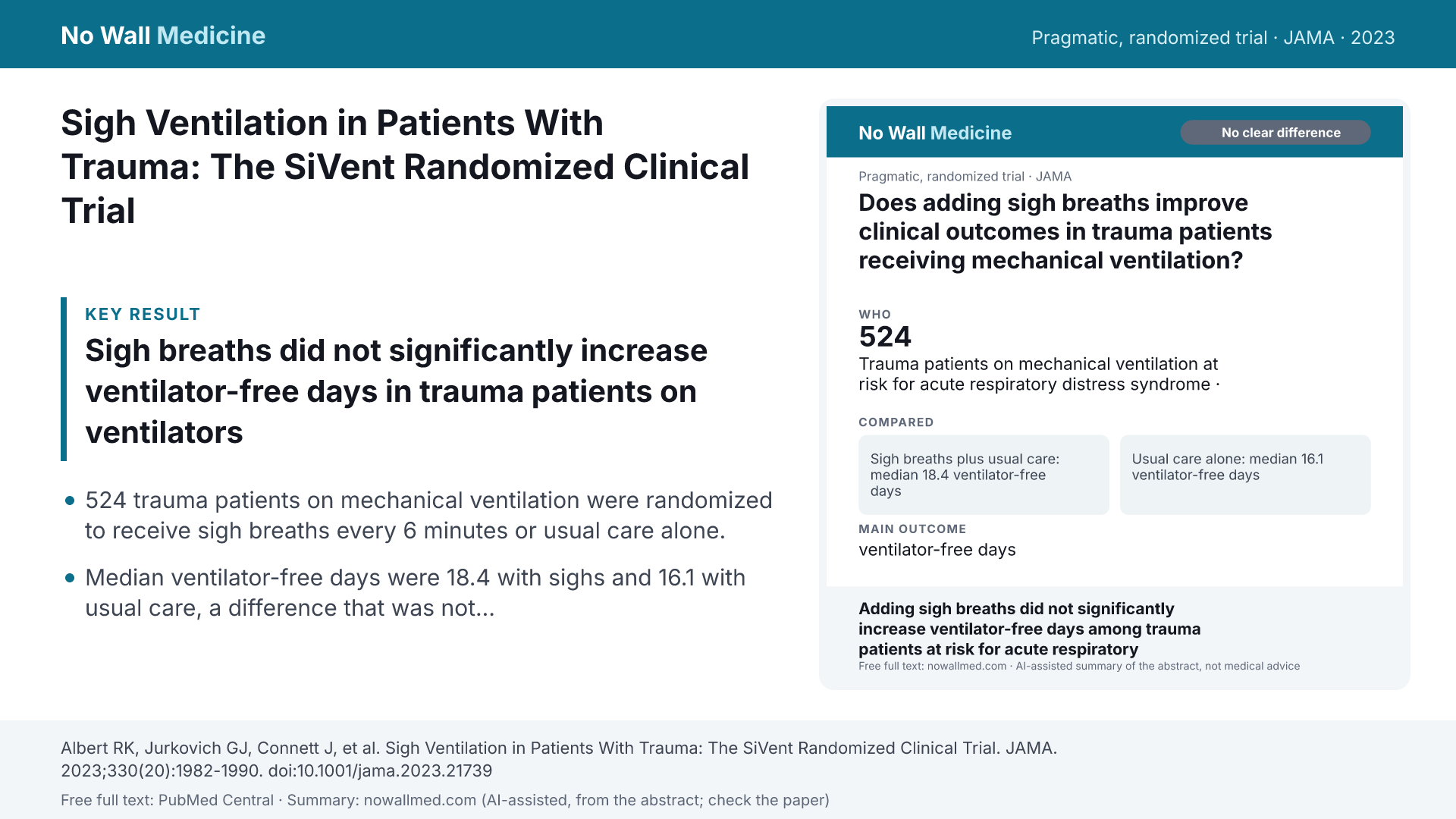
Sigh Ventilation in Patients With Trauma: The SiVent Randomized Clinical Trial
Key result: Sigh breaths did not significantly increase ventilator-free days in trauma patients on ventilators
Pragmatic, randomized trialNo clear difference
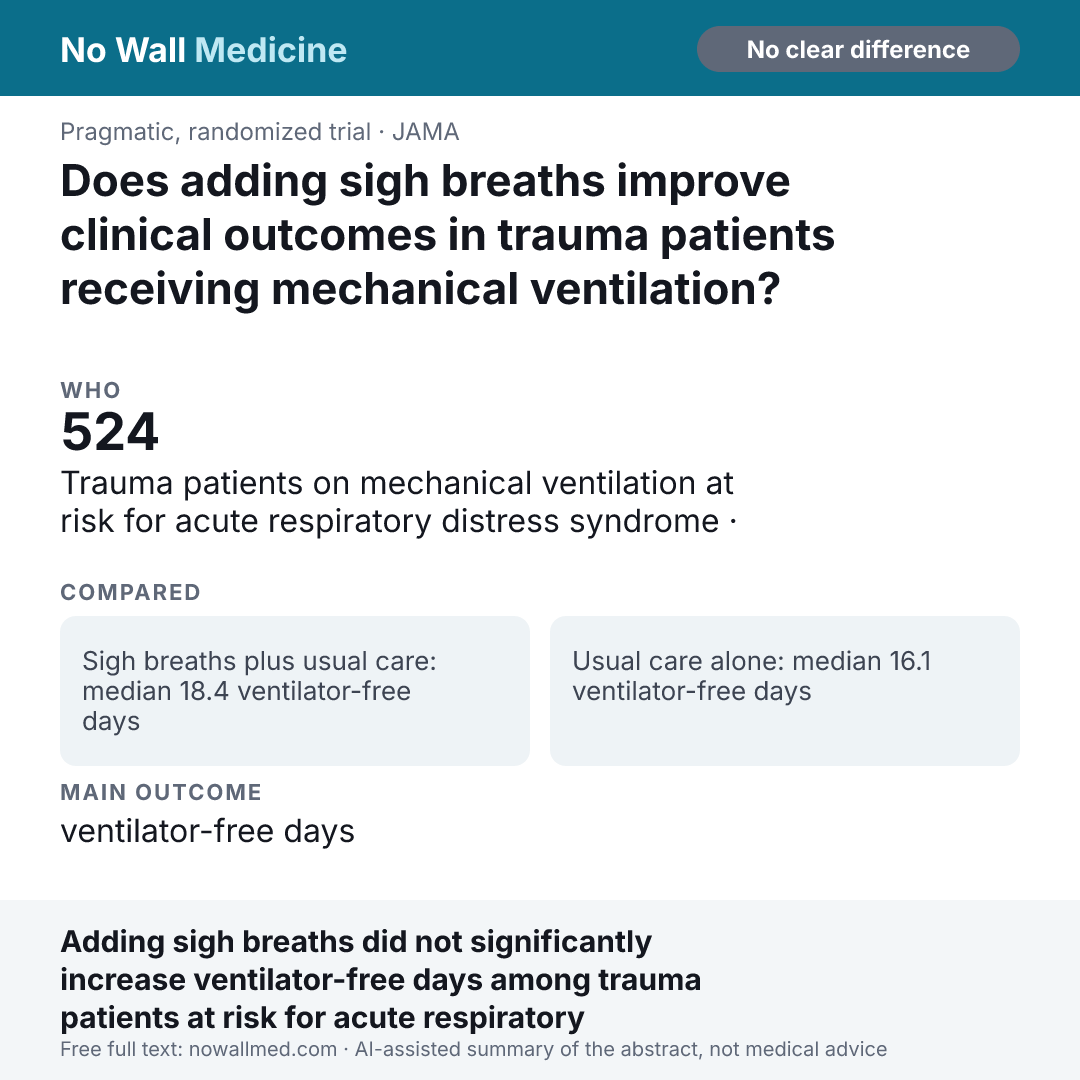
Does adding sigh breaths improve clinical outcomes in trauma patients receiving mechanical ventilation?
Who
524
Trauma patients on mechanical ventilation at risk for acute respiratory distress syndrome · 15 academic trauma centers in the US
Compared
Sigh breaths plus usual care: median 18.4 ventilator-free days
Usual care alone: median 16.1 ventilator-free days
Main outcome
ventilator-free days
Result: adjusted mean difference 1.4 days (95% CI, -0.2 to 3.0)
Bottom line: Adding sigh breaths did not significantly increase ventilator-free days among trauma patients at risk for acute respiratory distress syndrome.
JAMA · 2023-10-25 · Save PNG
Key points
- 524 trauma patients on mechanical ventilation were randomized to receive sigh breaths every 6 minutes or usual care alone.
- Median ventilator-free days were 18.4 with sighs and 16.1 with usual care, a difference that was not statistically significant.
- 28-day mortality was 11.6% with sighs versus 17.6% with usual care, a difference that was not statistically significant.
Discussion prompts
- Would these patients look like yours? Who was left out?
- Is the main outcome one that matters to patients?
- Is the difference large enough to change what you do?
Cite: Albert RK, Jurkovich GJ, Connett J, et al. Sigh Ventilation in Patients With Trauma: The SiVent Randomized Clinical Trial. JAMA. 2023;330(20):1982-1990. doi:10.1001/jama.2023.21739
Free full text: PubMed Central · Summary and visual abstract: nowallmed.com/a/sigh-ventilation-in-patients-with-trauma-the-sivent-randomized-12q846h/ (AI-assisted from the abstract; check the paper before relying on it).