Single-plane versus real-time biplane approaches for ultrasound-guided central venous catheterization in critical care patients: a randomized controlled trial
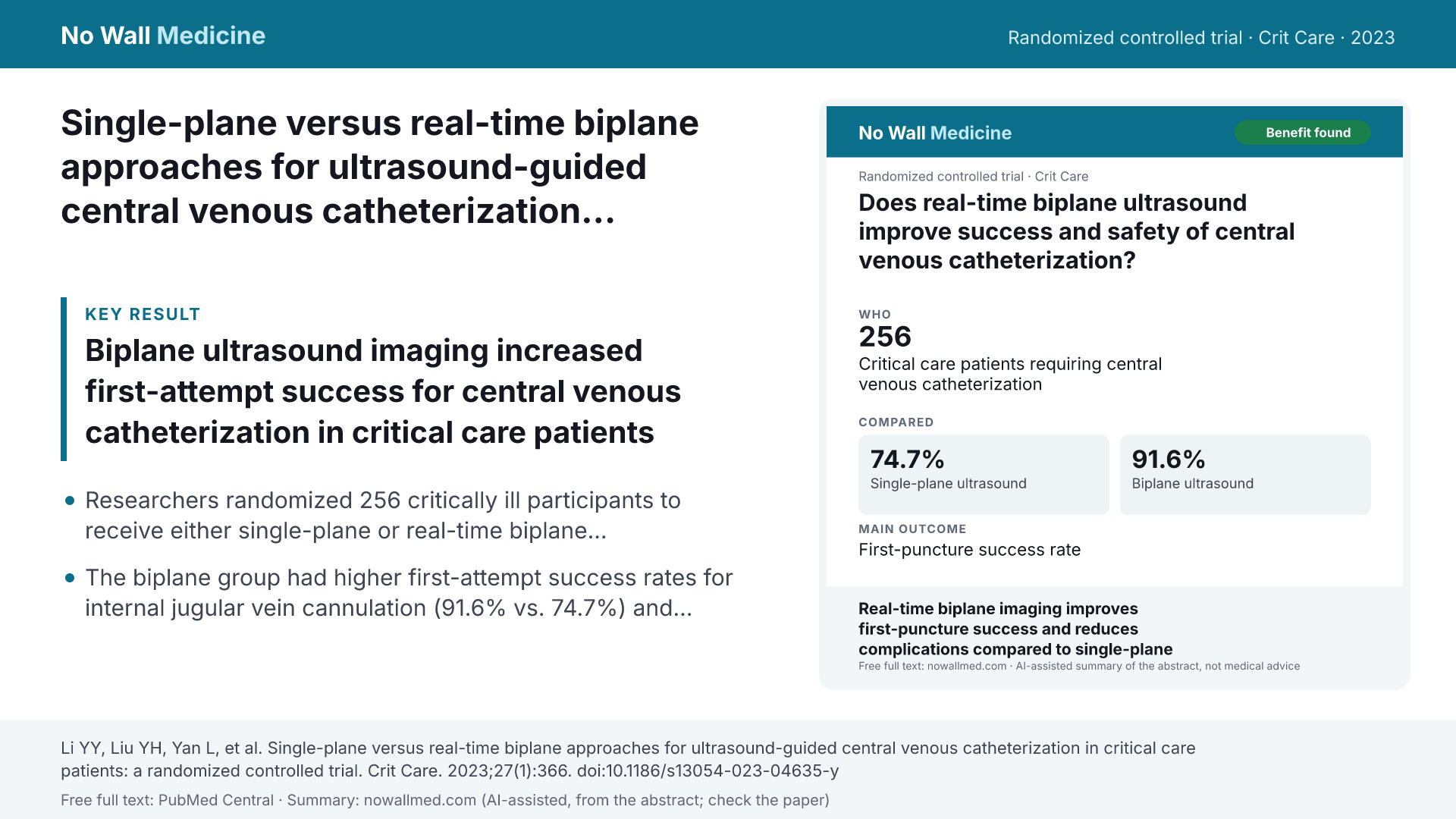
Key result: Biplane ultrasound imaging increased first-attempt success for central venous catheterization in critical care patients
Randomized controlled trialBenefit found
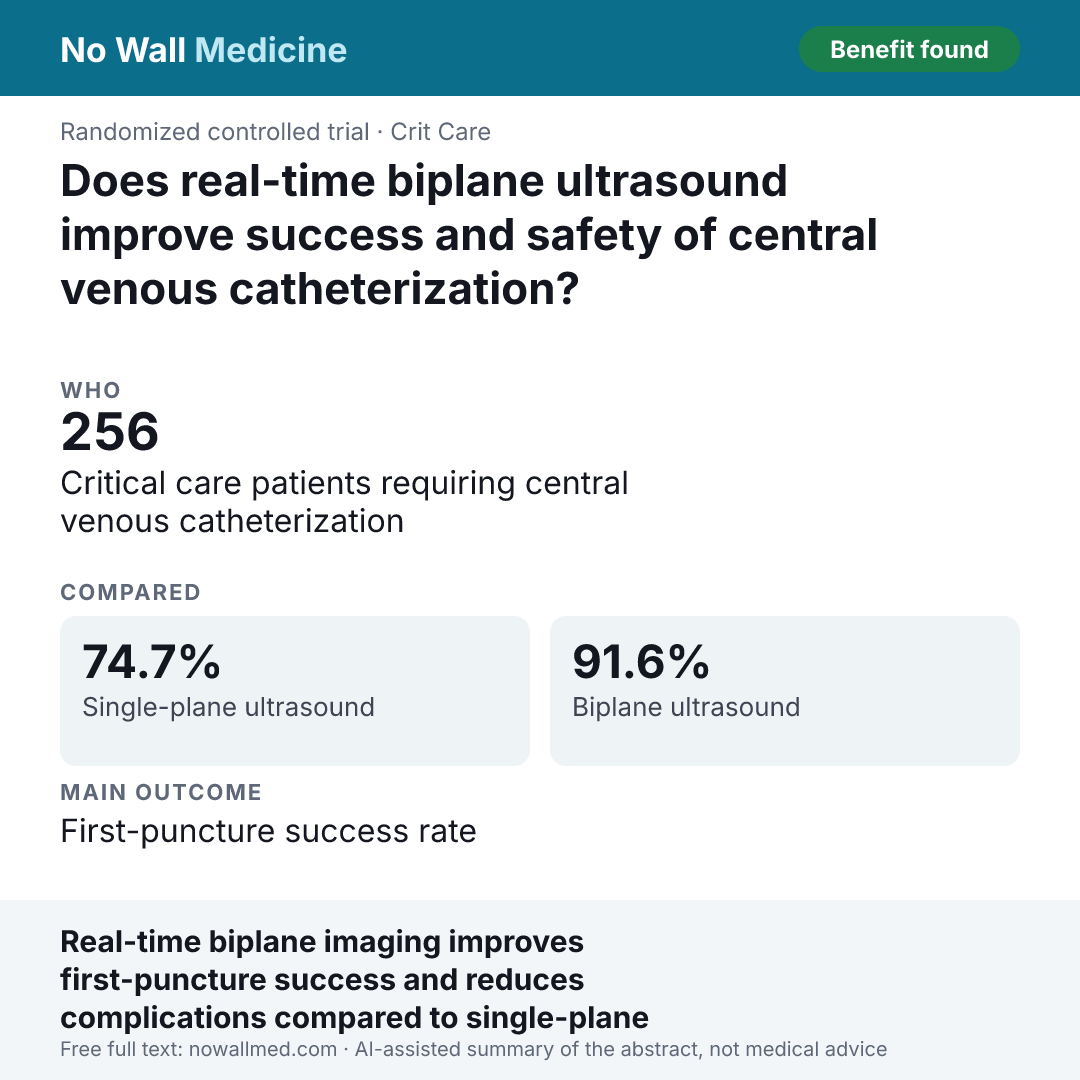
Does real-time biplane ultrasound improve success and safety of central venous catheterization?
Who
256
Critical care patients requiring central venous catheterization
Compared
74.7%Single-plane ultrasound
91.6%Biplane ultrasound
Main outcome
First-puncture success rate
Result: relative risk 1.226 (95% CI 1.069-1.405)
Bottom line: Real-time biplane imaging improves first-puncture success and reduces complications compared to single-plane ultrasound.
Crit Care · 2023-09-23 · Save PNG
Key points
- Researchers randomized 256 critically ill participants to receive either single-plane or real-time biplane ultrasound guidance for central venous catheterization.
- The biplane group had higher first-attempt success rates for internal jugular vein cannulation (91.6% vs. 74.7%) and femoral vein cannulation (90.9% vs. 68.3%).
- Biplane imaging was associated with shorter procedure times and fewer immediate complications for both internal jugular and femoral vein access.
Discussion prompts
- Would these patients look like yours? Who was left out?
- Is the main outcome one that matters to patients?
- Is the difference large enough to change what you do?
Cite: Li YY, Liu YH, Yan L, et al. Single-plane versus real-time biplane approaches for ultrasound-guided central venous catheterization in critical care patients: a randomized controlled trial. Crit Care. 2023;27(1):366. doi:10.1186/s13054-023-04635-y
Free full text: PubMed Central · Summary and visual abstract: nowallmed.com/a/single-plane-versus-real-time-biplane-approaches-for-ultrasound-1973lpq/ (AI-assisted from the abstract; check the paper before relying on it).