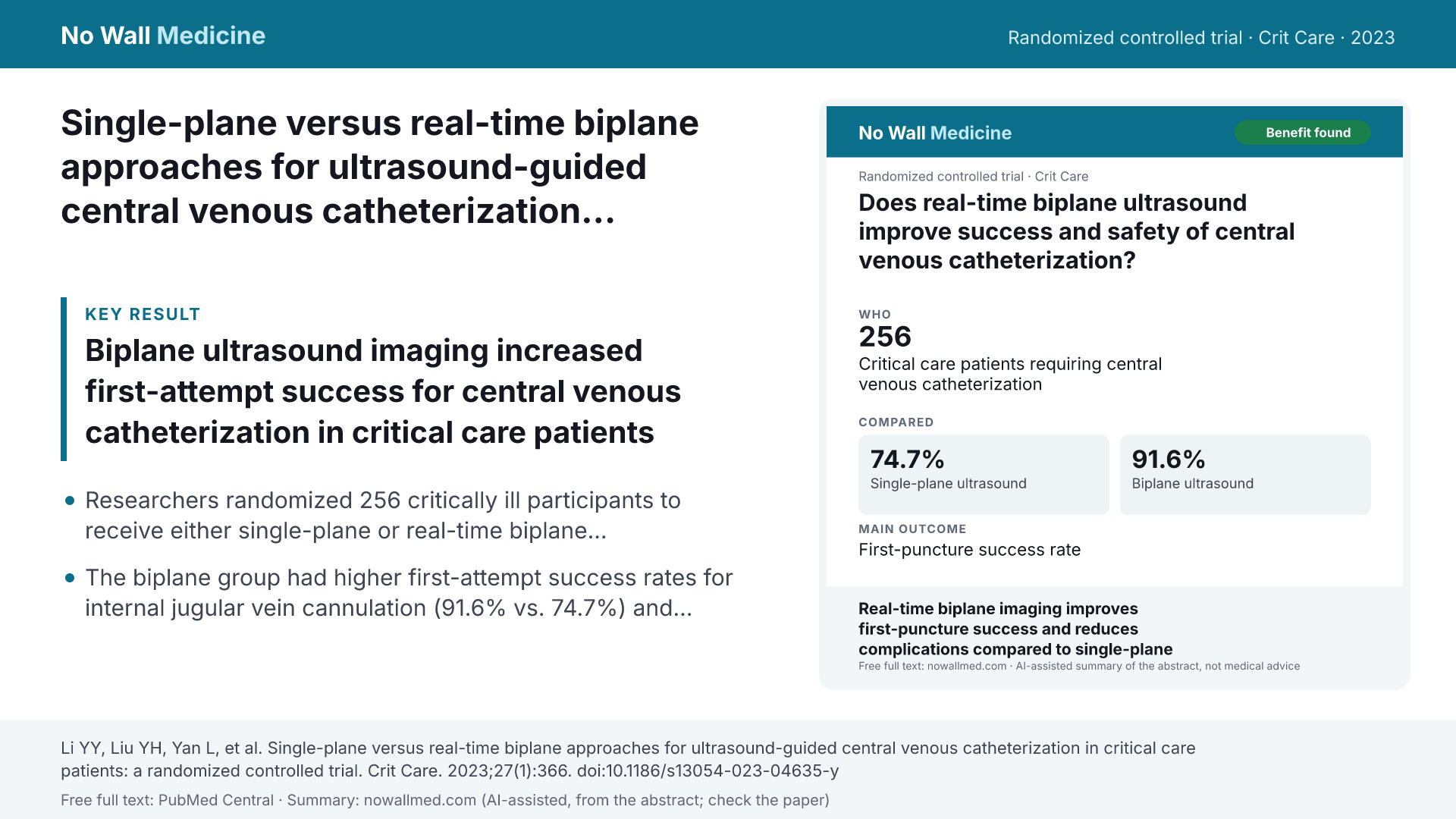
Biplane ultrasound imaging increased first-attempt success for central venous catheterization in critical care patients
Single-plane versus real-time biplane approaches for ultrasound-guided central venous catheterization in critical care patients: a randomized controlled trial
Randomized controlled trialBenefit found
Does real-time biplane ultrasound improve success and safety of central venous catheterization?
Who
256
Critical care patients requiring central venous catheterization
Compared
74.7%Single-plane ultrasound
91.6%Biplane ultrasound
Main outcome
First-puncture success rate
Result: relative risk 1.226 (95% CI 1.069-1.405)
Bottom line: Real-time biplane imaging improves first-puncture success and reduces complications compared to single-plane ultrasound.
Crit Care · 2023-09-23Download image
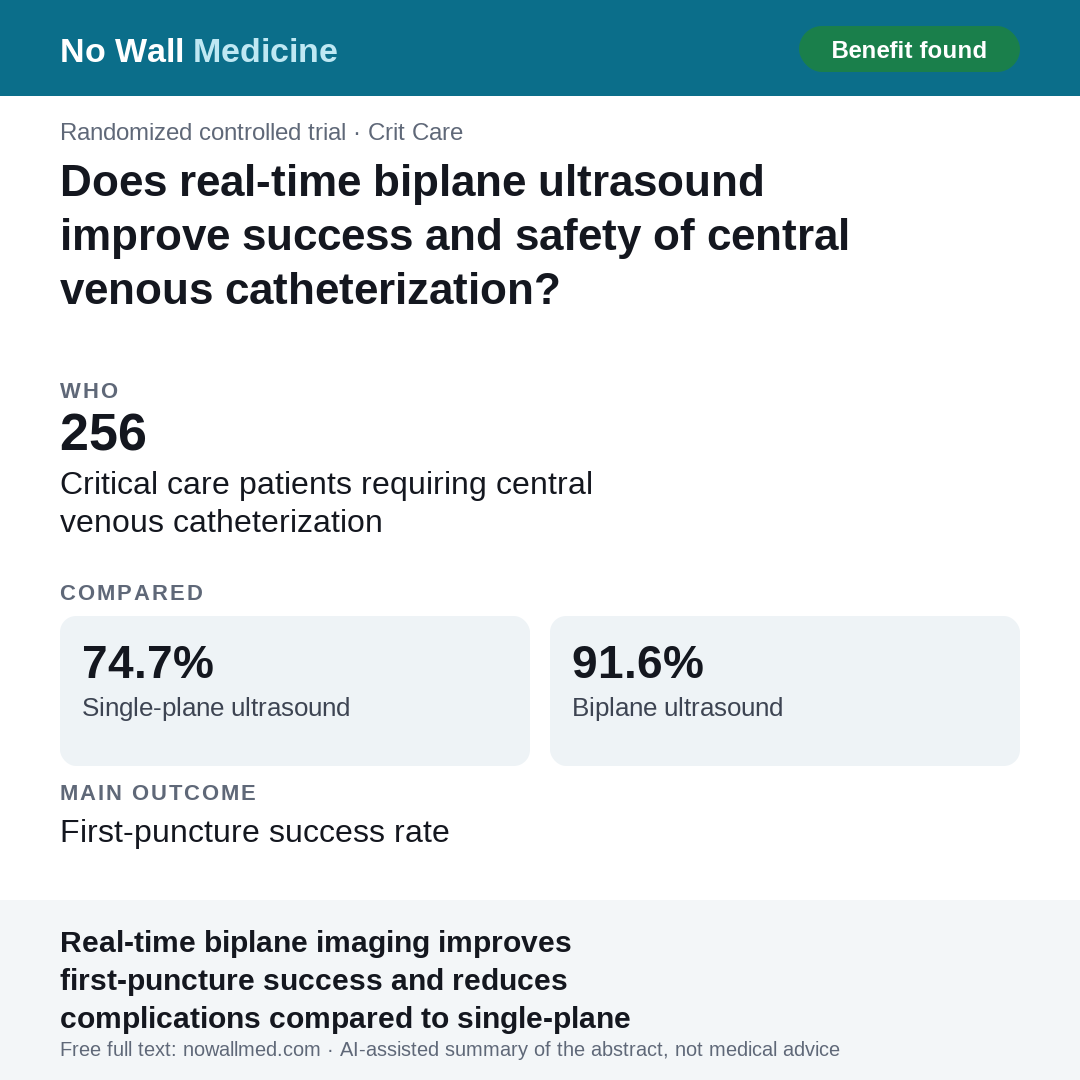
Clinical question: Does real-time biplane ultrasound improve success and safety of central venous catheterization?
Why it matters: It was unknown whether real-time biplane ultrasound imaging improves the success rate and safety of central venous catheterization compared to single-plane ultrasound guidance.
Key points
- Researchers randomized 256 critically ill participants to receive either single-plane or real-time biplane ultrasound guidance for central venous catheterization.
- The biplane group had higher first-attempt success rates for internal jugular vein cannulation (91.6% vs. 74.7%) and femoral vein cannulation (90.9% vs. 68.3%).
- Biplane imaging was associated with shorter procedure times and fewer immediate complications for both internal jugular and femoral vein access.
Headline and key points written with AI from the paper’s abstract, with every number checked against it. Read the paper before relying on them.
Was this summary helpful?
Subject terms
Cite this article
Li YY, Liu YH, Yan L, et al. Single-plane versus real-time biplane approaches for ultrasound-guided central venous catheterization in critical care patients: a randomized controlled trial. Crit Care. 2023. doi:10.1186/s13054-023-04635-y
Spotted a mistake? Suggest a correction