Site-specific therapy in cancers of unknown primary site: a systematic review and meta-analysis
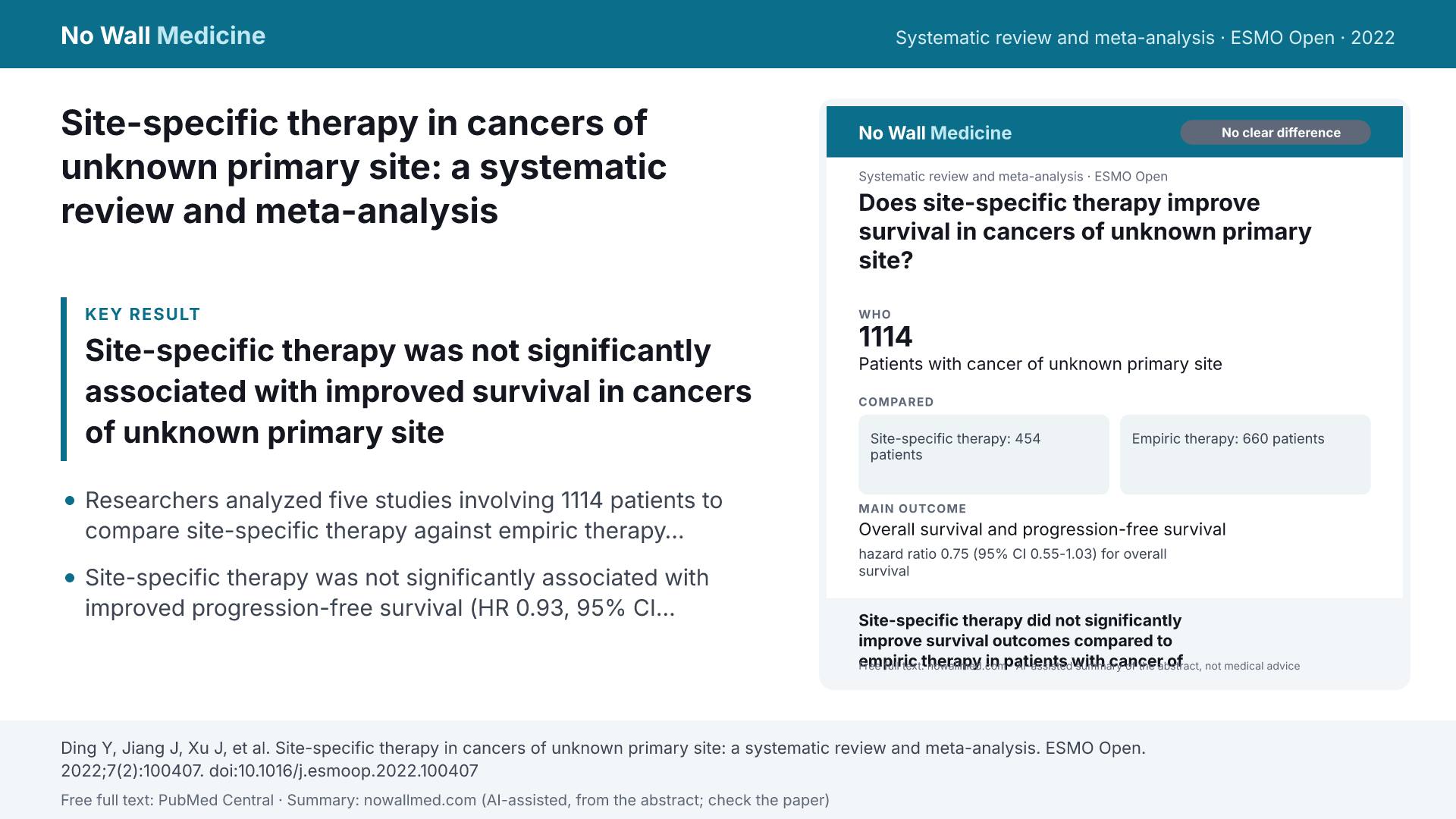
Key result: Site-specific therapy was not significantly associated with improved survival in cancers of unknown primary site
Systematic review and meta-analysisNo clear difference
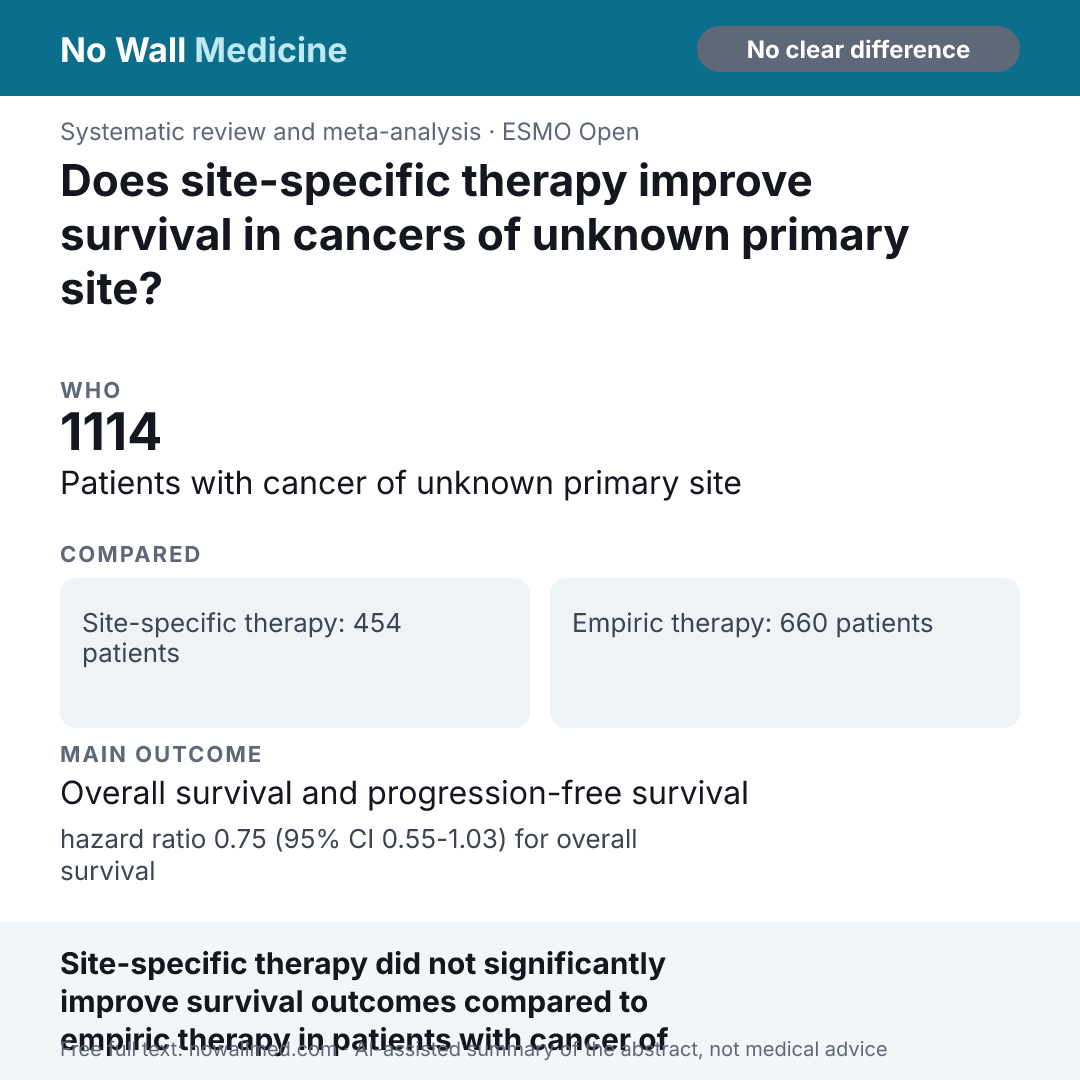
Does site-specific therapy improve survival in cancers of unknown primary site?
Who
1114
Patients with cancer of unknown primary site
Compared
Site-specific therapy: 454 patients
Empiric therapy: 660 patients
Main outcome
Overall survival and progression-free survival
Result: hazard ratio 0.75 (95% CI 0.55-1.03) for overall survival
Bottom line: Site-specific therapy did not significantly improve survival outcomes compared to empiric therapy in patients with cancer of unknown primary site.
ESMO Open · 2022-03-03 · Save PNG
Key points
- Researchers analyzed five studies involving 1114 patients to compare site-specific therapy against empiric therapy for cancers of unknown primary site.
- Site-specific therapy was not significantly associated with improved progression-free survival (HR 0.93, 95% CI 0.74-1.17, P = 0.534) or overall survival (HR 0.75, 95% CI 0.55-1.03, P = 0.069).
- In subgroup analyses, improved overall survival was associated with site-specific therapy in the high-accuracy predictive assay group (HR 0.46, 95% CI 0.26-0.81, P = 0.008).
Discussion prompts
- Would these patients look like yours? Who was left out?
- Is the main outcome one that matters to patients?
- Is the difference large enough to change what you do?
Cite: Ding Y, Jiang J, Xu J, et al. Site-specific therapy in cancers of unknown primary site: a systematic review and meta-analysis. ESMO Open. 2022;7(2):100407. doi:10.1016/j.esmoop.2022.100407
Free full text: PubMed Central · Summary and visual abstract: nowallmed.com/a/site-specific-therapy-in-cancers-of-unknown-primary-site-a-systematic-1sjwvrk/ (AI-assisted from the abstract; check the paper before relying on it).