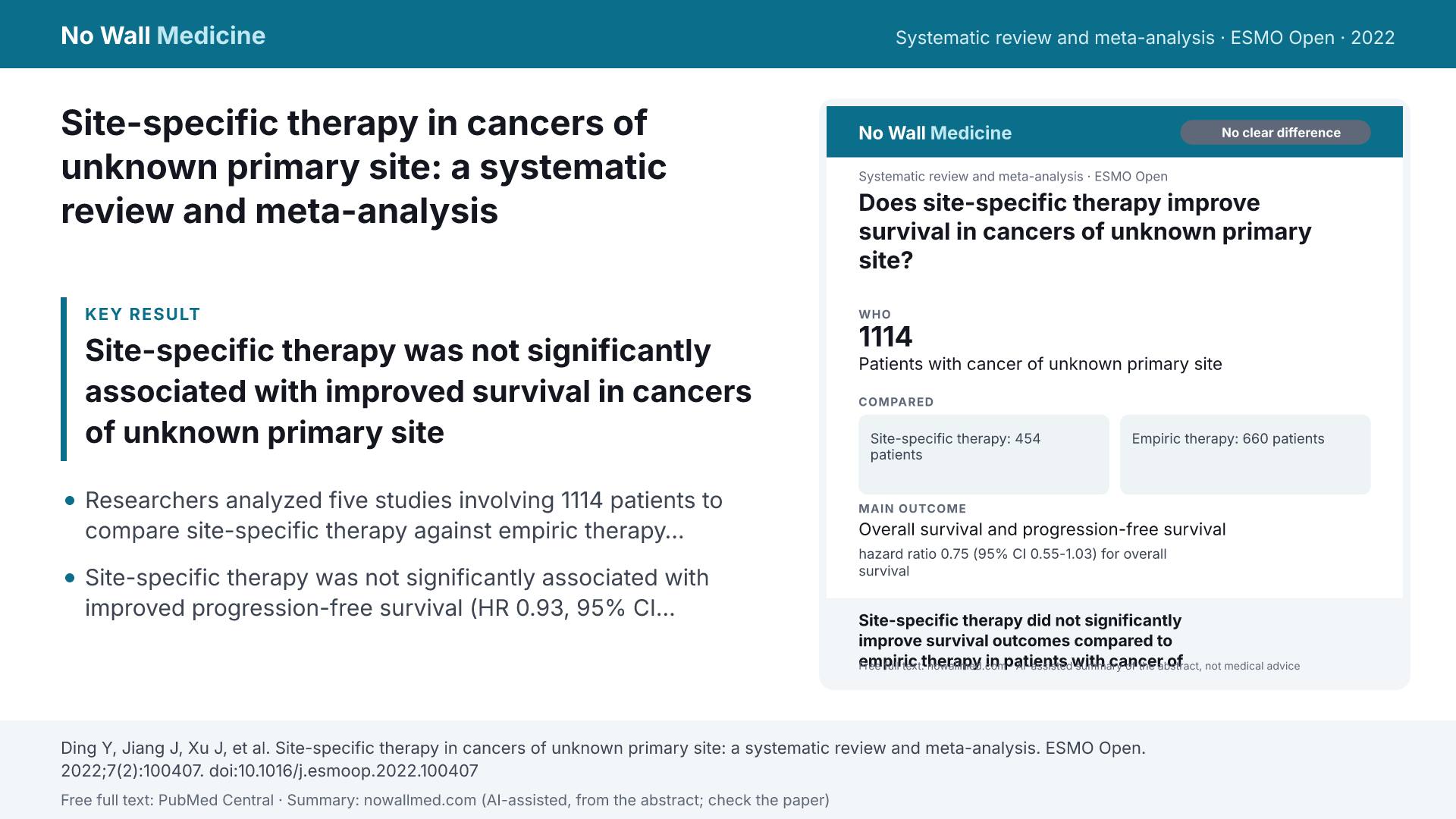
Site-specific therapy was not significantly associated with improved survival in cancers of unknown primary site
Site-specific therapy in cancers of unknown primary site: a systematic review and meta-analysis
Systematic review and meta-analysisNo clear difference
Does site-specific therapy improve survival in cancers of unknown primary site?
Who
1114
Patients with cancer of unknown primary site
Compared
Site-specific therapy: 454 patients
Empiric therapy: 660 patients
Main outcome
Overall survival and progression-free survival
Result: hazard ratio 0.75 (95% CI 0.55-1.03) for overall survival
Bottom line: Site-specific therapy did not significantly improve survival outcomes compared to empiric therapy in patients with cancer of unknown primary site.
ESMO Open · 2022-03-03 · Save PNG
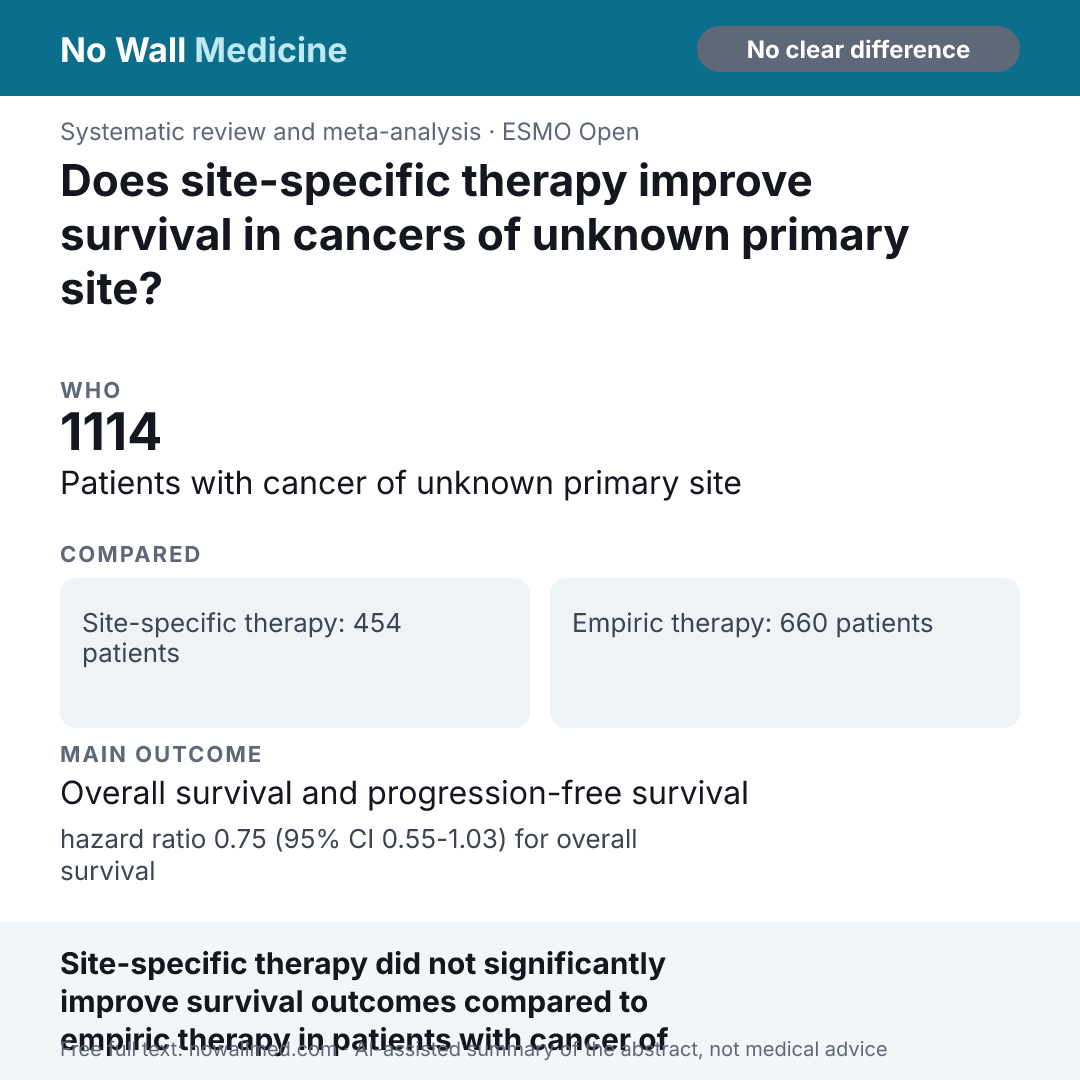
Clinical question: Does site-specific therapy improve survival in cancers of unknown primary site?
Key points
- Researchers analyzed five studies involving 1114 patients to compare site-specific therapy against empiric therapy for cancers of unknown primary site.
- Site-specific therapy was not significantly associated with improved progression-free survival (HR 0.93, 95% CI 0.74-1.17, P = 0.534) or overall survival (HR 0.75, 95% CI 0.55-1.03, P = 0.069).
- In subgroup analyses, improved overall survival was associated with site-specific therapy in the high-accuracy predictive assay group (HR 0.46, 95% CI 0.26-0.81, P = 0.008).
Headline and key points written with AI from the paper’s abstract, with every number checked against it. Read the paper before relying on them.
Was this summary helpful?
Subject terms
Headline, design, result, key points, caveat and citation as plain text.
Cite this article
Ding Y, Jiang J, Xu J, et al. Site-specific therapy in cancers of unknown primary site: a systematic review and meta-analysis. ESMO Open. 2022. doi:10.1016/j.esmoop.2022.100407
Spotted a mistake? Suggest a correction