Sleep disruption was associated with increased pain sensitivity and higher cellular inflammation in healthy adults
Sleep disruption and activation of cellular inflammation mediate heightened pain sensitivity: a randomized clinical trial
Assessor-blinded, cross-over, randomized clinical trialHarm found
Does sleep disruption increase pain sensitivity through cellular inflammation and slow wave sleep loss?
Who
95
95 healthy adults · single-site
Compared
undisturbed sleep
forced awakening: decreases in hPTH (P = 0.02)
Main outcome
heat pain threshold
Result: estimate=-0.15 (95% confidence interval, -0.30 to -0.03)
Bottom line: Sleep disruption increases pain sensitivity through decreased slow wave sleep and increased cellular inflammation.
Pain · 2022-10-27Download image
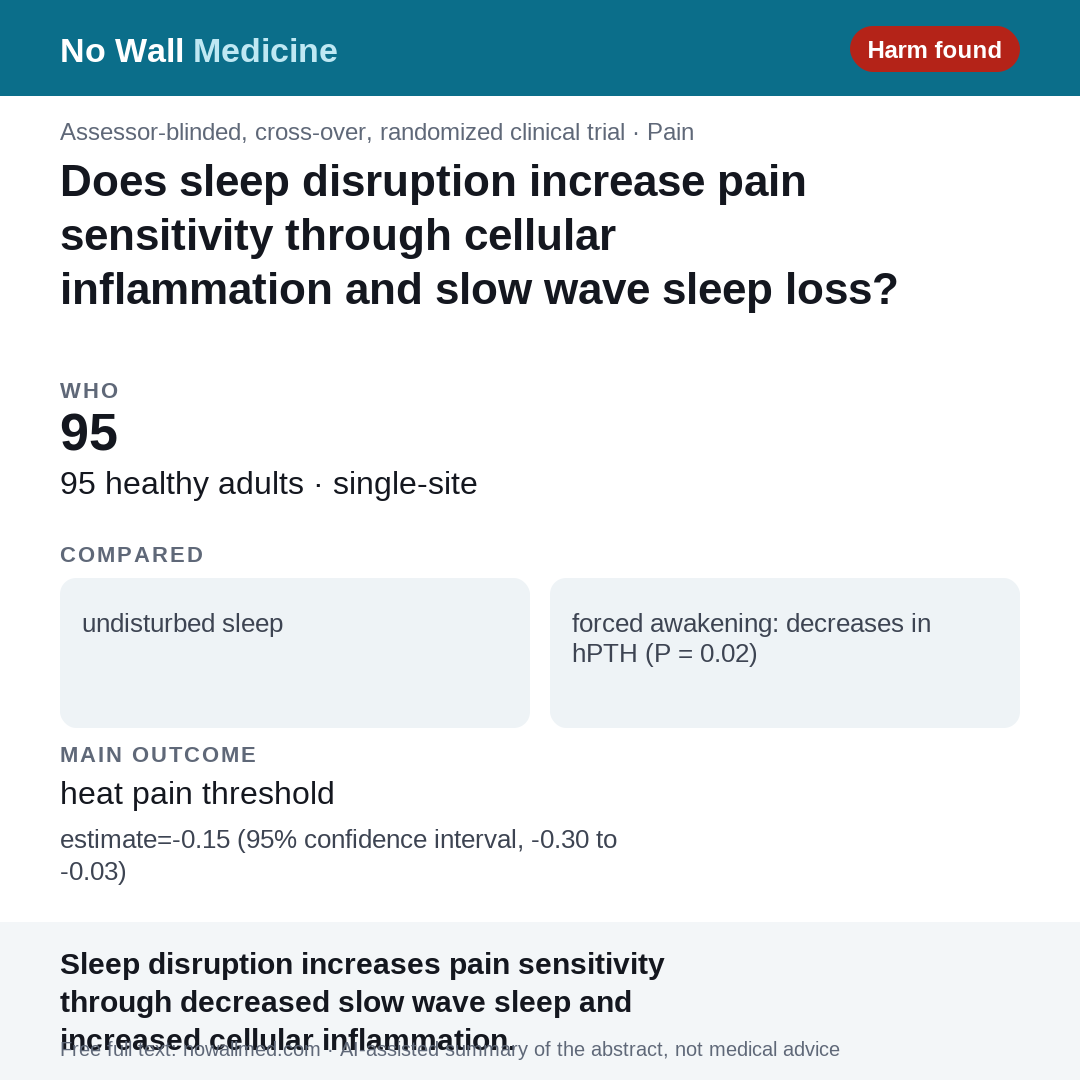
Clinical question: Does sleep disruption increase pain sensitivity through cellular inflammation and slow wave sleep loss?
Why it matters: The biological pathways that link sleep loss to increased sensitivity to pain were not known.
Key points
- Researchers studied 95 healthy adults in a randomized trial comparing 2 nights of undisturbed sleep to 2 nights of forced awakening.
- Forced awakening was associated with decreased heat pain threshold, decreased slow wave or N3 sleep, and increased production of interleukin-6 and tumor necrosis factor-α.
- A mediation analysis showed that the loss of N3 sleep and increased inflammation accounted for 34.9% of the effect on pain sensitivity.
Headline and key points written with AI from the paper’s abstract, with every number checked against it. Read the paper before relying on them.
Was this summary helpful?
Subject terms
Cite this article
Irwin MR, Olmstead R, Bjurstrom MF, Finan PH, Smith MT. Sleep disruption and activation of cellular inflammation mediate heightened pain sensitivity: a randomized clinical trial. Pain. 2022. doi:10.1097/j.pain.0000000000002811
Spotted a mistake? Suggest a correction
Top studies every Monday
The week’s key trials and guidelines in your specialties, plus any topics you follow. By email, free.
Get the weekly digest