Sleep health and its implications in First Nation Australians: A systematic review
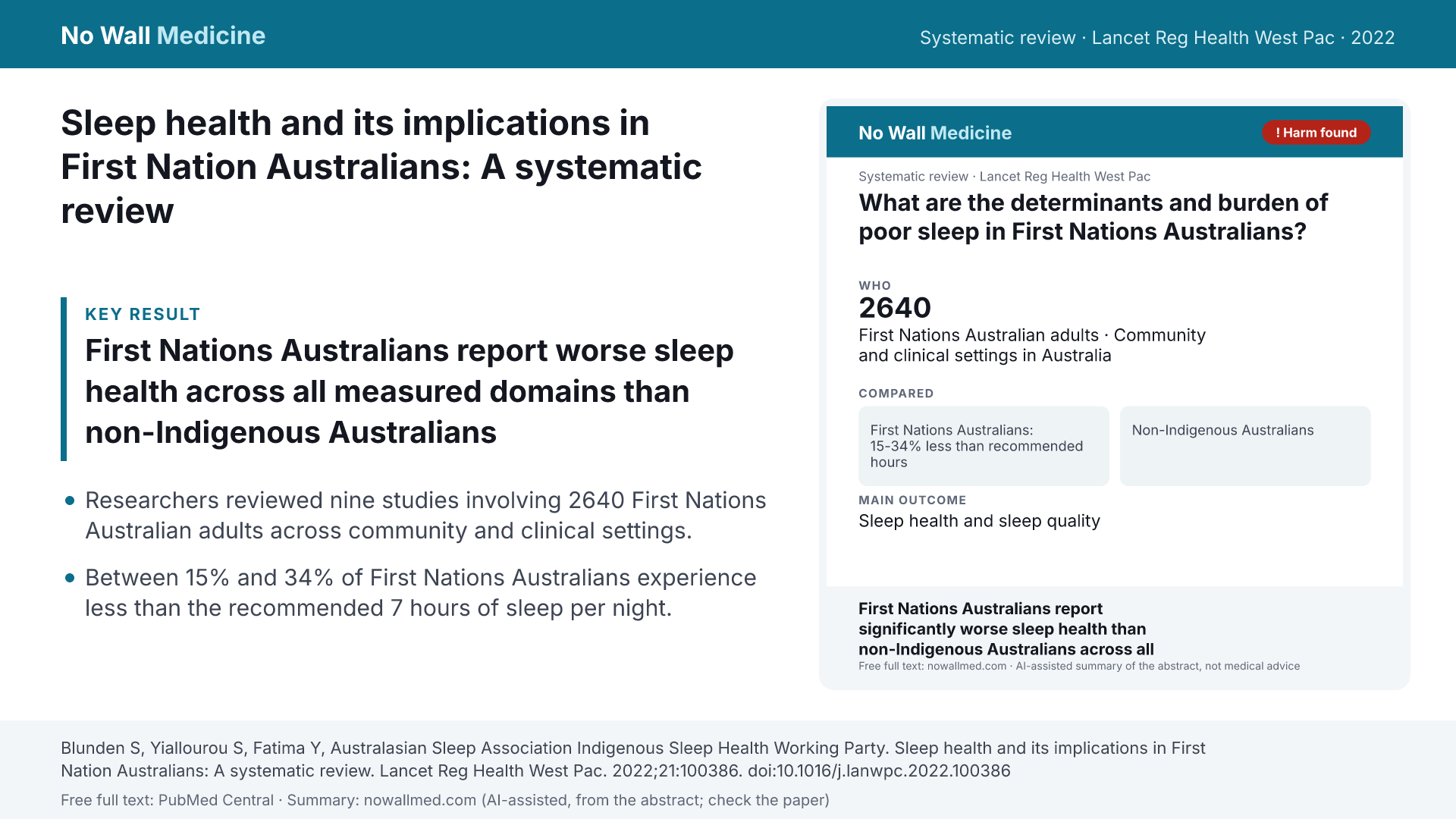
Key result: First Nations Australians report worse sleep health across all measured domains than non-Indigenous Australians
Systematic reviewHarm found
What are the determinants and burden of poor sleep in First Nations Australians?
Who
2640
First Nations Australian adults · Community and clinical settings in Australia
Compared
First Nations Australians: 15-34% less than recommended hours
Non-Indigenous Australians
Main outcome
Sleep health and sleep quality
Bottom line: First Nations Australians report significantly worse sleep health than non-Indigenous Australians across all measured domains.
Lancet Reg Health West Pac · 2022-02-11 · Funded by No external funding was provided
Key points
- Researchers reviewed nine studies involving 2640 First Nations Australian adults across community and clinical settings.
- Between 15% and 34% of First Nations Australians experience less than the recommended 7 hours of sleep per night.
- Clinical populations showed a high prevalence of obstructive sleep apnea, which is a breathing disorder during sleep, at 39-46%.
Discussion prompts
- Would these patients look like yours? Who was left out?
- Is the main outcome one that matters to patients?
- Is the difference large enough to change what you do?
Cite: Blunden S, Yiallourou S, Fatima Y, Australasian Sleep Association Indigenous Sleep Health Working Party. Sleep health and its implications in First Nation Australians: A systematic review. Lancet Reg Health West Pac. 2022;21:100386. doi:10.1016/j.lanwpc.2022.100386
Free full text: PubMed Central · Summary and visual abstract: nowallmed.com/a/sleep-health-and-its-implications-in-first-nation-australians-a-7x2fg4/ (AI-assisted from the abstract; check the paper before relying on it).